📅 Published on May 7, 2026 | 🕒 Last Reviewed & Updated on August 8, 2026
Why Muscle Anatomy Matters
Skeletal muscles make up about 40% of an adult’s body weight.[1] They work together in groups, contracting and relaxing in specific patterns controlled by the nervous system to create all voluntary movements, from blinking to sprinting.[1] Knowing muscle anatomy is crucial for healthcare professionals when planning surgeries, diagnosing nerve injuries, developing rehab plans, and analyzing movement in sports medicine. For students and fitness professionals, understanding muscle anatomy helps prevent injuries and improve performance.
This guide presents a systematic, region-by-region analysis of all major human muscle groups, validated against current United States clinical guidelines and peer-reviewed evidence.
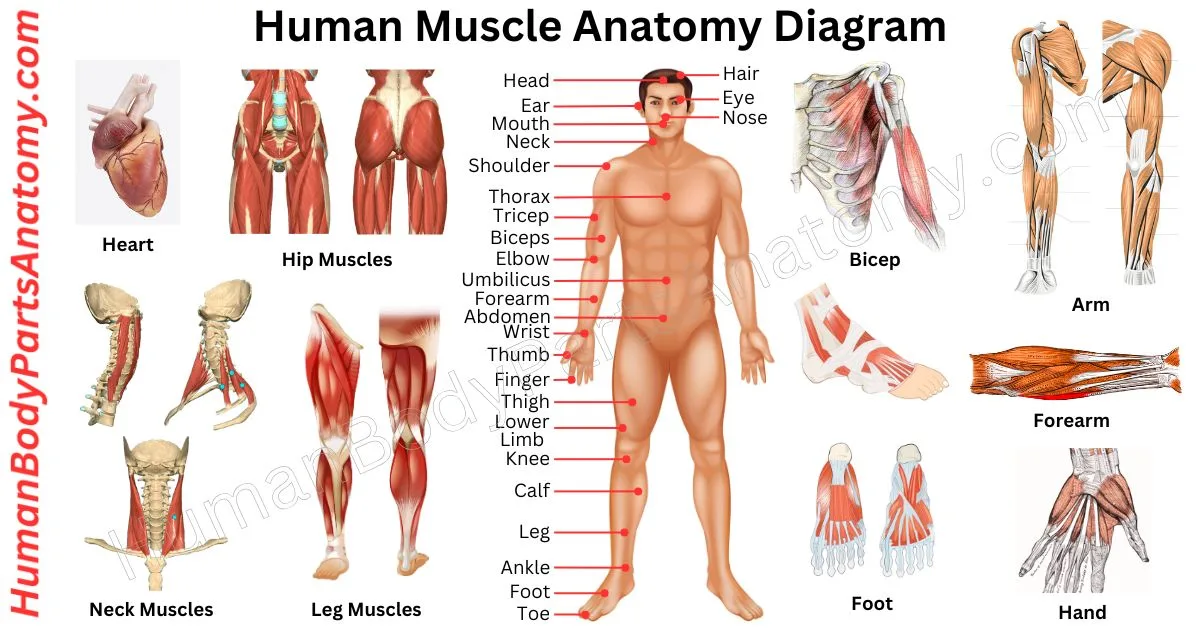
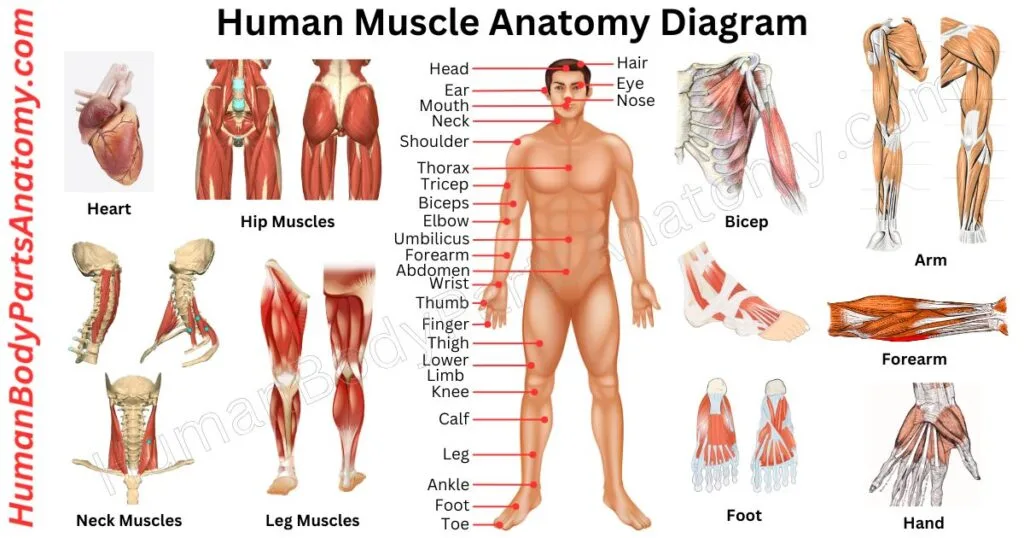
Muscles of Human Body Diagram
Human Muscle Anatomy
1. Head and Face Muscles
- Muscles of Facial Expression
- Frontalis
- Orbicularis Oculi
- Orbicularis Oris
- Zygomaticus Major
- Buccinator
- Muscles of Mastication (Chewing)
- Masseter
- Temporalis
- Medial Pterygoid
- Lateral Pterygoid
2. Neck Muscles
- Sternocleidomastoid (SCM)
- Platysma
- Scalenes (Anterior, Middle, Posterior)
- Levator Scapulae
3. Shoulder Muscles
- Deltoid
The Rotator Cuff (SITS Muscles)
- Supraspinatus
- Infraspinatus
- Teres Minor
- Subscapularis
4. Upper Back Muscles
- Trapezius
- Rhomboid Major and Minor
- Latissimus Dorsi
5. Chest Muscles
- Pectoralis Major
- Pectoralis Minor
- Serratus Anterior
- Intercostal Muscles
6. Arm Muscles
- Upper Arm
- Biceps Brachii
- Triceps Brachii
- Brachialis
- Coracobrachialis
- Forearm Muscles
- Anterior Compartment (Flexor Group)
- Posterior Compartment (Extensor Group)
7. Core (Abdominal) Muscles
- Rectus Abdominis
- External Oblique
- Internal Oblique
- Transversus Abdominis (TrA)
8. Lower Back Muscles
- Erector Spinae
- Multifidus
- Quadratus Lumborum (QL)
9. Hip Muscles
- Gluteus Maximus
- Gluteus Medius
- Gluteus Minimus
- Iliopsoas (Iliacus + Psoas Major)
10. Thigh Muscles
- Anterior Thigh: Quadriceps Femoris
- Rectus Femoris
- Vastus Lateralis
- Vastus Medialis
- Vastus Intermedius
- Posterior Thigh: Hamstrings
- Biceps Femoris
- Semitendinosus
- Semimembranosus
- Inner Thigh: Adductor Group
- Adductor Longus
- Adductor Brevis
- Adductor Magnus
- Gracilis
11. Lower Leg Muscles
- Posterior Leg: Calf Group
- Gastrocnemius
- Soleus
- Plantaris
- Anterior Leg
- Tibialis Anterior
- Extensor Digitorum Longus
- Lateral Leg: Fibular (Peroneal) Group
- Fibularis (Peroneus) Longus
- Fibularis (Peroneus) Brevis
1. Head and Face Muscles
Muscles of Facial Expression
The muscles of facial expression are anatomically distinct because they insert directly into the dermis instead of bone, enabling precise movement of the overlying skin.[2]
All facial muscles are innervated by the facial nerve (cranial nerve VII).[2] This is clinically significant because a single lesion can affect multiple muscles throughout the face simultaneously — a lower motor neuron lesion paralyses the entire ipsilateral half of the face, whereas an upper motor neuron lesion spares the forehead.[3]
1. Frontalis
This muscle originates from the galea aponeurotica and inserts into the skin of the forehead and eyebrows.[2] The frontalis elevates the eyebrows and produces horizontal forehead creases.[2]
Clinically, its function is among the first to be assessed in cases of cranial nerve VII palsy, as loss of forehead wrinkling on the affected side is a key indicator.[4]
2. Orbicularis Oculi
This ring-shaped muscle surrounds the eye and is classically described in two principal parts — orbital and palpebral — with the palpebral part further subdivided into preseptal and pretarsal portions, plus a small deep lacrimal part.[2] The orbital part closes the eye tightly, like when you squint, while the palpebral part controls blinking.[2]
Weakness of the orbicularis oculi results in lagophthalmos, or incomplete eyelid closure, which increases the risk of corneal exposure injury.[4]
3. Orbicularis Oris
Rather than forming a single ring muscle, the orbicularis oris consists of an interlocking network of fibers derived from multiple surrounding facial muscles.[2]
It compresses and protrudes the lips and is essential for intelligible speech, whistling, and oral containment during chewing.[2]
4. Zygomaticus Major
Extending obliquely from the zygomatic bone to the angle of the mouth, this muscle draws the lip superolaterally during smiling.[2]
It is the muscle central to research on the “Duchenne smile,” in which zygomaticus major contraction is accompanied by contraction of the orbicularis oculi.[5] This co-contraction is widely treated as a marker of genuine enjoyment, though recent work argues the association is weaker and more context-dependent than the classic account implies, so it should not be presented as a settled diagnostic sign.[2][5]
5. Buccinator
The buccinator forms the deep muscular layer of the cheek. It compresses the cheek against the molar teeth during chewing and is traversed by the parotid duct.[2] This muscle is important in dental anesthesia, maxillofacial surgery, and parotid gland pathology.[2]
Muscles of Mastication (Chewing)
The four primary muscles responsible for mastication receive innervation from the mandibular branch of the trigeminal nerve (cranial nerve V3), the only division of the trigeminal nerve carrying motor fibers.[6] These muscles facilitate temporomandibular joint (TMJ) movement, enabling the complex actions required for chewing and speaking.[6]
1. Masseter
The masseter originates from the zygomatic arch and inserts onto the angle and ramus of the mandible.[7] Relative to its size, it is the most powerful muscle involved in jaw closure, providing forceful elevation with some protraction of the mandible.[7]
Hypertrophy of the masseter muscle, often resulting from chronic bruxism or frequent jaw clenching, can lead to a broader facial appearance. This condition is a common indication for botulinum toxin (Botox) injections in both cosmetic and therapeutic contexts.[8]
2. Temporalis
This broad, fan-shaped muscle covers the temporal fossa and inserts via a tendon into the coronoid process of the mandible.[7] The anterior fibers elevate the jaw, while the posterior fibers retract the protruded mandible.[7]
During temporomandibular joint assessment, clinicians routinely palpate the temporalis muscle at the temple while the patient clenches the jaw.[9] Tenderness in this region is a characteristic finding in temporomandibular disorder (TMD).[9]
3. Medial Pterygoid
This muscle works alongside the masseter in a sling-like arrangement — the pterygomasseteric sling — beneath the mandible.[10] The medial pterygoid elevates and protrudes the jaw and also contributes to the mediolateral grinding motions of chewing.[10]
4. Lateral Pterygoid
Unlike the other muscles of mastication, the lateral pterygoid is the only one that participates in depressing the mandible (opening the jaw); it does so in concert with the anterior belly of the digastric and the mylohyoid, rather than alone.[11] Unilateral contraction causes deviation of the jaw toward the contralateral side.[11]
The lateral pterygoid primarily advances (protrudes) the jaw and plays a critical role in the function of the temporomandibular joint disc.[11] The superior head attaches to the articular disc, a relationship directly implicated in temporomandibular joint dysfunction.[9]
2. Neck Muscles
Sternocleidomastoid (SCM)
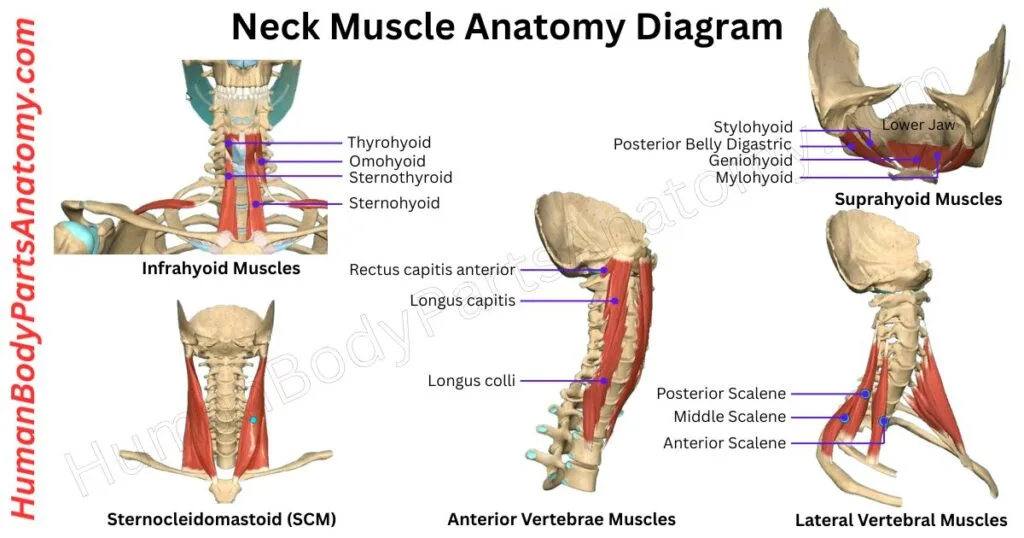
This primary anterior neck muscle runs obliquely from the manubrium of the sternum and medial clavicle to the mastoid process of the temporal bone and the superior nuchal line.[12] It is innervated by the accessory nerve (cranial nerve XI), with proprioceptive fibers from the cervical plexus.[12]
Unilateral contraction results in ipsilateral neck tilt and contralateral face rotation, a movement pattern used in the clinical assessment of torticollis (wry neck).[12]
Bilateral contraction flexes the neck against gravity and contributes to inspiration.[12] The SCM serves as a key landmark, dividing the neck into the anterior and posterior triangles and overlying the jugular venous system and carotid pulse.[12]
Platysma
This thin, sheet-like subcutaneous muscle spans the lower face and anterior neck.[2] Like the other muscles of facial expression, it is supplied by the facial nerve.[1][2] It depresses the mandible and lower lip and tenses the overlying skin.[2]
With age-related tissue laxity, the platysma develops vertical banding, known as “platysmal bands,” which are often targeted in lower face and neck rejuvenation procedures.[2]
Scalenes (Anterior, Middle, Posterior)
These muscles originate from the cervical transverse processes and insert onto ribs 1 and 2.[13] They are accessory muscles for deep inhalation, elevating the upper rib cage when the cervical spine is stabilized.[13]
The scalenes also help bend and tilt the neck to the side.[13] In medicine, the space between the anterior and middle scalenes, called the scalene triangle, is important because it contains the brachial plexus and subclavian artery.[13]
If the scalene triangle becomes crowded by muscle hypertrophy, spasm, or accessory bands, it can compress these nerves and blood vessels.[13] This can lead to thoracic outlet syndrome (TOS), which causes arm pain, tingling, or problems with blood flow; the neurogenic form, from brachial plexus compression, is by far the most common variant.[14]
Levator Scapulae
This muscle extends from the transverse processes of C1 to C4 to the superior angle of the medial scapular border.[15] It elevates the scapula and assists in downward rotation of the glenoid cavity.[15] Its innervation is from C3–C5, including the dorsal scapular nerve.[16]
It is a common site for myofascial trigger point formation in the neck–shoulder region, and is implicated in levator scapulae syndrome and cervical myofascial pain, especially in individuals who maintain prolonged cervical flexion during computer or smartphone use.[15]
Read More – Neck Muscle Anatomy: Guide with Key Muscles, Groups, Functions & Diagrams
3. Shoulder Muscles
Deltoid
The deltoid surrounds the shoulder girdle and serves as the primary mover of the glenohumeral joint.[17] Its three parts have distinct roles: the anterior head flexes and internally rotates the arm, the middle head abducts it, and the posterior head extends and externally rotates it.[17]
The deltoid is innervated by the axillary nerve (C5–C6), a terminal branch of the posterior cord of the brachial plexus, which passes through the quadrangular space and winds around the surgical neck of the humerus.[17]
Anterior dislocation is the predominant pattern of shoulder dislocation, and it directly endangers the axillary nerve because of the nerve’s course around the surgical neck of the humerus.[17] Deltoid weakness after dislocation should prompt clinical nerve assessment.[17]
The Rotator Cuff (SITS Muscles)
The rotator cuff is a group of four muscles that help move and dynamically stabilize the shoulder joint, holding the head of the humerus firmly in the shallow shoulder socket through movement in every direction.[18][19] These muscles keep the humeral head centred on the shallow glenoid fossa; without this support, the shoulder’s wide range of motion would make it unstable.[18]
1. Supraspinatus
It originates in the supraspinous fossa of the scapula and inserts into the superior facet of the greater tuberosity.[20] The supraspinatus initiates abduction — conventionally described as roughly the first 15 degrees — after which it continues to assist the deltoid through the remainder of the arc.[20] It is the only rotator cuff muscle that is not a rotator of the humerus.[18]
Its tendon passes beneath the coracoacromial arch — a bony-ligamentous tunnel where impingement is common.[18] The supraspinatus is the rotator cuff tendon most often involved in cuff tears, particularly in individuals with overhead occupational or athletic demands; most rotator cuff injuries are degenerative wear-and-tear injuries linked to repetitive overhead arm use rather than a single traumatic event.[18][19]
Clinical tests include the Hawkins-Kennedy test (for impingement) and the empty-can test (for supraspinatus integrity).[18]
2. Infraspinatus
It occupies the infraspinous fossa and inserts on the middle facet of the greater tuberosity.[18] The infraspinatus is the primary external rotator of the shoulder, innervated with the supraspinatus by the suprascapular nerve (C5–C6).[20][18] External rotation strength testing and the external rotation lag sign are used to assess its integrity.[18]
The AAOS 2025 clinical practice guideline states that clinical examination can be useful to diagnose or stratify patients with rotator cuff tears, but that a combination of tests increases diagnostic accuracy compared with any single test (strong recommendation); MRI, MR arthrography (MRA), CT, and ultrasound are useful adjuncts to clinical examination and radiographs (strong recommendation).[21]
3. Teres Minor
A small, narrow muscle below the infraspinatus, teres minor also externally rotates and adducts the arm.[22] It shares innervation (posterior branch of the axillary nerve) with the deltoid, and both may be affected together in axillary nerve injuries.[22]
4. Subscapularis
The only rotator cuff muscle on the anterior (costal) surface of the scapula, the subscapularis internally rotates and adducts the arm while preventing anterior displacement of the humeral head.[23]
It is a large, powerful, triangular muscle and the only rotator cuff muscle that internally rotates the humerus.[23] Isolated subscapularis tears are evaluated using the lift-off test (asking the patient to lift the hand away from the lumbar spine), the belly-press test, and the bear-hug test.[18]
The AAOS 2025 guideline reports that healed rotator cuff repairs show improved patient-reported and functional outcomes compared with physical therapy and with unhealed repairs (moderate strength), while both physical therapy and operative treatment produce significant improvement in small to medium full-thickness tears (strong strength).[21] This underscores the value of accurate diagnosis and shared decision-making rather than a single default pathway.[21]
4. Upper Back Muscles
Trapezius
One of the largest and most functionally complex muscles of the posterior trunk, the trapezius spans from the external occipital protuberance and nuchal ligament superiorly to the lower thoracic vertebrae inferiorly, with lateral insertions on the clavicle and scapular spine.[24]
The trapezius has three parts: the upper fibers elevate and upwardly rotate the scapula and extend the neck, the middle fibers retract (adduct) it, and the lower fibers depress it and assist upward rotation.[24] Working together, these parts produce the scapular upward rotation needed to raise the arm above shoulder level without impingement.[24]
The spinal accessory nerve (CN XI) provides motor innervation to the trapezius, with sensory contributions from the ventral rami of C3 and C4.[24] If this nerve is damaged during neck surgery or a posterior triangle lymph node biopsy, it can lead to trapezius palsy, causing scapular winging, shoulder droop, and painful, limited arm elevation.[24]
Rhomboid Major and Minor
The rhomboids originate from the spinous processes of C7–T5 (minor from C7–T1, major from T2–T5) and insert along the medial border of the scapula.[25] They retract the scapula (adduct it toward the midline), assist with downward rotation, and help press the medial scapular border against the posterior thoracic wall.[25] They are supplied by the dorsal scapular nerve.[16]
Rhomboid weakness, which is common in individuals with sustained forward head and rounded shoulder postures, contributes to scapular dyskinesis and is a frequent rehabilitation target in postural correction programs; rhomboid palsy is a recognised cause of scapular winging.[25]
Latissimus Dorsi
The latissimus dorsi (lats) is the broadest muscle of the back, originating from the spinous processes of the lower six thoracic vertebrae and, via the thoracolumbar fascia, a variable number of lumbar and sacral spinous processes, together with the posterior iliac crest, the inferior three to four ribs, and often the inferior angle of the scapula.[26]
It inserts via a flat tendon into the intertubercular groove (bicipital groove) of the humerus and is innervated by the thoracodorsal nerve.[26] Its primary actions are arm adduction, extension, and internal rotation, working with teres major and pectoralis major.[26] These combined movements power pull-ups, rowing, and swimming strokes.
The latissimus also acts as an accessory muscle of respiration, and is used as a pedicled muscle flap in reconstructive surgery, including breast reconstruction following mastectomy.[26]
5. Chest Muscles
Pectoralis Major
The largest anterior chest muscle has two distinct heads with different actions.[27] The clavicular head (superior portion) flexes and horizontally adducts the arm. The sternocostal head (inferior portion) adducts the arm and internally rotates it.[27]
Together, they are the primary drivers of pressing and pushing movements. The pectoralis major is innervated by both the medial and lateral pectoral nerves (C5–T1).[27]
Poland syndrome — congenital unilateral absence of the sternal head of the pectoralis major, often associated with ipsilateral hand anomalies — is a recognized clinical entity.[27]
Complete pectoralis major tendon rupture at the humeral insertion is characteristically sustained during heavy bench pressing and is generally managed with surgical repair in active individuals.[27][28]
Pectoralis Minor
The pectoralis minor originates from ribs 3–5 near the costochondral junctions and inserts into the medial border and superior surface of the coracoid process of the scapula.[29] It anteriorly tilts, depresses, and protracts the scapula, stabilising it against the thoracic wall.[29]
Tightness of the pectoralis minor — common in individuals with chronic forward shoulder posture — creates anterior scapular tilt that reduces subacromial space and contributes to rotator cuff impingement.[29]
Stretching of the pectoralis minor is a standard component of shoulder impingement and rotator cuff rehabilitation programs.[18] Most rotator cuff injuries are degenerative, wear-and-tear injuries associated with repetitive overhead arm use rather than a single traumatic event.[19]
Serratus Anterior
It originates from the superolateral surfaces of ribs 1–8 (and sometimes rib 9) and inserts along the costal surface of the medial scapular border.[30] The serratus anterior pulls the scapula forward and upward around the thorax.[29]
It is the primary muscle maintaining the scapula flush against the posterior chest wall and is essential for scapular upward rotation during arm elevation.[30] It is innervated by the long thoracic nerve; injury to this nerve produces medial scapular winging.[16][30]
Intercostal Muscles
The three layers of intercostal muscles — external, internal, and innermost — occupy the intercostal spaces between ribs.[31] The external intercostals raise the ribs during active inhalation; the internal intercostals depress the ribs during forced exhalation.[31]
Their activity is clinically observable. Intercostal retractions, which are the inward drawing of the skin between the ribs during inhalation, indicate increased work of breathing and are a key finding in respiratory distress assessment, alongside recruitment of other accessory muscles such as the scalenes and sternocleidomastoids.[32]
6. Arm Muscles
The muscles of the arm are divided into two main regions: the upper arm and the forearm. Each region contains different muscle groups that work together to support movement, strength, and flexibility of the arm, wrist, and hand.[33]
Upper Arm
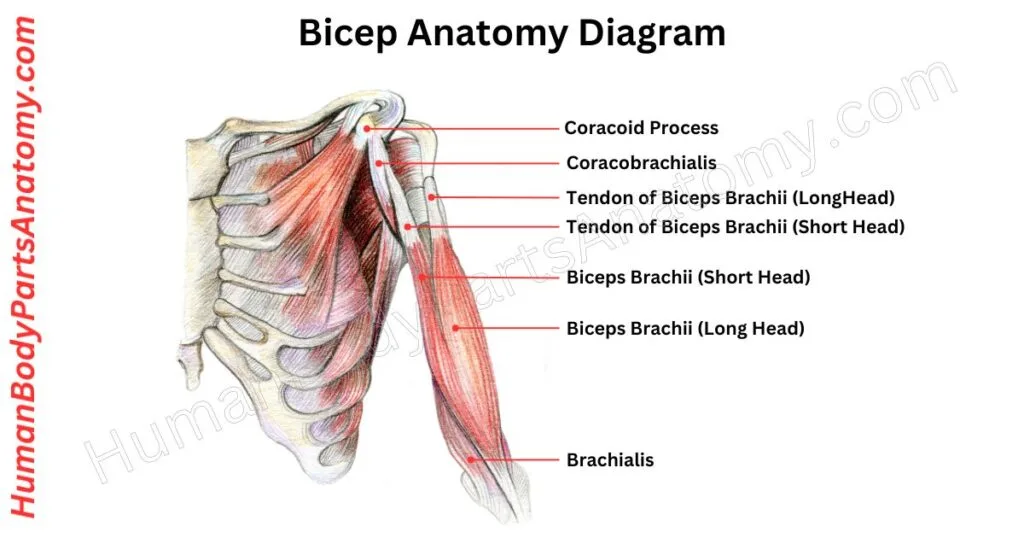
1. Biceps Brachii
The biceps has two heads: the long head arises from the supraglenoid tubercle of the scapula (and travels through the bicipital groove of the humerus), while the short head originates from the coracoid process.[34]
Primary functions include forearm supination and elbow flexion; it also assists with shoulder flexion.[35] Rupture of the long head tendon — producing the characteristic “Popeye deformity” (a balled-up muscle belly visible in the arm) — is common in middle-aged adults and may be managed conservatively or surgically depending on functional demands.[35]
The biceps jerk reflex (eliciting biceps contraction via the tendon) tests the integrity of the C5–C6 nerve roots, and is mediated by the musculocutaneous nerve.[36]
Read More – Ultimate Guide to Bicep Anatomy: Parts, Names, Functions & Diagram
2. Triceps Brachii
With three heads (long, lateral, medial), the triceps is the principal extensor of the elbow, assisted by the anconeus.[34] The long head also extends and adducts the arm at the shoulder.[34]
The radial nerve innervates the triceps and anconeus, and the triceps jerk reflex tests the C7–C8 roots, predominantly C7.[36] The radial nerve is most commonly injured at the spiral groove of the humerus, producing wrist drop and finger extension weakness while typically sparing triceps strength, because the branches to the triceps arise proximal to the groove.[37]
3. Brachialis
It originates from the anterior surface of the distal humerus and inserts into the ulnar tuberosity.[38] The brachialis is a pure elbow flexor — unlike the biceps, its line of pull does not change with forearm rotation, making it the most consistent flexor regardless of position. It commonly has dual innervation, primarily from the musculocutaneous nerve with an additional branch from the radial nerve.[38]
4. Coracobrachialis
This slender muscle runs from the coracoid process to the medial shaft of the humerus. It assists with shoulder flexion and adduction.[34] The musculocutaneous nerve (C5–C7) pierces the coracobrachialis before supplying the anterior arm compartment.[39]
Because the musculocutaneous nerve continues as the lateral antebrachial cutaneous nerve, a lesion at this level produces weakness of elbow flexion and supination together with sensory loss over the lateral (radial) forearm — a picture that can be mistaken for C6 radiculopathy.[39] The distinguishing features are the absence of neck pain and of a dermatomal pattern extending into the thumb, and preserved cervical spine examination, rather than sparing of forearm sensation.
Forearm Muscles
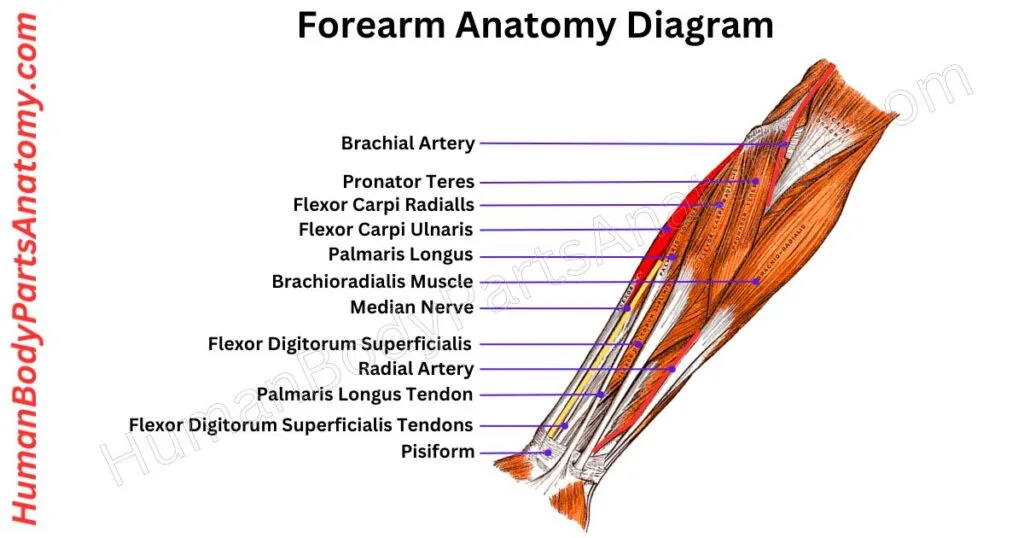
The forearm contains around 20 muscles, grouped into two main compartments — an anterior (flexor–pronator) compartment and a posterior (extensor–supinator) compartment.[33] These muscles work together to control movements of the wrist, hand, and fingers, enabling actions such as gripping, lifting, rotating the forearm, and performing fine motor tasks.[33]
1. Anterior Compartment (Flexor Group)
The flexor compartment controls wrist and finger flexion and forearm pronation.[33] Key muscles include the flexor carpi radialis, flexor carpi ulnaris, flexor digitorum superficialis (FDS — flexes the PIP joints), flexor digitorum profundus (FDP — the only muscle that flexes the distal interphalangeal joints), and the pronator teres.[40][33] The superficial muscles share a common flexor origin on the medial epicondyle of the humerus.[33] The median nerve and ulnar nerve innervate the compartment’s muscles in complementary territories: the ulnar nerve supplies the flexor carpi ulnaris and the medial half of the FDP, and the median nerve (via the anterior interosseous branch) supplies the remainder.[40]
2. Posterior Compartment (Extensor Group)
The extensor compartment is responsible for wrist and digit extension and forearm supination.[41] Notable muscles include the extensor carpi radialis longus and brevis (ECRL, ECRB), extensor digitorum communis, extensor carpi ulnaris, and the supinator.[41]
The common extensor origin at the lateral epicondyle of the humerus is the site of lateral epicondylalgia, commonly known as “tennis elbow,” which primarily affects the ECRB tendon.[41]
This is among the most common upper extremity overuse injuries in both athletic and occupational settings.[41]
Read More – Forearm Anatomy: Parts of the Forearm, Radius, Ulna, Muscles & Diagram
7. Core (Abdominal) Muscles
The layers of the anterolateral abdominal wall create a self-contained pressure chamber around the lumbar spine.[42] When co-activated, they generate intra-abdominal pressure that offloads compressive spinal forces — functioning, in effect, as the body’s built-in weightlifting belt.[42] The wall comprises five paired muscles: external oblique, internal oblique, transversus abdominis, rectus abdominis, and pyramidalis, innervated principally by the T7–T12 nerves.[43]
Rectus Abdominis
These paired, vertically oriented muscles extend from the pubic symphysis to the xiphoid process and the costal cartilages of ribs 5 to 7.[42] They are separated at the midline by the linea alba, with the lateral border forming the linea semilunaris.[43]
They are the primary muscles responsible for trunk flexion, and they compress the abdominal viscera and stabilise the pelvis during ambulation.[43] Tendinous intersections divide each muscle into segments, creating the “six-pack” appearance in lean, trained individuals.[43]
Diastasis recti — abnormal widening and thinning of the linea alba with increased inter-recti distance — is a clinically important finding in postpartum women and individuals with abdominal obesity, and is an essential consideration before prescribing abdominal strengthening exercises.[44]
External Oblique
The most superficial lateral abdominal muscle has fibers running inferomedially (in the direction of hands-in-front-pockets).[42] It flexes the trunk, laterally bends the spine ipsilaterally, and rotates the trunk contralaterally.[42]
Its aponeurosis contributes to the formation of the inguinal ligament and the anterior rectus sheath — structures central to inguinal hernia anatomy and repair.[42]
Internal Oblique
Located deep to the external oblique, its fibers run in the opposite, superomedial direction.[42] The internal oblique rotates the trunk to the same side and assists with lateral flexion.[43][42] Inferiorly, its aponeurosis joins that of the transversus abdominis to form the conjoint tendon.[42]
The cross-sectional X-shaped arrangement of the two oblique muscle pairs creates a natural brace that resists torsional spinal loading during rotational movements.[42]
Transversus Abdominis (TrA)
The deepest and thinnest abdominal layer runs horizontally around the trunk, encircling it like a natural corset.[42]
Unlike the other abdominal muscles, the TrA does not produce visible trunk movement. Classic electromyographic work showed that TrA activity begins in advance of deltoid activity irrespective of the direction of rapid arm movement, consistent with a feedforward role in pre-tensioning the thoracolumbar fascia and stiffening the spine against impending loads.[45] More recent work has challenged the strict “corset” interpretation, reporting that TrA activation is not uniformly symmetrical and may form part of a global rather than purely local muscle synergy — so this mechanism should be described as well supported but not uncontested.[46]
8. Lower Back Muscles
The erector spinae is a group of muscles and tendons that run vertically from the sacrum and iliac crest up to the ribs, cervical spine, and skull.[47] It has three columns: the iliocostalis laterally, the longissimus in the middle, and the spinalis next to the spinous processes.[47]
These muscles extend the spine and are important for keeping us upright, generating substantially larger extension forces than the quadratus lumborum.[48] Strain of the erector spinae is a common cause of acute mechanical low back pain.[47]
Multifidus
The multifidus runs in short, angled segments from the transverse processes and sacrum of the lower vertebrae to the spinous processes of the vertebrae above.[49] Architectural and intraoperative measurements show it is uniquely designed for lumbar spine stability, stiffening individual segments during movement and loading rather than producing gross trunk motion.[49]
It is the main deep posterior stabiliser of the lumbar spine and works together with the transversus abdominis and pelvic floor as part of what is often described as the “inner unit.”[49]
Quadratus Lumborum (QL)
It runs from the inner lip of the iliac crest and the iliolumbar ligament to the 12th rib and the transverse processes of L1–L4.[48] The QL laterally flexes the lumbar spine, hikes the hip, and anchors the 12th rib as a fixed point for diaphragmatic contraction during breathing.[48]
Because it connects the pelvis and the chest, the QL is often overlooked as a source of ongoing lower back and posterior hip pain, and it can generate referred pain that mimics radicular symptoms.[48] Trigger points in the QL are described as producing deep, aching pain over the posterior iliac crest and lateral hip.[48]
It is worth noting that biomechanical modelling data reported in the NLM literature question the QL’s role as a major lumbar stabiliser: its estimated force contributions are substantially smaller than those of the erector spinae and multifidus.[48]
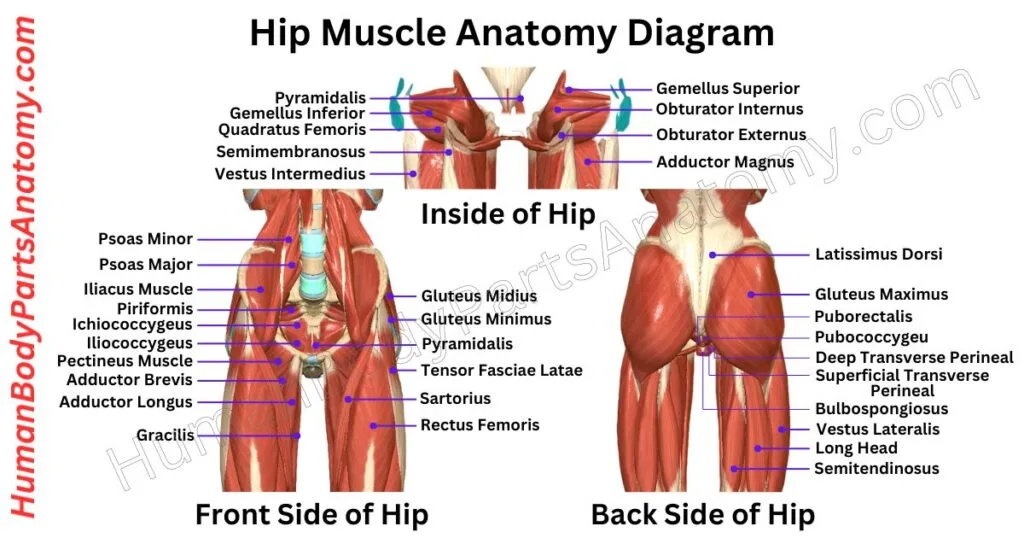
9. Hip Muscles
Gluteus Maximus
The gluteus maximus is the largest and most superficial of the three gluteal muscles and is commonly described as the largest single muscle in the body by mass.[50] (For comparison, NLM sources describe the four-headed quadriceps femoris as the most voluminous muscle group.[51]) It has a broad origin from the posterior surface of the iliac crest, the sacrum, and the sacrotuberous ligament, inserting into the iliotibial tract and the gluteal tuberosity of the femur, and is innervated by the inferior gluteal nerve.[50]
It is the main muscle that extends the hip and torso and is also a strong external rotator.[50] Electromyographic work shows its activation during sprinting far exceeds that during walking, running, or stair climbing, consistent with its role in explosive lower-body movement.[50]
Weakness in the gluteus maximus is associated with compensations such as anterior pelvic tilt (which increases lumbar lordosis), excessive contralateral trunk lean during single-leg stance, and knee valgus collapse during landing.[52][53] Each of these has been linked to increased injury risk along the lower-limb kinetic chain.[53]
Gluteus Medius
The gluteus medius is a thick, fan-shaped muscle on the lateral hip, arising from the outer surface of the ilium and inserting on the greater trochanter.[52] Its main actions are hip abduction and, via its anterior fibers, internal rotation.[54]
During the single-leg stance phase of walking, the gluteus medius keeps the opposite side of the pelvis from dropping. If it fails, the contralateral pelvis sags — a positive Trendelenburg sign, and, in gait, a Trendelenburg (gluteal) gait.[55] The gluteus medius and minimus are innervated by the superior gluteal nerve (L4–S1).[54]
Gluteus Minimus
The gluteus minimus is the smallest and deepest gluteal muscle.[55] It shares its origin (the outer ilium), innervation, blood supply, and main actions (abduction and internal rotation) with the gluteus medius, and the two work together to stabilize the hip.[55]
Tendinopathy and tears of the gluteus minimus and medius are the principal pathology underlying greater trochanteric pain syndrome (GTPS), which presents with lateral hip pain and point tenderness over the greater trochanter, often worse with side-lying at night and with weight-bearing; abnormal gait patterns may accompany it.[55]
Iliopsoas (Iliacus + Psoas Major)
The iliopsoas is the main hip flexor and is formed by the iliacus, which arises from the iliac fossa, and the psoas major, which arises from the vertebral bodies and transverse processes of T12 to L5.[56] These muscles join and attach to the lesser trochanter of the femur.[56]
When the hip is extended, such as when standing, a tight iliopsoas tilts the pelvis anteriorly and increases lumbar lordosis.[56] This is a commonly cited postural pattern in sedentary individuals and is discussed as a contributor to low back pain related to tight hip flexors.[56]
The psoas major is the only muscle that links the lumbar spine to the lower limb.[57] Because of this, its length and activation are highly relevant to lumbopelvic movement and back health.[57]
Read More – Hip Muscle Anatomy: Guide on Key Muscle Groups, Names, Functions & Diagram
10. Thigh Muscle
Anterior Thigh: Quadriceps Femoris
The four quadriceps muscles converge on a common quadriceps tendon that envelops the patella and continues as the patellar tendon to insert into the tibial tuberosity.[51] Together, they are the primary knee extensors and are essential for all weight-bearing lower-limb function.[51]
1. Rectus Femoris
This is the only quadriceps muscle that crosses both the hip and the knee.[58] It starts at the anterior inferior iliac spine (AIIS) and helps with both hip flexion and knee extension.[58]
Because it crosses both joints, the rectus femoris is prone to strain during kicking, when hip extension and knee flexion occur simultaneously — a common injury in football and soccer players.[58]
2. Vastus Lateralis
This is the largest quadriceps muscle. It arises from the lateral aspect of the proximal femur, including the greater trochanter, intertrochanteric line, and linea aspera.[51]
If the lateral quadriceps become disproportionately dominant relative to the medial side, the resulting lateral vector can contribute to patellar maltracking and, in some cases, lateral subluxation.[51]
3. Vastus Medialis
This muscle lies on the medial side of the quadriceps. Its distal, obliquely oriented fibers, called the vastus medialis oblique (VMO), help balance the lateral pull on the patella during knee extension.[51]
VMO function is frequently discussed in relation to patellofemoral pain syndrome (PFPS). The APTA/JOSPT clinical practice guideline for patellofemoral pain recommends exercise therapy targeting both hip and knee musculature, with hip-targeted exercise (posterolateral hip: extensors, abductors, external rotators) often preferred in the early stages and the combination preferred overall.[53] Importantly, the same guideline recommends against using EMG biofeedback of medial vastii activity to augment quadriceps exercise — that is, selective “VMO-only” training is not supported, whereas general hip-and-knee strengthening is.[53]
4. Vastus Intermedius
This muscle lies underneath the rectus femoris, between the other vastus muscles, arising from the anterior and lateral surfaces of the femoral shaft.[51]
The vastus intermedius extends the knee. Through its deep connective tissue it is continuous with the articularis genus, a small muscle that retracts the suprapatellar pouch during knee extension to prevent impingement of the synovial lining.[51]
Posterior Thigh: Hamstrings
The hamstrings are three muscles in the posterior compartment of the thigh: biceps femoris (long and short heads), semitendinosus, and semimembranosus.[59] Together, they extend the hip and flex the knee.[59] They mainly arise from the ischial tuberosity and are among the most frequently strained muscles in sprinting athletes.[60] Injury is most strongly associated with the late swing phase of high-speed running, when the hamstrings contract eccentrically to decelerate rapid knee extension; the biceps femoris long head is the most commonly injured of the three.[61]
1. Biceps Femoris
This muscle has a long head that starts at the ischial tuberosity and a short head that starts at the linea aspera.[62] The long head is supplied by the tibial division of the sciatic nerve, while the short head is supplied by the common fibular division.[62]
Biceps femoris flexes the knee and externally rotates the flexed leg.[59] Because the short head has a different nerve supply, it can be selectively affected in common fibular nerve injuries, which is a useful clinical clue.[62]
2. Semitendinosus
This is a long, strap-like muscle with a long distal tendon.[59] It flexes the knee, extends the hip, and internally rotates the tibia.[59]
The tendon is widely used as a graft for ACL reconstruction, known as the “hamstring graft,” because it is accessible, of adequate length, and associated with acceptable donor-site morbidity.[59]
3. Semimembranosus
This is the deepest and most medial of the hamstring muscles.[59] One of its tendinous expansions helps form the oblique popliteal ligament at the back of the knee, reinforcing the posterior joint capsule.[59]
A bursa sits between the semimembranosus tendon and the medial head of the gastrocnemius.[63] This bursa can communicate with the knee joint, and when it distends with synovial fluid it forms a Baker’s cyst (popliteal cyst) — most often secondary to degenerative meniscal tears or arthritis, and frequently identified incidentally on knee MRI.[64]
Inner Thigh: Adductor Group
The adductors move the thigh toward the body’s midline and remain active during walking, running, and lateral deceleration.[62] Most arise from the pubis and insert on the linea aspera; the adductor magnus is the exception, with an additional “hamstring” portion arising from the ischial tuberosity.[62]
Groin strain, which most often affects the adductor longus, is one of the most common soft tissue injuries in athletes participating in kicking and cutting sports such as soccer, ice hockey, and rugby.[65]
1. Adductor Longus
This is the most anterior adductor muscle and the one most often strained.[65] It extends from the body of the pubis to the middle third of the linea aspera.[62] Tenderness at its proximal pubic origin following sudden groin pain is a strong indicator of adductor longus injury; approximately a quarter of adductor longus injuries involve the proximal origin at the pubic bone.[65]
2. Adductor Brevis
This muscle is shorter and deeper than the adductor longus. It adducts the thigh and also assists hip flexion.[62] It lies between the anterior and posterior branches of the obturator nerve.[62]
3. Adductor Magnus
This is the largest and most complex adductor muscle.[62] It has two parts: the adductor portion, innervated by the obturator nerve (L2–L4), and the hamstring portion, innervated by the tibial division of the sciatic nerve.[62]
The hamstring portion also extends the hip, so the adductor magnus shares function with the posterior thigh muscles.[65]
Near its distal end, the adductor magnus has an opening called the adductor hiatus, through which the femoral artery and vein pass from the anterior to the posterior thigh to become the popliteal vessels.[62]
4. Gracilis
This is the most medial and superficial muscle of the thigh. It is long and flat, running from the inferior pubic ramus to the medial aspect of the proximal tibia, where it joins the pes anserinus.[62]
The gracilis adducts the thigh, flexes the knee, and internally rotates the flexed leg.[62] Its tendon is commonly harvested together with the semitendinosus for hamstring-graft ACL reconstruction.[62]

Read More – Thigh Muscle Anatomy: Key Muscle Groups, Names, Functions & Diagram
11. Lower Leg Muscles
The lower leg is divided into compartments: the posterior (calf) compartment, subdivided into superficial and deep layers, the anterior compartment, and the lateral compartment, also known as the fibular (peroneal) group.[66] Each group has a specific role in supporting movement, balance, and stability.
Posterior Leg: Calf Group
1. Gastrocnemius
The two-headed gastrocnemius forms the prominent, palpable bulk of the calf. The medial head (larger) and lateral head originate from the posterior femoral condyles and converge distally to join the soleus at the Achilles tendon.[63]
The gastrocnemius crosses both the knee and ankle joints. While its main job is plantarflexion of the foot, it also contributes to knee flexion.[63]
Strains of the gastrocnemius, often called “tennis leg,” typically affect the medial head at the myotendinous junction.[63] These injuries often occur suddenly during rapid push-off, especially in middle-aged recreational athletes.[63]
2. Soleus
The soleus arises from the posterior fibular head and proximal fibula, the soleal line of the tibia, and a fibrous arch connecting the two bones.[67] Unlike the gastrocnemius, the soleus acts only at the ankle, plantarflexing the foot regardless of knee position.[68]
This difference is exploited clinically during rehabilitation: bent-knee heel raises bias load toward the soleus.[68] The soleus is predominantly composed of slow-twitch fibres, making it highly fatigue-resistant and well suited to postural work.[68]
The soleus is sometimes called the “peripheral heart” because of its role in the calf muscle pump: during standing and walking, its rhythmic contractions help propel venous blood from the deep calf veins back toward the heart.[68] Impaired calf-pump function in immobile individuals contributes to venous stasis, one component of the recognised risk profile for deep vein thrombosis (DVT).[68]
Both the gastrocnemius and soleus join to form the Achilles (calcaneal) tendon, the thickest and strongest tendon in the body, which inserts on the posterior calcaneus.[69]
3. Plantaris
The plantaris is a small, thin muscle with a short muscle belly and a very long tendon, running between the gastrocnemius and soleus.[68]
The plantaris contributes little to ankle or knee movement.[68] During surgery, its tendon can be confused with adjacent structures, and it is sometimes harvested for tendon grafts.[68]
A tear of the plantaris can cause a sudden snapping sensation and pain in the posterior calf.[68] It is a recognised but frequently misattributed injury and is distinct from Achilles tendon rupture.[69]
Anterior Leg
1. Tibialis Anterior
The tibialis anterior originates from the lateral condyle of the tibia, the proximal lateral surface of the tibial shaft, and the interosseous membrane; its tendon inserts on the medial cuneiform and the base of the first metatarsal.[70] It is the main dorsiflexor and invertor of the foot, and its tendon is visible on the dorsum of the foot during resisted dorsiflexion.[70]
Weakness or paralysis caused by injury to the common fibular (peroneal) nerve — most often at the fibular neck, where it is superficial, making it the most frequent mononeuropathy of the leg — or by L5 nerve root compression can lead to foot drop.[71][72] The person cannot lift the front of the foot while walking, and may adopt a high-steppage gait to clear the toes.[71]
2. Extensor Digitorum Longus
The extensor digitorum longus originates from the lateral tibial condyle, the anterior surface of the fibula, and the interosseous membrane.[70] This muscle extends the four lesser toes (digits 2 to 5) and assists dorsiflexion; the whole anterior compartment is supplied by the deep fibular (peroneal) nerve.[70] Its four tendons are visible on the dorsum of the foot during toe extension.
Lateral Leg: Fibular (Peroneal) Group
1. Fibularis (Peroneus) Longus
The fibularis (peroneus) longus runs behind the lateral malleolus and crosses the sole of the foot from lateral to medial, attaching to the base of the first metatarsal and the medial cuneiform.[67]
Because of its oblique course, the fibularis longus everts and weakly plantarflexes the foot while also supporting the transverse arch.[67] If the tendon subluxes over the lateral malleolus — classically after forced dorsiflexion with contraction — it can produce a snapping or popping sensation at the ankle.[67]
2. Fibularis (Peroneus) Brevis
The fibularis (peroneus) brevis is shorter and lies deeper than the longus. It arises from the distal two-thirds of the lateral fibula and attaches to the styloid process (tuberosity) at the base of the fifth metatarsal.[67]
That tuberosity is the site of zone 1 avulsion fractures (also called pseudo-Jones fractures), which occur when the hindfoot is forced into inversion.[73] These are distinct from the true Jones fracture, which occurs in zone 2, at the metaphyseal–diaphyseal junction, a vascular watershed area with a much higher nonunion rate.[72][73] Note also that while the peroneus brevis was traditionally held responsible for tuberosity avulsions, more recent anatomical work implicates the lateral band of the plantar aponeurosis as a major contributor.[73]
The fibularis brevis is the primary evertor of the foot and helps stabilise the lateral ankle.[67] Strengthening it is a standard component of rehabilitation after a lateral ankle sprain — among the most common musculoskeletal injuries encountered in primary care, emergency departments, and orthopedic clinics, with ankle sprains accounting for roughly 7% to 10% of emergency department visits and up to 40% of sports-related injuries.[74][75]
FAQ’s
Counts vary by source and classification system. Commonly cited figures range from more than 400 named skeletal muscles to approximately 600–650.[76] Exact counts differ depending on the anatomical classification system used and on whether vestigial or small accessory muscles are included.[76]
The gluteus maximus is the largest and most superficial of the gluteal muscles and is conventionally described as the largest single muscle by mass.[52] NLM sources describe the quadriceps femoris — a four-headed group — as the most voluminous muscle of the human body, so the two claims are not in conflict once “single muscle” versus “muscle group” is specified.[51] The sartorius, running from the anterior superior iliac spine (ASIS) to the medial tibia at the pes anserinus, is the longest single muscle.[77] The gluteus medius, with the minimus, is essential for pelvic stability in single-leg stance and is therefore among the most biomechanically consequential muscles for healthy gait.[52]
The stapedius muscle of the middle ear is the smallest named skeletal muscle.[78][79] It dampens ossicular movement in response to loud sound, protecting the inner ear.[79] Classic texts describe it as roughly 1 mm in length; cadaveric dissection studies measuring the muscle belly within its bony canal report lengths of approximately 9 to 11 mm with a tendon of about 2 mm, so quoted dimensions depend on what is being measured.[78]
The deep stabilizers — transversus abdominis, multifidus, and pelvic floor — are commonly grouped as the “inner unit” of postural control.[49] The erector spinae, gluteus medius, and scapular retractors such as the rhomboids and middle/lower trapezius are the key “outer unit” muscles for maintaining upright alignment of the spine, pelvis, and shoulder girdle.[48][24][52]
Foot drop results from weakness or paralysis of the tibialis anterior and the other anterior compartment muscles.[71] The most common causes are compression or injury of the common fibular (peroneal) nerve at the fibular neck, where the nerve runs superficially, and L5 nerve root compression from a lumbar disc herniation. Lesions of the lumbar plexus, sciatic nerve, or deep fibular nerve can produce the same picture.[71]
References-
- Physiology, Skeletal Muscle. McCuller C, Jessu R, Callahan AL. StatPearls [Internet]. NCBI Bookshelf, NLM/NIH. Updated 30 Jul 2023. NBK537139. PMID: 30725824. https://www.ncbi.nlm.nih.gov/books/NBK537139/
- Anatomy, Head and Neck: Facial Muscles. Fakoya AO, Hohman MH, Westbrook KE, Varacallo MA. StatPearls [Internet]. NCBI Bookshelf, NLM/NIH. Updated 20 Apr 2024. NBK493209. https://www.ncbi.nlm.nih.gov/books/NBK493209/
- Facial Nerve Anatomy and Clinical Applications. Seneviratne SO, Patel BC. StatPearls [Internet]. NCBI Bookshelf, NLM/NIH. Updated 23 May 2023. NBK554569. https://www.ncbi.nlm.nih.gov/books/NBK554569/
- Facial Nerve Palsy. StatPearls [Internet]. NCBI Bookshelf, NLM/NIH. Updated 9 Apr 2026. NBK549815. https://www.ncbi.nlm.nih.gov/books/NBK549815/
- Reconsidering the Duchenne Smile: Formalizing and Testing Hypotheses About Eye Constriction and Positive Emotion. J Nonverbal Behav. PubMed-indexed, open access. PMC8317937. https://pmc.ncbi.nlm.nih.gov/articles/PMC8317937/
- Anatomy, Head and Neck, Mastication Muscles. StatPearls [Internet]. NCBI Bookshelf, NLM/NIH. Updated 5 Jun 2023. NBK541027. https://www.ncbi.nlm.nih.gov/books/NBK541027/
- Anatomy, Head and Neck, Masseter Muscle. StatPearls [Internet]. NCBI Bookshelf, NLM/NIH. Updated 5 Jun 2023. NBK539869. https://www.ncbi.nlm.nih.gov/books/NBK539869/
- Prevention and correction of paradoxical masseteric bulging following botulinum toxin injection for masseter hypertrophy. PubMed-indexed, 2022. PMID: 35028386. https://pmc.ncbi.nlm.nih.gov/articles/PMC8714579/
- Anatomy, Head and Neck, Temporomandibular Joint. StatPearls [Internet]. NCBI Bookshelf, NLM/NIH. Updated 8 Sep 2025. NBK538486. https://www.ncbi.nlm.nih.gov/books/NBK538486/
- Anatomy, Head and Neck, Medial Pterygoid Muscle. StatPearls [Internet]. NCBI Bookshelf, NLM/NIH. Updated 5 Jun 2023. NBK546588. https://www.ncbi.nlm.nih.gov/books/NBK546588/
- Anatomy, Head and Neck, Lateral Pterygoid Muscle. StatPearls [Internet]. NCBI Bookshelf, NLM/NIH. Updated 10 Sep 2024. NBK549799. https://www.ncbi.nlm.nih.gov/books/NBK549799/
- Anatomy, Head and Neck: Sternocleidomastoid Muscle. Bordoni B, Jozsa F, Varacallo MA. StatPearls [Internet]. NCBI Bookshelf, NLM/NIH. Updated 6 Apr 2026. NBK532881. https://www.ncbi.nlm.nih.gov/books/NBK532881/
- Anatomy, Head and Neck, Scalenus Muscle. Bordoni B, Jozsa F, Varacallo MA. StatPearls [Internet]. NCBI Bookshelf, NLM/NIH. Updated 25 Mar 2025. NBK519058. https://www.ncbi.nlm.nih.gov/books/NBK519058/
- Thoracic Outlet Syndrome. StatPearls [Internet]. NCBI Bookshelf, NLM/NIH. Updated 10 Apr 2023. NBK557450. https://www.ncbi.nlm.nih.gov/books/NBK557450/
- Anatomy, Head and Neck, Levator Scapulae Muscles. Henry JP, Munakomi S. StatPearls [Internet]. NCBI Bookshelf, NLM/NIH. Updated 28 Aug 2023. NBK553120. https://www.ncbi.nlm.nih.gov/books/NBK553120/
- Anatomy, Shoulder and Upper Limb, Shoulder Muscles. StatPearls [Internet]. NCBI Bookshelf, NLM/NIH. Updated 8 Aug 2023. NBK534836. https://www.ncbi.nlm.nih.gov/books/NBK534836/
- Anatomy, Shoulder and Upper Limb, Deltoid Muscle. Elzanie A, Varacallo MA. StatPearls [Internet]. NCBI Bookshelf, NLM/NIH. Updated 30 Jan 2024. NBK537056. https://www.ncbi.nlm.nih.gov/books/NBK537056/
- Anatomy, Rotator Cuff. StatPearls [Internet]. NCBI Bookshelf, NLM/NIH. Updated 18 Jun 2026. NBK441844. https://www.ncbi.nlm.nih.gov/books/NBK441844/
- Rotator Cuff Injuries. MedlinePlus, NLM/NIH; primary NIH organization: NIAMS. https://medlineplus.gov/rotatorcuffinjuries.html
- Anatomy, Shoulder and Upper Limb, Arm Supraspinatus Muscle. Jeno SH, Munjal A, Schindler GS. StatPearls [Internet]. NCBI Bookshelf, NLM/NIH. Updated 28 Aug 2023. NBK537202. https://www.ncbi.nlm.nih.gov/books/NBK537202/
- American Academy of Orthopaedic Surgeons. Management of Rotator Cuff Injuries: Evidence-Based Clinical Practice Guideline. Published 18 Aug 2025 (replaces the 2019 edition). https://www.aaos.org/rccpg2025 · Full text: https://www.aaos.org/globalassets/quality-and-practice-resources/rotator-cuff/rotator-cuff-2025/rotator-cuff-cpg.pdf
- Anatomy, Shoulder and Upper Limb, Teres Minor Muscle. StatPearls [Internet]. NCBI Bookshelf, NLM/NIH. Updated 8 May 2023. NBK513324. https://www.ncbi.nlm.nih.gov/books/NBK513324/
- Anatomy, Shoulder and Upper Limb, Subscapularis Muscle. Aguirre K, Mudreac A, Kiel J. StatPearls [Internet]. NCBI Bookshelf, NLM/NIH. Updated 28 Aug 2023. NBK513344. https://www.ncbi.nlm.nih.gov/books/NBK513344/
- Anatomy, Back, Trapezius. Ourieff J, Scheckel B, Agarwal A. StatPearls [Internet]. NCBI Bookshelf, NLM/NIH. Updated 11 Mar 2023. NBK518994. PMID: 30085536. https://www.ncbi.nlm.nih.gov/books/NBK518994/
- Anatomy, Back, Rhomboid Muscles. StatPearls [Internet]. NCBI Bookshelf, NLM/NIH. Updated 16 May 2023. NBK534856. https://www.ncbi.nlm.nih.gov/books/NBK534856/
- Anatomy, Back, Latissimus Dorsi. Jeno SH, Varacallo MA. StatPearls [Internet]. NCBI Bookshelf, NLM/NIH. Updated 5 Mar 2023. NBK448120. https://www.ncbi.nlm.nih.gov/books/NBK448120/
- Anatomy, Thorax, Pectoralis Major. Solari F, Burns B. StatPearls [Internet]. NCBI Bookshelf, NLM/NIH. Updated 24 Jul 2023. NBK525991. https://www.ncbi.nlm.nih.gov/books/NBK525991/
- Haley CA, Zacchilli MA. Pectoralis major injuries: evaluation and treatment. Clin Sports Med. 2014;33(4):739–756. PMID: 25280620. https://pubmed.ncbi.nlm.nih.gov/25280620/
- Anatomy, Shoulder and Upper Limb, Pectoral Muscles. StatPearls [Internet]. NCBI Bookshelf, NLM/NIH. Updated 28 Aug 2023. NBK545241. https://www.ncbi.nlm.nih.gov/books/NBK545241/
- Anatomy, Thorax, Serratus Anterior Muscles. StatPearls [Internet]. NCBI Bookshelf, NLM/NIH. Updated 10 Sep 2024. NBK531457. https://www.ncbi.nlm.nih.gov/books/NBK531457/
- Anatomy, Thorax, Muscles. Tang A, Bordoni B. StatPearls [Internet]. NCBI Bookshelf, NLM/NIH. Updated 24 Jul 2023. NBK538321. https://www.ncbi.nlm.nih.gov/books/NBK538321/
- Anatomy, Thorax, Wall Movements. StatPearls [Internet]. NCBI Bookshelf, NLM/NIH. Updated 13 Mar 2024. NBK526023. https://www.ncbi.nlm.nih.gov/books/NBK526023/
- Anatomy, Shoulder and Upper Limb, Forearm Compartments. StatPearls [Internet]. NCBI Bookshelf, NLM/NIH. Updated 31 Jul 2023. NBK539784. https://www.ncbi.nlm.nih.gov/books/NBK539784/
- Anatomy, Shoulder and Upper Limb, Arm Muscles. StatPearls [Internet]. NCBI Bookshelf, NLM/NIH. Updated 24 Jul 2023. NBK554420. https://www.ncbi.nlm.nih.gov/books/NBK554420/
- Anatomy, Shoulder and Upper Limb, Biceps Muscle. StatPearls [Internet]. NCBI Bookshelf, NLM/NIH. Updated 30 Jan 2024. NBK519538. https://www.ncbi.nlm.nih.gov/books/NBK519538/
- Deep Tendon Reflexes. StatPearls [Internet]. NCBI Bookshelf, NLM/NIH. Updated 24 Jul 2023. NBK531502. https://www.ncbi.nlm.nih.gov/books/NBK531502/
- Anatomy, Shoulder and Upper Limb, Arm Nerves. StatPearls [Internet]. NCBI Bookshelf, NLM/NIH. Updated 13 Mar 2024. NBK547735. https://www.ncbi.nlm.nih.gov/books/NBK547735/
- Anatomy, Shoulder and Upper Limb, Brachialis Muscle. Plantz MA, Bordoni B. StatPearls [Internet]. NCBI Bookshelf, NLM/NIH. Updated 21 Feb 2023. NBK551630. https://www.ncbi.nlm.nih.gov/books/NBK551630/
- Anatomy, Shoulder and Upper Limb, Arm Structure and Function. StatPearls [Internet]. NCBI Bookshelf, NLM/NIH. Updated 25 Jul 2023. NBK507841. https://www.ncbi.nlm.nih.gov/books/NBK507841/
- Anatomy, Shoulder and Upper Limb, Hand Flexor Digitorum Profundus Muscle. StatPearls [Internet]. NCBI Bookshelf, NLM/NIH. Updated 13 Nov 2023. NBK526046. https://www.ncbi.nlm.nih.gov/books/NBK526046/
- Anatomy, Shoulder and Upper Limb, Wrist Extensor Muscles. StatPearls [Internet]. NCBI Bookshelf, NLM/NIH. Updated 4 Jun 2026. NBK534805. https://www.ncbi.nlm.nih.gov/books/NBK534805/
- Anatomy, Abdomen and Pelvis: Anterolateral Abdominal Wall. StatPearls [Internet]. NCBI Bookshelf, NLM/NIH. Updated 24 Jul 2023. NBK525975. https://www.ncbi.nlm.nih.gov/books/NBK525975/
- Anatomy, Anterolateral Abdominal Wall Muscles. StatPearls [Internet]. NCBI Bookshelf, NLM/NIH. Updated 24 Jul 2023. NBK470334. https://www.ncbi.nlm.nih.gov/books/NBK470334/
- Diastasis Recti Rehabilitation. Hall H, Sanjaghsaz H. StatPearls [Internet]. NCBI Bookshelf, NLM/NIH. Updated 8 Aug 2023. NBK573063. PMID: 34424636. https://www.ncbi.nlm.nih.gov/books/NBK573063/
- Hodges PW, Richardson CA. Feedforward contraction of transversus abdominis is not influenced by the direction of arm movement. Exp Brain Res. 1997;114(2):362–370. PMID: 9166925. DOI: 10.1007/PL00005644. https://pubmed.ncbi.nlm.nih.gov/9166925/
- Morris SL, Lay B, Allison GT. Transversus abdominis is part of a global not local muscle synergy during arm movement. Hum Mov Sci. 2013;32(5):1176–1185. PMID: 23482302. https://pubmed.ncbi.nlm.nih.gov/23482302/
- Architecture of the rectus abdominis, quadratus lumborum, and erector spinae. PubMed-indexed. PMID: 11182129. https://pubmed.ncbi.nlm.nih.gov/11182129/
- Anatomy, Abdomen and Pelvis, Quadratus Lumborum. StatPearls [Internet]. NCBI Bookshelf, NLM/NIH. Updated 17 Jul 2024. NBK535407. https://www.ncbi.nlm.nih.gov/books/NBK535407/
- Ward SR, Kim CW, Eng CM, Gottschalk LJ 4th, Tomiya A, Garfin SR, Lieber RL. Architectural analysis and intraoperative measurements demonstrate the unique design of the multifidus muscle for lumbar spine stability. J Bone Joint Surg Am. 2009;91(1):176–185. PMID: 19122093. DOI: 10.2106/JBJS.G.01311. https://pubmed.ncbi.nlm.nih.gov/19122093/
- Anatomy, Bony Pelvis and Lower Limb, Gluteus Maximus Muscle. Elzanie A, Borger J. StatPearls [Internet]. NCBI Bookshelf, NLM/NIH. Updated 1 Apr 2023. NBK538193. PMID: 30855781. https://www.ncbi.nlm.nih.gov/books/NBK538193/
- Anatomy, Bony Pelvis and Lower Limb: Thigh Quadriceps Muscle. Bordoni B, Varacallo MA. StatPearls [Internet]. NCBI Bookshelf, NLM/NIH. Updated 8 May 2023. NBK513334. https://www.ncbi.nlm.nih.gov/books/NBK513334/
- Anatomy, Bony Pelvis and Lower Limb, Gluteus Medius Muscle. StatPearls [Internet]. NCBI Bookshelf, NLM/NIH. Updated 17 Feb 2023. NBK557509. https://www.ncbi.nlm.nih.gov/books/NBK557509/
- Willy RW, Hoglund LT, Barton CJ, et al. Patellofemoral Pain: Clinical Practice Guidelines Linked to the ICF from the Academy of Orthopaedic Physical Therapy, American Physical Therapy Association. J Orthop Sports Phys Ther. 2019;49(9):CPG1–CPG95. DOI: 10.2519/jospt.2019.0302. https://www.jospt.org/doi/10.2519/jospt.2019.0302
- Anatomy, Abdomen and Pelvis: Superior Gluteal Nerve. StatPearls [Internet]. NCBI Bookshelf, NLM/NIH. Updated 14 Aug 2023. NBK535408. https://www.ncbi.nlm.nih.gov/books/NBK535408/
- Anatomy, Bony Pelvis and Lower Limb, Gluteus Minimus Muscle. Greco AJ, Vilella RC. StatPearls [Internet]. NCBI Bookshelf, NLM/NIH. Updated 22 May 2023. NBK556144. https://www.ncbi.nlm.nih.gov/books/NBK556144/
- Anatomy, Bony Pelvis and Lower Limb: Iliopsoas Muscle. Bordoni B, Varacallo MA. StatPearls [Internet]. NCBI Bookshelf, NLM/NIH. Updated 8 Jun 2026. NBK531508. https://www.ncbi.nlm.nih.gov/books/NBK531508/
- Anatomy, Bony Pelvis and Lower Limb: Psoas Major. Siccardi MA, Tariq MA, Valle C. StatPearls [Internet]. NCBI Bookshelf, NLM/NIH. Updated 8 Aug 2023. NBK535418. https://www.ncbi.nlm.nih.gov/books/NBK535418/
- Anatomy, Abdomen and Pelvis, Rectus Femoris Muscle. Murdock CJ, Mudreac A, Agyeman K. StatPearls [Internet]. NCBI Bookshelf, NLM/NIH. Updated 13 Nov 2023. NBK539897. https://www.ncbi.nlm.nih.gov/books/NBK539897/
- Anatomy, Bony Pelvis and Lower Limb, Hamstring Muscle. Hu Y, Raja A. StatPearls [Internet]. NCBI Bookshelf, NLM/NIH. Updated 31 Jan 2026. NBK546688. https://www.ncbi.nlm.nih.gov/books/NBK546688/
- Hamstring Injury. StatPearls [Internet]. NCBI Bookshelf, NLM/NIH. Updated 8 Aug 2023. NBK558936. https://www.ncbi.nlm.nih.gov/books/NBK558936/
- Sprinting Biomechanics and Hamstring Injuries: Is There a Link? A Literature Review. PubMed-indexed review, 2021. PMID: 34678922. https://pubmed.ncbi.nlm.nih.gov/34678922/
- Anatomy, Bony Pelvis and Lower Limb: Femoral Muscles. StatPearls [Internet]. NCBI Bookshelf, NLM/NIH. Updated 24 Oct 2023. NBK500008. https://www.ncbi.nlm.nih.gov/books/NBK500008/
- Anatomy, Bony Pelvis and Lower Limb: Gastrocnemius Muscle. StatPearls [Internet]. NCBI Bookshelf, NLM/NIH. Updated 11 Apr 2026. NBK532946. https://www.ncbi.nlm.nih.gov/books/NBK532946/
- Baker’s Cyst. StatPearls [Internet]. NCBI Bookshelf, NLM/NIH. Updated 4 Aug 2023. NBK430774. https://www.ncbi.nlm.nih.gov/books/NBK430774/
- Adductor Strain. StatPearls [Internet]. NCBI Bookshelf, NLM/NIH. Updated 13 Dec 2025. NBK493166. https://www.ncbi.nlm.nih.gov/books/NBK493166/
- Anatomy, Bony Pelvis and Lower Limb: Foot and Ankle. StatPearls [Internet]. NCBI Bookshelf, NLM/NIH. Updated 24 May 2026. NBK546698. https://www.ncbi.nlm.nih.gov/books/NBK546698/
- Anatomy, Bony Pelvis and Lower Limb, Foot Muscles. StatPearls [Internet]. NCBI Bookshelf, NLM/NIH. Updated 9 Dec 2025. NBK539705. https://www.ncbi.nlm.nih.gov/books/NBK539705/
- Anatomy, Bony Pelvis and Lower Limb: Leg Posterior Compartment. StatPearls [Internet]. NCBI Bookshelf, NLM/NIH. Updated 13 May 2026. NBK537340. https://www.ncbi.nlm.nih.gov/books/NBK537340/
- Anatomy, Bony Pelvis and Lower Limb: Achilles Tendon. Wong M, Jardaly AH, Kiel J. StatPearls [Internet]. NCBI Bookshelf, NLM/NIH. Updated 8 Aug 2023. NBK499917. https://www.ncbi.nlm.nih.gov/books/NBK499917/
- Anatomy, Bony Pelvis and Lower Limb: Leg Anterior Compartment. Lezak B, Launico MV. StatPearls [Internet]. NCBI Bookshelf, NLM/NIH. Updated 8 Jun 2026. NBK539725. https://www.ncbi.nlm.nih.gov/books/NBK539725/
- Foot Drop. StatPearls [Internet]. NCBI Bookshelf, NLM/NIH. Updated 1 May 2025. NBK554393. https://www.ncbi.nlm.nih.gov/books/NBK554393/
- Common peroneal nerve dysfunction. MedlinePlus Medical Encyclopedia, U.S. National Library of Medicine, NIH. Review date 28 Aug 2023; reviewed by Campellone JV, MD (Cooper Medical School of Rowan University) and the A.D.A.M. editorial team. https://medlineplus.gov/ency/article/000791.htm
- 5th Metatarsal Fracture. StatPearls [Internet]. NCBI Bookshelf, NLM/NIH. Updated 29 May 2023. NBK544369. https://www.ncbi.nlm.nih.gov/books/NBK544369/
- Acute Ankle Sprain. Bergman R, Li D, Shuman VL. StatPearls [Internet]. NCBI Bookshelf, NLM/NIH. Updated 2 Aug 2025. NBK459212. https://www.ncbi.nlm.nih.gov/books/NBK459212/
- Calcaneofibular Ligament Injury. Le MQT, Harper DE, Dixon M, Tiu TK. StatPearls [Internet]. NCBI Bookshelf, NLM/NIH. Updated 21 Mar 2026. NBK557378. https://www.ncbi.nlm.nih.gov/books/NBK557378/
- Histology, Muscle. Campbell NJ, Maani CV. StatPearls [Internet]. NCBI Bookshelf, NLM/NIH. Updated 1 May 2023. NBK537195. https://www.ncbi.nlm.nih.gov/books/NBK537195/
- Anatomy, Bony Pelvis and Lower Limb: Thigh Muscles. StatPearls [Internet]. NCBI Bookshelf, NLM/NIH. Updated 17 Dec 2022. NBK482445. https://www.ncbi.nlm.nih.gov/books/NBK482445/
- Microsurgical Anatomy of Stapedius Muscle: Anatomy Revisited, Redefined with Potential Impact in Surgeries. PubMed-indexed cadaveric study. PMID: 30906706. https://pubmed.ncbi.nlm.nih.gov/30906706/
- Gierek T, et al. [The stapedius muscle — present opinions about anatomy and physiology]. Otolaryngol Pol. 2007;61(1):29–32. PMID: 17605415. DOI: 10.1016/S0030-6657(07)70379-7. https://pubmed.ncbi.nlm.nih.gov/17605415/
Read More-
Human Body-
- Human Anatomy: Guide to Bones, Muscles, Organs, Systems, Functions & Diagram
- Human Skeleton Anatomy: All 206 Bones Explained with Functions & Diagrams
Head, Face & Senses-
- Nose Anatomy: Parts of the Nose, Structure, Nasal Cavity & Sinuses Explained
- Skull Anatomy: Parts of the Skull, Structure, Cranial, Facial Bones & Functions
- Mouth Anatomy: Guide on Parts of Mouth, Lips, Palate, Gums & Oral Cavity
- Eye Anatomy: Parts of the Eye, Cornea, Lens, Retina, Optic Nerve & Diagram
- Ear Anatomy: Parts of the Ear, Outer, Middle & Inner Ear & Structures
Brain & Nervous System-
- Brain Anatomy: Parts of the Brain, Structure, Functions & Regions Explained
- The 4 Lobes of the Brain: Complete Guide with Locations & Functions
Spine & Back-
- Cervical Spine Anatomy: C1–C7 Vertebrae, Muscles & Nerves Explained
- Spine Anatomy: Parts of the Spine, Vertebrae, Curves, Spinal Cord & Diagram
- Neck Muscle Anatomy: Guide with Key Muscles, Groups, Functions & Diagrams
- Rib Cage Anatomy: Ribs, Sternum, Thoracic, Vertebrae & Functions Explained
Organs-
- Pancreas Anatomy: Parts of Pancreas, Structure, Location, Functions & Role
- Stomach Anatomy: Parts of Stomach, Regions, Layers & Digestive Function
- Heart Anatomy: Guide on Parts of Heart, Chambers, Valves & Blood Flow
- Liver Anatomy: Key Parts of Liver, Functions, Lobes, Segments & Diagram
- Kidney Anatomy: Guide on Parts of Kidney, Structure, Functions & Diagram
Upper Limb-
- Shoulder Anatomy: Parts of the Shoulder, Bones, Joint Structure & Diagram
- Hand Anatomy: Parts of the Hand, Bones, Muscles with Functions & Diagram
- Arm Anatomy: Parts of Arm, Bones, Muscles & Joints with Functions & Diagram
Lower Limb-
- Hip Muscle Anatomy: Guide on Key Muscle Groups, Names, Functions & Diagram
- Hip Bone Anatomy: Parts of Hip Bone, Ilium, Pubis, Functions & Diagram
- Leg Anatomy: Parts of the Leg, Bones, Muscles & Lower Leg with Functions
- Knee Anatomy: Parts of Knee, Bones, Ligaments, Cartilage & Joint Structure
- Thigh Muscle Anatomy: Key Muscle Groups, Names, Functions & Diagram
Medical Disclaimer
All content on HumanBodyPartsAnatomy.com is educational and based on verified, peer-reviewed medical sources. Articles are authored or reviewed by qualified medical or biomedical professionals to ensure accuracy.
This website does not provide medical advice, diagnosis, or treatment. Always consult a licensed healthcare professional for personal medical guidance.
No commercial or promotional interests influence the medical content published on this site.