📅 Published on March 18, 2026 | 🕒 Last updated on March 18, 2026
Overview of Human Bone Anatomy
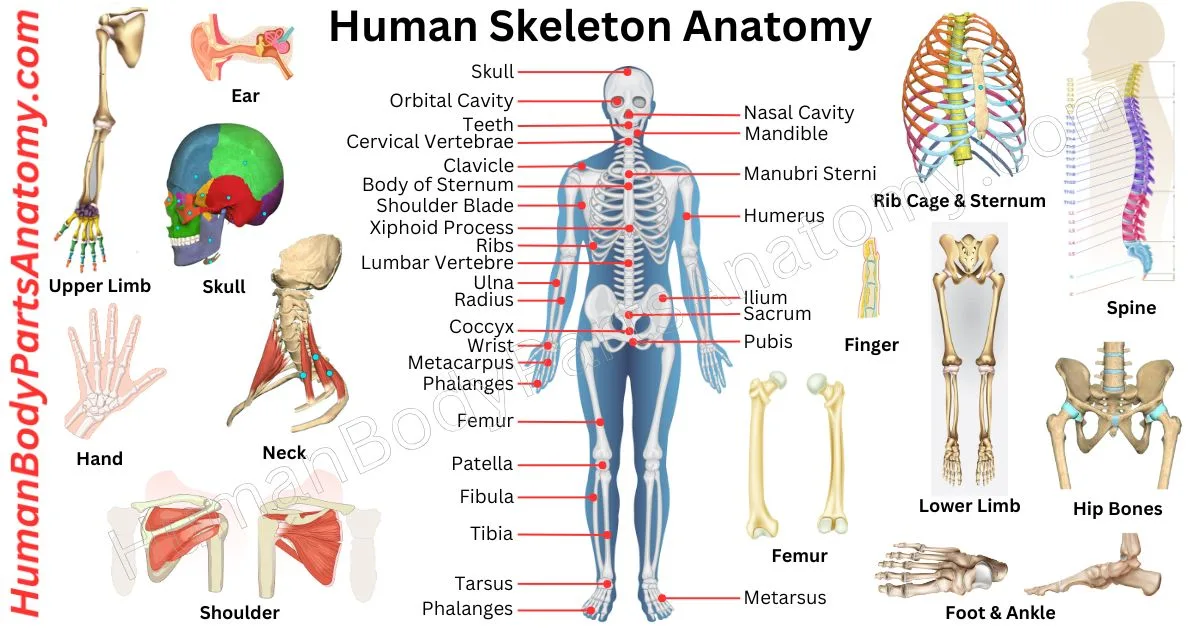
Human skeleton anatomy describes the bones inside our body that give us shape and support. The skeleton helps us stand, sit, walk, and move. It also protects important organs like the brain, heart, and lungs. At birth, a human baby has about 270 bones. As we grow, some bones join together. By the time we reach adulthood, the total number of bones of the human body becomes around 206. The skeletal system makes up about 14% of body weight, which is usually 10 to 11 kilograms (22–24 pounds) in an adult. Bones also have other important jobs. They produce blood cells in the bone marrow and store minerals such as calcium and phosphorus that keep bones strong.
Bones grow and become stronger during childhood and young adulthood. Peak bone strength is reached between the ages of 25 and 30. After that, keeping bones healthy depends on eating a balanced diet, staying active, and getting enough calcium and vitamin D. Learning about human skeleton anatomy helps us understand how our body moves and stays strong.
Human Skeleton Diagram Labeled
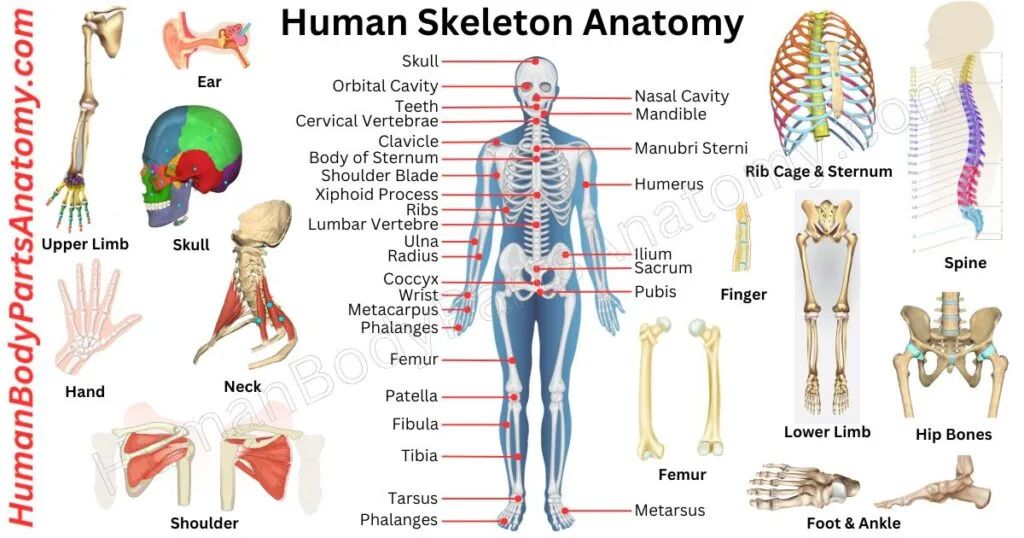
Bones of the Human Body
Skull (Head) Bones – 22 Bones
A. Cranial Bones (Protect the Brain) – 8 Bones
- Frontal (1)
- Parietal (2)
- Temporal (2)
- Occipital (1)
- Sphenoid (1)
- Ethmoid (1)
B. Facial Bones (Form the Face) – 14 Bones
- Nasal (2)
- Maxilla (2)
- Zygomatic (2)
- Palatine (2)
- Lacrimal (2)
- Inferior nasal concha (2)
- Vomer (1)
- Mandible (1)
Auditory Ossicles (Middle Ear) – 6 Bones
- Malleus (2)
- Incus (2)
- Stapes (2)
Hyoid Bone – 1 Bone
- Hyoid
Thoracic Cage (Chest) – 25 Bones
A. Sternum – 1 Bone
B. Ribs – 24 Bones (12 Pairs)
- True ribs (1–7)
- False ribs (8–10)
- Floating ribs (11–12)
Vertebral Column (Spine) – 33 Bones
A. Cervical Spine (Neck) – 7 Bones
- C1 – Atlas
- C2 – Axis
- C3 to C7 (5)
B. Thoracic Spine (Upper Back) – 12 Bones
- T1 to T12
C. Lumbar Spine (Lower Back) – 5 Bones
- L1 to L5
D. Sacrum – 5 fused bones
- S1 to S5 (fused)
E. Coccyx – 4 fused bones
- Tailbone
Upper Limb Bones – 64 Bones
A. Shoulder Girdle – 4 Bones
- Clavicle (2)
- Scapula (2)
B. Arm & Forearm – 6 Bones
- Humerus (2)
- Radius (2)
- Ulna (2)
C. Wrist (Carpal Bones) – 16 Bones (8 per hand)
- Scaphoid
- Lunate
- Triquetrum
- Pisiform
- Trapezium
- Trapezoid
- Capitate
- Hamate
D. Hand Bones – 38 Bones
- Metacarpals (10)
- Phalanges (28)
- Proximal
- Middle
- Distal
Pelvic Girdle – 2 Bones
- Hip bones (2)
- Ilium
- Ischium
- Pubis (fused in adults)
Lower Limb Bones – 62 Bones
A. Thigh & Leg – 8 Bones
- Femur (2)
- Patella (2)
- Tibia (2)
- Fibula (2)
B. Ankle (Tarsal Bones) – 14 Bones (7 per foot)
- Talus
- Calcaneus
- Navicular
- Cuboid
- Medial cuneiform
- Intermediate cuneiform
- Lateral cuneiform
C. Foot Bones – 38 Bones
- Metatarsals (10)
- Phalanges (28)
Sesamoid Bones (Variable)
- Patella (largest sesamoid bone)
- Small sesamoid bones in the hands and feet
Human Skeleton Anatomy
Skull
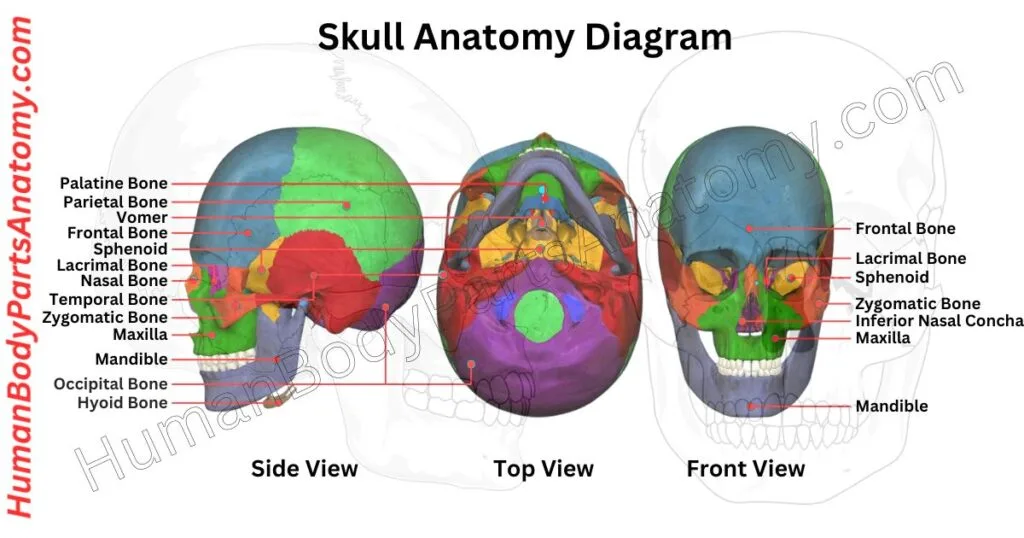
The human skull is one of the most important structures in the body. It’s a strong, bony framework that does far more than just protect the brain — it also shapes the face, houses vital sense organs, and supports many of the functions we rely on every day, from seeing and hearing to breathing and chewing.
What Is the Skull Made Of?
The human skull is made up of 22 bones. When the three tiny ear bones (called ossicles) and the hyoid bone in the throat are included, that number rises to 29. Nearly all of these bones are held tightly together by fibrous joints called sutures, which interlock like puzzle pieces to form a rigid, protective shell.
The Two Main Parts of the Skull
The skull is divided into two key sections. The first is the neurocranium, which wraps around and protects the brain. The second is the viscerocranium, which forms the face and includes the lower jaw, known as the mandible. Together, these two sections give the skull its distinctive shape.
Three Types of Skull Bones
Skull bones fall into three main categories: cranial bones (which form the braincase), facial bones (which shape the face and support the eyes, nose, and mouth), and the ossicles (three tiny bones in each ear that play a critical role in transmitting sound).
Why Is the Skull Located at the Top of the Body?
The skull sits at the very top and front of the body — and that’s no accident. The brain and all major sense organs are concentrated in the head, a biological arrangement known as cephalization. This positioning gives the brain quick access to sensory information from the environment, which is essential for fast reflexes and decision-making.
What Does the Skull Protect?
Inside the skull, you’ll find the brain, eyes, ears, nose, and mouth. These organs work together to give us the ability to see, hear, smell, taste, and think. The skull is uniquely designed to support all of them: it keeps the eyes properly spaced for depth perception, positions the ears on opposite sides of the head so we can detect the direction of sounds, and provides openings for the nose and mouth to function freely.
Key Functions of the Human Skull
Beyond protection, the skull plays several important roles. It provides attachment points for the muscles used in chewing and facial expression.
It also supports the top of the spine, balancing the head and allowing it to move in multiple directions. The nasal cavity within the skull helps warm and filter air before it reaches the lungs.
Understanding the skull’s structure helps explain how the human body is built for both survival and sensory awareness — making it one of the most fascinating and functional structures in anatomy.
Read More – Skull Anatomy: Complete Guide with Parts, Names, Functions & Diagram
Vertebral Column or Spine
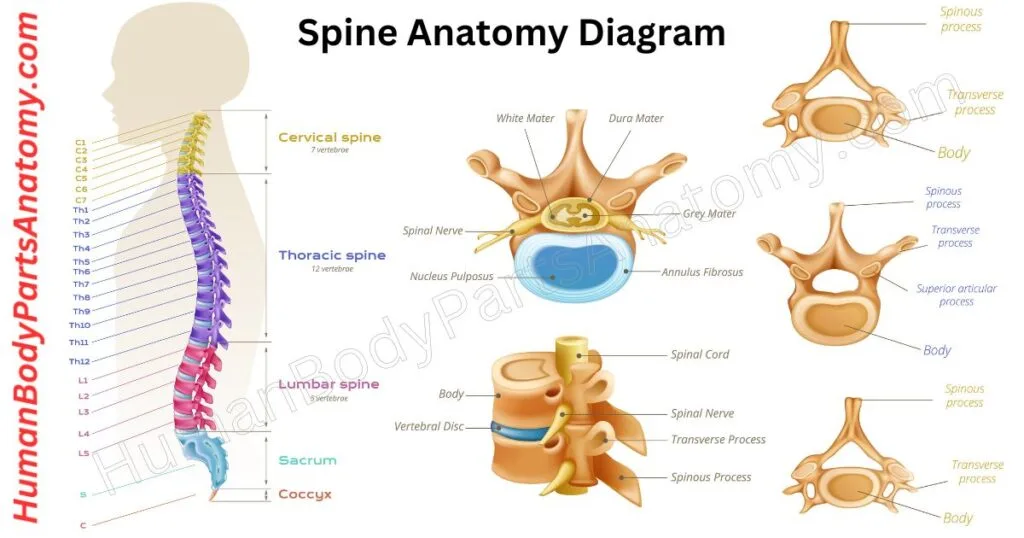
The spine — also called the vertebral column or backbone — is one of the most essential structures in the human body. It serves three critical roles: protecting your spinal cord, supporting your body’s upright posture, and enabling everyday movement.
How Is the Spine Structured?
Your spine is made up of 33 small bones called vertebrae, stacked neatly on top of each other from the base of your skull to your tailbone. Between each vertebra sits a soft, rubbery pad called an intervertebral disc. These discs work like shock absorbers — cushioning impact, preventing bone-on-bone friction, and giving your spine the flexibility to bend, twist, and rotate.
Together, the vertebrae form a hollow channel called the spinal canal, which acts as a protective tunnel surrounding and shielding the delicate spinal cord and its branching nerve roots.
The Five Regions of the Spine
Vertebrae are organized into five distinct regions, each serving a specific function:
- Cervical (neck) — 7 vertebrae that support the head and enable neck movement
- Thoracic (mid-back) — 12 vertebrae that anchor the rib cage and protect chest organs
- Lumbar (lower back) — 5 large vertebrae that bear most of the body’s weight
- Sacral (pelvic area) — 5 fused vertebrae that connect the spine to the hips
- Coccygeal (tailbone) — 4 small fused vertebrae that provide a base for pelvic floor muscles
What Does the Spine Actually Do?
Beyond structure, the spine plays a direct role in your quality of life. It keeps your body balanced while standing, walking, or running.
Spine allows you to bend forward to tie your shoes, twist to look over your shoulder, and carry heavy loads. It also transmits nerve signals between the brain and the rest of the body — making it critical for sensation and muscle control.
When the spine is healthy, most people never think about it. But injuries, poor posture, or degenerative conditions like herniated discs or spinal stenosis can quickly impact mobility and overall well-being.
Read More – Spine Anatomy: Complete Guide with Parts, Names, Functions & Diagram
Hip Bone
The hip — medically called the coxa — is one of the most important joints in the human body. It supports your body weight, keeps you balanced, and makes everyday movements like walking, running, and sitting possible.
Where Is the Hip Located?
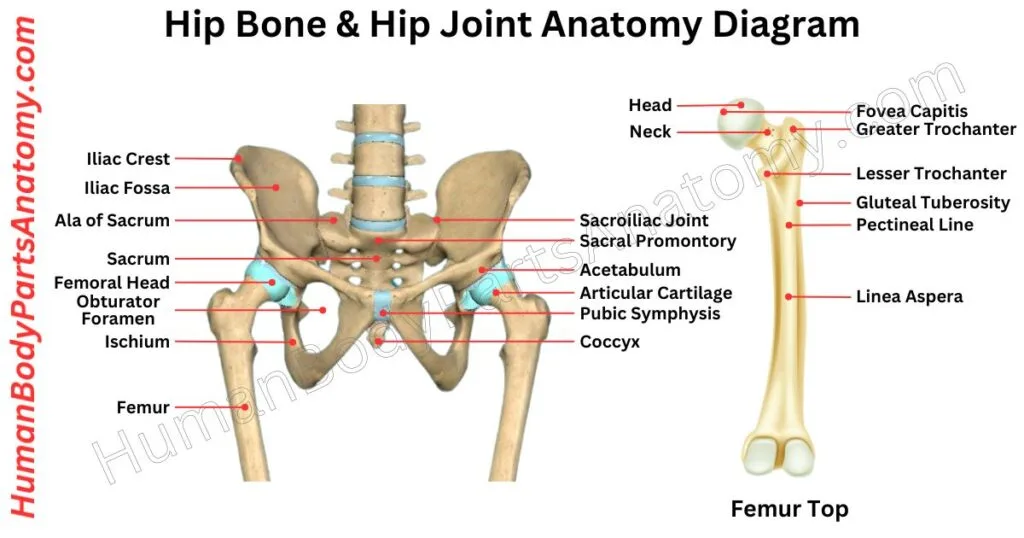
Your hip sits on the outer side of your pelvis, slightly toward the front and side of your buttocks. It rests just below the iliac crest — the curved upper edge of your pelvic bone — and near a large pelvic opening called the obturator foramen.
What Makes Up the Hip?
The hip is built for both strength and movement. It is surrounded by powerful muscles, ligaments, tendons, and soft tissues that protect a bony landmark on your upper thigh bone called the greater trochanter. These structures work together to keep the joint stable while allowing a wide range of motion.
In adults, the hip bone is formed by three bones — the ilium, ischium, and pubis — that fuse together over time. They form a deep, cup-shaped socket known as the acetabulum, which cradles the rounded head of the femur (thigh bone) to create the hip joint.
Why Is Hip Health Important?
Your hips carry your entire upper body weight with every step you take. When something goes wrong — whether it is hip pain, arthritis, a stress fracture, or a muscle strain — it can quickly affect your mobility and quality of life.
Understanding basic hip anatomy makes it easier to recognize early warning signs, communicate with your doctor, and take steps to protect your long-term joint health.
Read More – Hip Bone Anatomy: Complete Guide with Parts, Names, Functions & Diagram
Auditory Ossicles (Middle Ear) – 6 Bones
Deep inside your middle ear sit three of the tiniest bones in the human body — the malleus, incus, and stapes. Together, they form a miniature chain that links your eardrum to the inner ear.
Despite their incredibly small size, these three bones — known as the auditory ossicles — are essential to how you hear every sound around you.
The Malleus (Hammer) — First in Line
The malleus is the first bone in the chain and the one directly attached to the eardrum. Its nickname, “the hammer,” comes from its shape.
Key facts about the malleus:
- Its long handle is firmly connected to the eardrum.
- Its rounded head sits in a small cavity called the epitympanic recess.
- It links directly to the incus, passing vibrations forward.
When your eardrum moves, the malleus moves with it — kicking off the entire hearing process.
The Incus (Anvil) — The Middle Link
Positioned between the malleus and stapes, the incus is called “the anvil” because of its shape. It acts as the essential connector between the two other bones.
What makes up the incus:
- A central body that attaches to the malleus
- One limb that anchors to the back wall of the middle ear for stability
- Another limb that connects to the stapes, passing the vibrations along
Without the incus, the sound signal would have no bridge to cross.
The Stapes (Stirrup) — The Smallest Bone in the Human Body
The stapes holds a remarkable record: it is the smallest bone in the entire human body. Shaped like a tiny riding stirrup, it completes the ossicle chain with precision.
Structure of the stapes:
- A head that connects to the incus
- Two thin arms that form the stirrup shape
- A flat base called the footplate, which rests against the oval window
When the stapes vibrates, its footplate gently presses on the oval window — sending sound energy into the fluid-filled cochlea of the inner ear, where hearing signals are generated and sent to the brain.

Read More – Ultimate Guide to Ear Anatomy: Parts, Structure, Functions & Diagram
Hyoid Bone
The hyoid bone is a small, U-shaped bone located at the front of your neck. It sits just below your lower jaw and above your larynx (voice box). You can actually feel it yourself — simply place your fingers where your chin meets your neck and swallow. That subtle movement you feel? That’s your hyoid bone.
Why Is the Hyoid Bone Unique?
The hyoid is unlike any other bone in the human body. It does not directly connect to any other bone. Instead, it is held in place by a network of muscles, ligaments, and cartilage. This is why it is often called the body’s only “floating bone.”
What Does the Hyoid Bone Do?
The hyoid bone plays a key role in three essential functions: speaking, swallowing, and breathing. It acts as an anchor point and provides support for several important structures in your head and neck, including your:
- Tongue
- Throat
- Voice box (larynx)
- Epiglottis (the flap that keeps food out of your airway)
- Muscles in the floor of your mouth
Without the hyoid, these everyday actions would not be possible.
Parts of the Hyoid Bone
The hyoid bone has three main parts:
1. Body (Central Section) This is the middle portion of the bone. The front surface is slightly rounded and curves outward, while the back surface curves inward.
2. Greater Horns Two long extensions that project backward and outward from each side of the body. They serve as attachment points for many important neck muscles, making them critical for movement and stability.
3. Lesser Horns Two smaller projections located near the top of the bone, close to where the greater horns begin. They point upward and slightly backward toward the base of the skull. A ligament called the stylohyoid ligament connects at the tip of each lesser horn, linking the hyoid to the temporal bone of the skull.
Rib Cage
The rib cage, also known as the thoracic cage, is one of the most important structures in the human body. This bony framework sits at the center of your upper body, and it does far more than most people realize — from shielding your vital organs to helping you breathe with every single breath you take.
What Makes Up the Rib Cage?
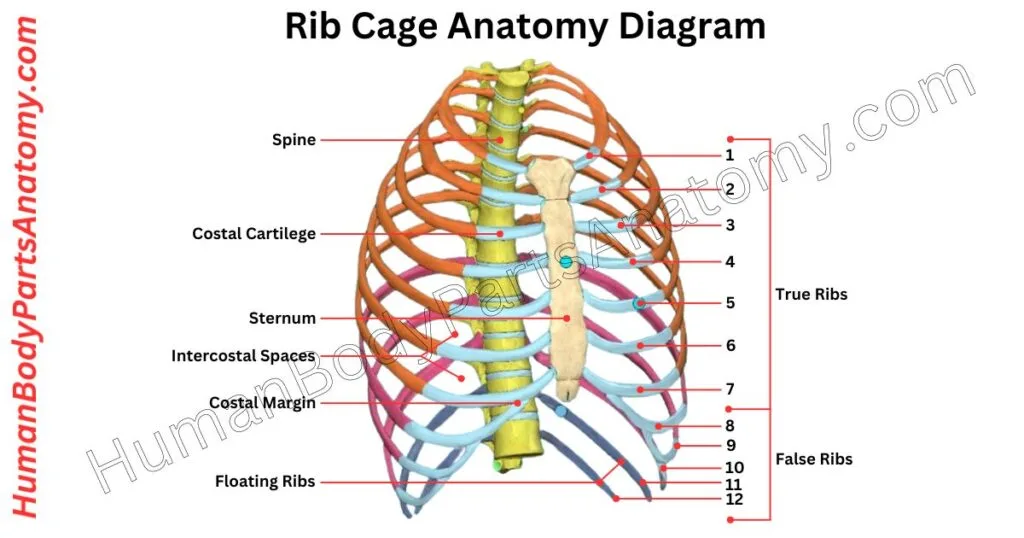
The rib cage is made up of three main components:
- 12 pairs of ribs — curved bones that form the walls of the chest
- The sternum — the flat bone running down the center of your chest
- 12 thoracic vertebrae — the section of the spine the ribs attach to at the back
Each rib connects to the spine at the back and curves forward toward the sternum. Most ribs connect to the sternum through costal cartilage — a flexible, rubbery tissue that gives the rib cage just enough give to expand and compress during breathing.
What Does the Rib Cage Do?
The rib cage serves several critical functions:
- Protects Vital Organs- It shields the heart, lungs, and major blood vessels from injury — acting like a natural armor for the body’s most essential systems.
- Supports Breathing- The ribs expand outward when you inhale and contract when you exhale, helping the lungs draw in oxygen and release carbon dioxide efficiently.
- Supports the Shoulder Girdle- The rib cage provides structural support for the shoulders, enabling a full range of arm movement.
- Anchors Key Muscles- Muscles in the neck, back, chest, and abdomen all attach to the rib cage, making it a central hub for movement, stability, and posture.
Why Is the Rib Cage Important?
The rib cage is uniquely designed to be both strong and flexible. This combination enables it to absorb impact and protect delicate organs while still allowing for free movement with every breath you take. Without it, normal functions like breathing, lifting, and even standing upright would not be possible.
Read More – Rib Cage Anatomy: Complete Guide with Parts, Names, Functions & Diagram
Sternum
The sternum, commonly called the breastbone, is a flat, narrow bone running vertically down the center of your chest. It serves as the front anchor of the rib cage, connecting with the ribs and collarbone to form a protective shield around your vital organs.
Understanding the sternum’s structure can help you better recognize chest pain, injuries, or medical procedures that involve this area.
The Three Parts of the Sternum
The sternum is made up of three distinct sections, each with a specific role:
1. Manubrium (Top Section) The manubrium is the broad, upper portion of the sternum. At the very top, you can feel a small indentation called the suprasternal notch — that slight hollow at the base of your throat.
On each side, the manubrium connects to the collarbones (clavicles), forming the sternoclavicular joints, which are the only bony joints linking your arms to the rest of your skeleton.
2. Body (Middle Section) Also called the gladiolus, the body is the longest part of the sternum. It runs down the center of the chest and provides attachment points for the cartilages of ribs 3 through 7.
Where the manubrium and body meet, you’ll find a slight outward ridge known as the sternal angle, or angle of Louis — a landmark doctors and nurses use to locate the second rib and count down to other ribs during physical exams.
3. Xiphoid Process (Bottom Section) The xiphoid process is the small, triangular tip at the bottom of the sternum. It’s the softest and most flexible part, especially in children, and it gradually hardens with age.
Its size and shape vary from person to person. This section serves as an attachment point for the diaphragm and some abdominal muscles, playing a quiet but important role in breathing and core stability.
Why Is the Sternum Important?
The sternum’s primary job is protection. It forms the front wall of the thoracic cavity, shielding the heart, lungs, and major blood vessels from external impact. It also plays a structural role in breathing, moving slightly with each breath as the rib cage expands and contracts.
In medical settings, the sternum is central to procedures like CPR chest compressions and open-heart surgery, where surgeons split it (a procedure called a sternotomy) to access the chest cavity.

Shoulder
Your shoulder is one of the most complex and mobile joints in the human body. It is made up of five major bones that work together to support movement, stability, and strength.
Understanding these bones can help you recognize common shoulder problems, including injuries from falls, accidents, and conditions such as arthritis.
1. Scapula (Shoulder Blade)
The scapula, commonly referred to as the shoulder blade, is a large, flat, triangular bone situated on the upper back. It serves as an anchor point for 17 different muscles, making it one of the most muscular bones in the body.
Most of the shoulder’s range of motion actually occurs between the scapula and the chest wall. The scapula is a key component of the shoulder girdle — a network of bones, muscles, and ligaments that work together to allow your arm to move freely in all directions.
2. Clavicle (Collarbone)
The clavicle, or collarbone, is a long, slender bone that runs horizontally between the shoulder and the chest. It acts as the structural link connecting the arm to the rest of the body.
The clavicle has a joint at each end, and both of these joints are prone to developing arthritis over time. It is also one of the most commonly broken bones from falls or direct impact.
3. Acromion
The acromion is a flat, bony extension that projects from the top of the scapula. It forms the highest point of the shoulder and gives it that characteristic square, rounded shape.
The acromion also forms the roof of the shoulder joint, protecting the rotator cuff tendons beneath it. When the space under the acromion narrows, it can lead to a painful condition called shoulder impingement syndrome.
4. Coracoid Process
The coracoid process is another bony projection that extends from the scapula, pointing forward toward the front of the body. While it may be small, it plays a critical role in shoulder stability.
Several important muscles and ligaments attach to the coracoid process, helping to support the collarbone, the shoulder joint, and the upper arm bone (humerus). It also serves as an attachment point for the short head of the biceps muscle.
5. Glenoid Cavity (Shoulder Socket)
The glenoid cavity is the shallow, cup-shaped socket of the shoulder’s ball-and-socket joint. The rounded head of the humerus (upper arm bone) fits into this socket to create the shoulder joint.
Because the socket is relatively shallow, the shoulder relies heavily on surrounding muscles, tendons, and ligaments for stability. Any irregularities in the glenoid cavity — such as damage from injury or wear — can cause joint instability.
In some cases, this leads to a painful, limiting condition known as frozen shoulder (adhesive capsulitis), where the joint stiffens and movement becomes difficult.

Arm & Forearm Bones
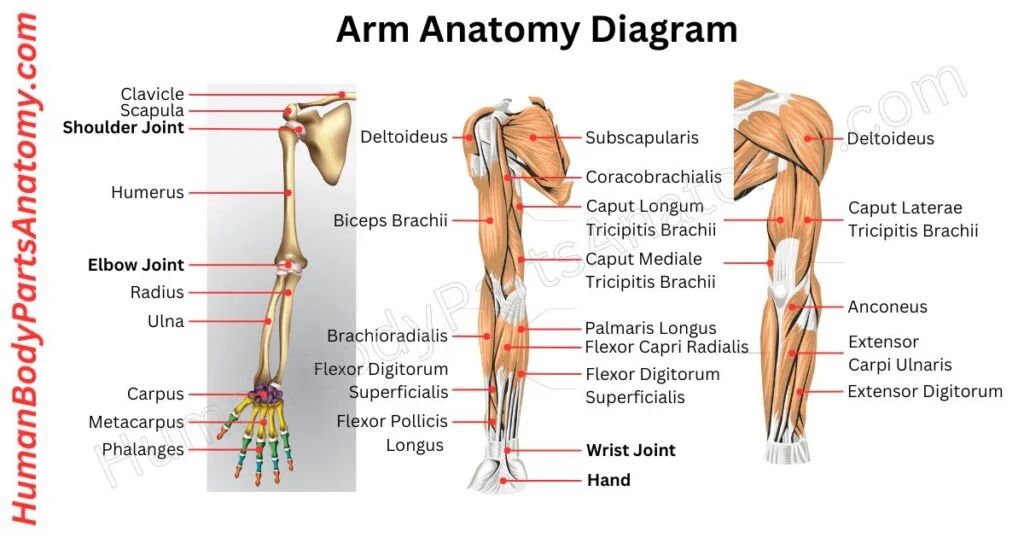
Your arm is made up of three major bones that work together to give you strength, flexibility, and a wide range of motion. These bones are the humerus (upper arm), the radius, and the ulna (both in the forearm). Understanding what each bone does can help you make sense of arm injuries, pain, and treatment options.
1. Humerus: The Upper Arm Bone
The humerus is the long bone that runs from your shoulder down to your elbow. At the top, it forms the “ball” part of your shoulder’s ball-and-socket joint — known medically as the glenohumeral joint. This design allows your arm to move in nearly every direction.
At the lower end, the humerus connects to the two forearm bones to form the elbow joint. Many important muscles and ligaments attach along the length of the humerus. It includes some that extend all the way down into your hand, and power your grip and finger movements.
In most cases, the humerus only becomes a medical concern when it breaks. Humerus fractures can happen in several different locations along the bone — near the shoulder, in the middle of the shaft, or near the elbow. Each type may require a different treatment approach, ranging from a sling or cast to surgery.
Read More – Comprehensive Guide to Arm Anatomy: Parts, Names & Diagram
2. Radius
The radius is one of the two bones in your forearm. It sits on the thumb side near the hand but is always located on the outer side of the elbow.
One of the radius’s most unique features is that it can rotate. When you turn your palm up or down, the radius actually twists around the other forearm bone, the ulna.
At the elbow, the radius forms part of a complex joint with the humerus. It functions almost like a small ball-and-socket joint where the radius acts as the socket.
At the other end, the radius plays a major role in forming the wrist joint. It bears a significant portion of the force that travels from your hand up through your arm.
The radius and ulna are connected to each other at both the elbow and wrist through cartilage joints, and they are further stabilized by multiple ligaments along the length of the forearm.
3. Ulna
The ulna is the second forearm bone, running along the pinky-finger side of your arm. Unlike the radius, the ulna does not rotate — it stays in a fixed position regardless of how you turn your hand, anchoring the forearm and providing stability.
At the elbow, the ulna forms a hinge-type joint with the humerus. You can feel this joint working every time you bend and straighten your arm. The bony point you feel at the back of your elbow is actually part of the ulna, called the olecranon.
At the wrist, the ulna has a smaller contact area with the wrist bones compared to the radius. So it generally bears less of the load from hand and wrist movements. Still, it plays an important role in wrist stability.
Like the radius, the ulna is connected to the forearm through cartilage joints at both ends and a series of ligaments running the full length of the forearm.
Broken ulnas are a common injury, often occurring alongside radius fractures, particularly from falls or direct impacts.
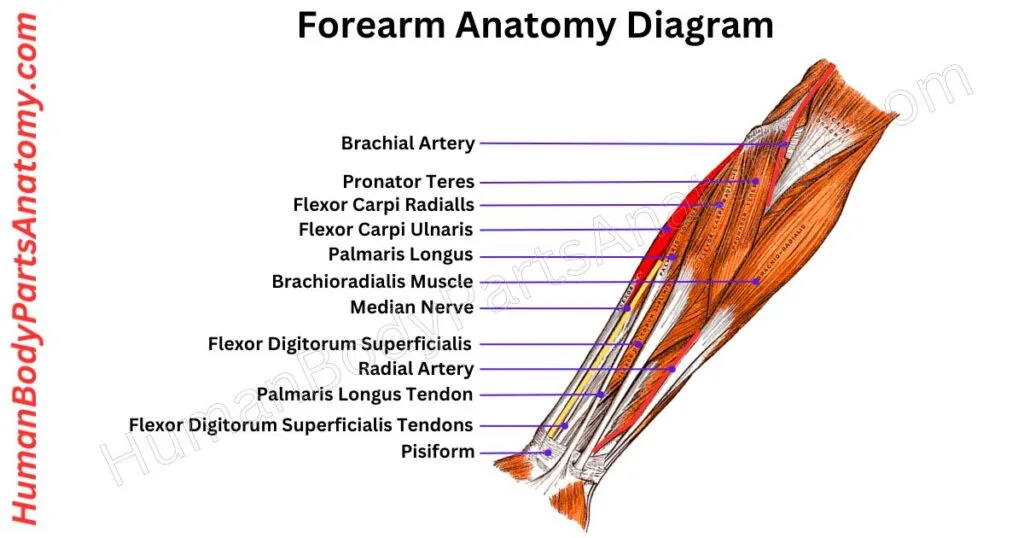
Read More – Complete Guide to Forearm Anatomy: Parts, Names, Functions & Diagram
Wrist
The wrist is made up of eight small bones called carpal bones, arranged in two rows. Each bone plays a specific role in movement, stability, and load distribution. Understanding these bones helps explain why wrist injuries can be complex — and why proper diagnosis matters.
1. Scaphoid
The scaphoid is one of the most important bones in the wrist. It sits in the first row of carpal bones but acts as a bridge between both rows. It helps coordinate movement throughout the entire wrist.
Its name comes from the Greek word for “boat,” which reflects its curved, elongated shape. Most of its surface is covered in cartilage, allowing it to connect with five neighboring bones in the wrist and forearm.
The small area of bone not covered by cartilage is where ligaments attach and where blood vessels — supplied by the radial artery — enter the bone.
This blood supply is critical. When the scaphoid is fractured, blood flow can be disrupted, making healing difficult or even impossible without treatment.
Because the scaphoid is so central to wrist mechanics, a fracture that doesn’t heal properly (called a nonunion) can cause long-term pain, stiffness, and arthritis.
2. Lunate
The lunate sits in the center of the first row of wrist bones, and has a crescent shape when viewed from the side.
Like most carpal bones, the lunate is almost entirely covered in cartilage, which allows for a wide range of wrist motion. Fractures of the lunate are uncommon, but it is frequently involved in wrist dislocations.
It can also cause problems if the ulna bone (one of the two forearm bones) is longer than the radius. This can cause the ulna to repeatedly rub against the lunate, leading to a condition called ulnar impaction syndrome.
3. Triquetrum
The triquetrum is located on the pinky (small finger) side of the wrist in the first row of carpal bones. It adds stability to the wrist, increases the surface area available for weight transfer from the hand, and forms a joint with the pisiform bone directly in front of it.
Though less commonly discussed, the triquetrum plays an important role in the overall balance and strength of the wrist.
4. Trapezoid
The trapezoid is a roughly trapezoidal-shaped bone in the second row of carpal bones. Its primary function is to anchor the index finger metacarpal — the long bone running to your index finger — firmly in place.
The trapezoid is one of the least commonly injured wrist bones, largely due to its protected central position.
5. Trapezium
The trapezium is a saddle-shaped bone in the second row of carpal bones. It serves as the main connection point between the thumb metacarpal and the wrist. Its unique shape is what gives the thumb its remarkable range of motion — allowing it to rotate, flex, extend, and oppose the other fingers.
Two problems are commonly seen with the trapezium. Fractures can occur, but the most frequent issue is arthritis at the base of the thumb — a condition called basal joint arthritis or CMC (carpometacarpal) arthritis.
This is especially common in women over 40 and can cause significant pain and weakness with gripping or pinching.
6. Capitate
The capitate is the largest bone in the wrist and sits at the center of the second row of carpal bones. It connects with multiple bones in both the wrist and hand and sits directly beneath the middle finger metacarpal.
Because of its central location, the capitate contributes significantly to overall wrist motion and serves as a hub for transmitting forces across the wrist.
7. Hamate
The hamate is a large, uniquely shaped bone in the second row of carpal bones. It has an almost triangular appearance when viewed from above and supports the ring and little finger metacarpals. It also serves as an attachment point for several ligaments, including one involved in carpal tunnel syndrome.
The hamate can be injured in two distinct ways. The body of the hamate may fracture from direct trauma, such as a punch.
More distinctively, the hook of the hamate — a bony projection on the palm side — can fracture from repeated impact, such as swinging a baseball bat, golf club, or tennis racket. This type of injury is often missed on regular X-rays and may require a CT scan for diagnosis.
8. Pisiform
The pisiform is a small bone that sits on the pinky side of the wrist, embedded within the flexor carpi ulnaris tendon. It is classified as a sesamoid bone — a bone that forms inside a tendon, similar to the kneecap in the knee.
Like all sesamoid bones, the pisiform changes the direction of pull of the tendon it sits in, improving the mechanical efficiency of wrist and finger flexion. It forms a small joint with the triquetrum bone behind it.
While injuries to the pisiform are uncommon, it can fracture from a fall onto an outstretched hand or develop arthritis in its joint with the triquetrum.
Hand Bones
Your hand is made up of several groups of bones, and the metacarpals are right in the middle. These five bones sit in the palm of your hand, connecting your wrist to your fingers.
1. Metacarpal Bones
The five metacarpal bones form the core structure of the palm. Each one bridges two important joints: on the wrist side, it connects to a carpal (wrist) bone at the carpometacarpal (CMC) joint.
On the finger side, it links to the finger bones at the metacarpophalangeal (MCP) joint — the joint you know as your knuckle.
Doctors number the metacarpals 1 through 5, starting from the thumb. Like other long bones in the body, each metacarpal has three sections: the base (closest to the wrist), the shaft or body (the long middle portion), and the head (nearest the fingers).
Those rounded heads are what form the bumps you see across your knuckles when you make a fist. The first metacarpal — the one connected to your thumb — is set apart from the rest.
This separate positioning is exactly what gives your thumb its wide range of motion, including the ability to rotate and oppose the other fingers. That’s what lets you grip, pinch, and pick things up.
Metacarpals 2 through 5, on the other hand, are tightly packed together at the wrist end. This close arrangement adds stability to the hand and also has a practical benefit.
If one of these four bones fractures, the neighboring bones act like natural supports, often keeping the break from shifting out of place.
2. Phalanges
The phalanges are the small bones that make up your fingers and thumbs. Across both hands, there are 14 phalanges total — and their arrangement differs depending on which digit you’re looking at.
How Many Phalanges Does Each Finger Have?
Your thumb has just two phalanges: a proximal phalanx (closer to the palm) and a distal phalanx (at the fingertip). Each of your other four fingers has three phalanges: proximal, middle, and distal — moving from the knuckle outward to the tip.
Just like the metacarpals, each phalanx has a base, a body, and a head. The base of each phalanx sits snugly against the rounded head of the metacarpal below it, forming the knuckle joint where finger movement begins.
Femur?
The femur, commonly known as the thigh bone, is the longest and strongest bone in the human body. It is located in the upper leg, and connects the hip joint above to the knee joint below, playing a central role in nearly every movement you make.
At its upper end, the femur forms the hip joint by fitting into a cup-shaped socket in the pelvis called the acetabulum. This ball-and-socket design allows a wide range of motion, including walking, running, sitting, and rotating the leg.
At its lower end, the femur meets the tibia (shinbone) and the patella (kneecap) to form the knee joint, which supports bending and straightening of the leg.
One of the femur’s most important jobs is weight-bearing. Whether you are standing still or moving, this bone carries the full load of your upper body and distributes it evenly down to your legs and feet.
The femur also serves as a major attachment point for some of the body’s most powerful muscles, including the quadriceps, hamstrings, and glutes.
These muscles, along with key tendons and ligaments, attach directly to the femur and work together to control hip and knee movement.
Because of its size and central location, the femur is critical to mobility, stability, and overall musculoskeletal health. Injuries to the femur, such as fractures or stress injuries, can significantly impact a person’s ability to walk and perform daily activities, making proper bone health essential at every age.

Read More – Femur Anatomy: Complete Guide with Parts, Names, Functions & Diagram
What is Patella?
The patella, commonly known as the kneecap, is the largest sesamoid bone in the human body. A sesamoid bone is a small, rounded bone that forms within a tendon, and the patella sits right at the front of the knee.
Shape and Structure of the Patella
The patella has a roughly triangular shape with three distinct borders. The pointed lower tip is called the apex, and it faces downward toward the shin.
The flat upper border is known as the base, which is where the quadriceps tendon attaches. The two side edges make up the medial (inner) and lateral (outer) borders.
The bone has two main surfaces:
- Front surface (anterior): This side sits just under the skin, which is why you can easily feel your kneecap when you press on the front of your knee.
- Back surface (posterior): This side faces inward toward the knee joint. It contains two smooth, cartilage-covered areas called articular facets — one on the inner side and one on the outer side. These facets connect with the rounded ends (condyles) of the femur, or thigh bone, forming a joint called the patellofemoral joint.
The back surface of the patella is covered in some of the thickest cartilage in the entire body. It helps to handle the significant pressure placed on the knee during everyday activities like walking, climbing stairs, and squatting.
What Does the Patella Do?
The patella plays a critical role in improving the efficiency of the knee. It acts as a pivot point that shifts the patellar tendon away from the knee’s central joint. This increases the length of the lever arm, which is the mechanical distance over which the muscle force acts.
By increasing this distance, the patella amplifies the force your thigh muscles apply when straightening the leg. Without the kneecap, your quadriceps muscles would need to work significantly harder to extend the knee.
Studies suggest the patella increases the mechanical advantage of the quadriceps by up to 50%, making everyday movements far more energy-efficient.
The patella also protects the knee joint from direct impact and reduces friction between the tendon and the femur as the knee bends and straightens.
Why the Patella Matters for Your Health
Because the patella is under constant stress, it is a common site for knee problems. Conditions like patellar tendinitis (jumper’s knee), chondromalacia patellae (softening of the cartilage behind the kneecap), and patellar dislocation are among the most frequent knee complaints seen by orthopedic doctors in the U.S.
Keeping the quadriceps and surrounding muscles strong is one of the best ways to protect the kneecap and maintain healthy knee function long-term.
What is Tibia?
The tibia, commonly known as the shin bone, is one of the most important bones in the human body. It plays a central role in how you stand, walk, run, and move every day.
The tibia is the second-longest bone in the body, right behind the femur (thigh bone). In most adults, it measures around 15 inches (38 centimeters). Despite being a weight-bearing bone that handles significant daily stress, it’s also one of the strongest bones in your body.
What Does the Tibia Do?
The tibia serves several critical functions:
- Weight-bearing: It supports your entire body weight whenever you’re standing or moving.
- Stabilization: It helps keep your body balanced and stable during physical activity.
- Joint connection: It bridges your knee and ankle joints, enabling coordinated leg movement.
- Muscle attachment: Muscles, tendons, and ligaments in your leg, knee, and ankle all anchor to the tibia.
Where Is the Tibia Located?
You have one tibia in each leg. It’s the larger of the two lower-leg bones, positioned toward the front and inner side of your leg. The other bone, the fibula (calf bone), runs alongside it on the outer edge.
The tibia extends from just below your knee all the way down to your ankle joint.
What Does the Tibia Look Like?
The tibia has three distinct sections, each with a specific role:
1. Proximal Aspect (Upper End) – This is the top portion of the tibia, located just beneath the knee. It forms a wide, flat surface — almost like a shelf — that supports the knee joint. It includes the medial condyle, lateral condyle, and intercondylar eminence.
2. Shaft (Middle Section) – The long, triangular midsection of the bone. This is what forms the visible ridge of your shin and carries most of your body weight. It includes structures like the anterior border, posterior surface, soleal line, and lateral border.
3. Distal Aspect (Lower End) – The bottom portion of the tibia connects to the fibula and the talus bone, forming the ankle joint. It also sits above the heel bone (calcaneus). This section includes the medial malleolus — the small bony bump you can feel on the inner side of your ankle — and the fibular notch.
What Is the Fibula?
The fibula is the calf bone — the slender, smaller bone running along the outer side of your lower leg. It works alongside the tibia (shinbone), the larger bone beside it, to give your lower leg its shape and strength. Together, these two bones form the structural foundation of everything below your knee.
While the fibula may be smaller, it plays a surprisingly important role. It anchors key muscles and tendons, stabilizes the ankle joint, and connects critical ligaments from the knee down through the lower leg.
Because the fibula bears less weight than the tibia or femur (thigh bone), it’s actually more vulnerable to fractures.
What Does the Fibula Do?
The fibula serves several essential functions in your lower body:
- Provides structure to the outer calf and lower leg
- Stabilizes the ankle joint, forming the bony bump you feel on the outside of your ankle (called the lateral malleolus)
- Supports muscles and tendons that control foot and ankle movement
- Anchors knee ligaments to the lower leg, helping maintain joint stability
- Assists with weight distribution during walking, running, and other activities
Where Is the Fibula Located?
The fibula is positioned on the outer (lateral) side of your lower leg, running from just below the knee all the way down to the ankle. It sits parallel to and slightly behind the tibia. While the tibia is the primary weight-bearing bone, the fibula provides crucial support and balance to the entire lower leg.
What Does the Fibula Look Like?
The fibula has three main parts:
- The head — a slightly rounded, wedge-shaped top end that meets the tibia just below the knee
- The shaft — a long, narrow middle section that runs the length of the lower leg
- The lateral malleolus — the notched lower end that forms the outer part of your ankle joint
How Big Is the Fibula?
The fibula is the third-longest bone in the human body, after the femur and the tibia. In most adults, the fibula measures approximately 14 inches (about 35 cm) in length. The plural form of fibula is fibulae.
Foot Bones
The foot is the part of your lower limb that sits below the ankle joint. It is one of the most complex structures in the human body — built specifically to support your body weight, absorb impact, and help you move efficiently.
The skin on top of the foot (the dorsal side) is soft and flexible, while the skin on the bottom (the plantar side) is thick, tough, and tightly attached to a strong band of tissue called the plantar aponeurosis, which supports the arch of the foot.
How Many Bones Are in the Foot?
The human foot contains 26 bones — that’s roughly 25% of all the bones in your entire body. These bones are organized into three main groups: tarsal bones, metatarsals, and phalanges.
1. Metatarsals (The Forefoot)
The 5 metatarsals are long, slender bones that make up the middle section of the foot, connecting the tarsal bones to the toes. They are numbered 1 through 5, starting from the big toe side. These bones play a key role in weight distribution when you walk or stand.
2. Phalanges (The Toe Bones)
The toes contain 14 phalanges in total. Most toes have three phalanges each — a proximal (base), middle, and distal (tip) bone. The big toe (hallux) is the exception, with only two phalanges: a proximal and a distal bone.
- Sesamoid Bones — Two small, pea-shaped bones found beneath the big toe joint, embedded within a tendon. Though tiny, they reduce friction and help tendons move smoothly, making push-off during walking and running more efficient.
Ankle Bones (Tarsal Bones)
The tarsus is a group of 7 bones that make up the back portion of the foot. Together, these tarsal bones give your foot its structure, support the arches that help you walk and run, and serve as key anchoring points for the muscles of your leg and foot.
The seven tarsal bones are the calcaneus, talus, navicular, cuboid, and three cuneiform bones (medial, intermediate, and lateral).
1. Talus
The talus is the bone that links your leg to your foot. On its upper and outer sides, it joins with the tibia and fibula to form the talocrural joint, which is your ankle joint.
Underneath, it connects to the calcaneus to form the subtalar joint and to the navicular bone to form the talocalcaneonavicular joint. The talus also plays a role in supporting the medial longitudinal arch — one of the primary weight-bearing arches of the foot.
2. Calcaneus
The calcaneus is the largest tarsal bone and is commonly known as the heel bone. It connects to the talus, navicular, and cuboid bones, forming the subtalar, talocalcaneonavicular, and calcaneocuboid joints.
Because of its position, the calcaneus helps support both the medial and lateral longitudinal arches of the foot, making it essential for balance and shock absorption during movement.
3. Navicular Bone
It is shaped like a small boat. The navicular bone sits between the talus behind it and the three cuneiform bones in front of it. It also sits on the inner (medial) side, next to the cuboid.
This placement allows it to form several joints, including the cuneonavicular, cuboideonavicular, and talocalcaneonavicular joints. The navicular is a key building block of the medial longitudinal arch of the foot.
4. Cuboid Bone
The cuboid bone is found on the outer (lateral) edge of the foot, in the far row of tarsal bones. It sits just behind the 4th and 5th metatarsal bones, in front of the calcaneus, and to the outer side of the navicular and cuneiform bones.
As a result, it forms four joints: the tarsometatarsal, calcaneocuboid, cuboideonavicular, and cuneocuboid joints. Because of its position on the outer edge, the cuboid contributes to the lateral longitudinal arch of the foot.
5. Three Cuneiform Bones
The cuneiform bones are three wedge-shaped bones named for where they sit: medial (inner), intermediate (middle), and lateral (outer). All three connect to the navicular bone at the back and to their corresponding metatarsal bones at the front.
They also connect to each other, forming the tarsometatarsal, cuneonavicular, cuneocuboid, and intercuneiform joints. The cuneiform bones support both the medial longitudinal arch and the transverse arch — the arch that runs across the width of your foot.
FAQ’s-
The adult human body contains 206 bones, organized into the axial skeleton (80 bones) and the appendicular skeleton (126 bones). Newborns have roughly 270–300 bones that gradually fuse into the adult count by early adulthood (ages 18–25). Minor variations — such as extra sesamoid or sutural bones — can occur in a small percentage of people but do not alter the established baseline of 206.
The human skeleton is divided into two main divisions: the axial skeleton (80 bones), which forms the central axis of the body and includes the skull, vertebral column, and thoracic cage; and the appendicular skeleton (126 bones), which comprises the limbs along with the pectoral and pelvic girdles that connect them to the axial skeleton. Together, these two divisions account for all 206 bones in the adult body.
The axial skeleton (80 bones) runs along the body’s central axis — the skull, spine, and rib cage — and primarily protects vital organs and supports the head and trunk. The appendicular skeleton (126 bones) includes the limbs and their connecting girdles, and is built for movement and locomotion. While the axial skeleton is largely protective and relatively fixed, the appendicular skeleton is highly mobile and designed for a wide range of physical activity.
Bones are classified into five types based on shape: long bones (e.g., femur, humerus), short bones (e.g., carpal and tarsal bones), flat bones (e.g., skull, sternum, ribs), irregular bones (e.g., vertebrae, sphenoid), and sesamoid bones (e.g., patella). Each type is structurally adapted to its specific mechanical role — from bearing weight and enabling movement to protecting organs and reducing tendon friction.
The skeletal system performs six major functions: structural support, organ protection, enabling movement via muscle-bone leverage, mineral storage (99% of the body’s calcium and 85% of its phosphorus), hematopoiesis (blood cell production in red bone marrow), and energy storage in yellow bone marrow. These roles make the skeleton a metabolically active, continuously remodeling organ system — not merely a passive framework.
A newborn has approximately 270 to 300 bones, compared to 206 in a fully developed adult. The higher count in infants reflects separate bone segments and cartilage that gradually harden and fuse through a process called ossification, which continues until approximately ages 18–25. Notable examples include the skull’s fontanelles, the sacrum’s five separate vertebrae, and the three-part hip bone — all of which fuse into single structures by adulthood.
The axial skeleton consists of 80 bones along the body’s central vertical axis, divided into three regions: the skull (28 bones — 8 cranial, 14 facial, 6 ear ossicles), the vertebral column (26 bones — 7 cervical, 12 thoracic, 5 lumbar, sacrum, coccyx), and the thoracic cage (25 bones — 1 sternum and 24 ribs), plus the hyoid bone (1). This framework protects the brain, spinal cord, heart, and lungs, and anchors the muscles of the neck, back, and chest.