📅 Published on August 27, 2026 | 🕒 Last Reviewed & Updated on October 1, 2026
Knee pain is a common problem that can affect people of all ages. It may develop from a minor injury, overuse, a sports-related strain, or health conditions such as osteoarthritis. Some cases improve with home care, including rest, ice, gentle activity, and over-the-counter pain relievers. However, knee pain that follows a significant injury, causes swelling or instability, or continues for several days should be evaluated by a healthcare provider. [1] Getting the right diagnosis can help identify the underlying cause and guide appropriate treatment before the problem becomes worse.
What Is Knee Pain?
Knee pain is aching, soreness, or discomfort that develops in or around the knee joint. The exact location and type of pain may provide clues about its possible cause. It can result from an injury, repeated stress, inflammation, arthritis, or problems involving the ligaments, tendons, cartilage, muscles, or bones around the knee.[1]
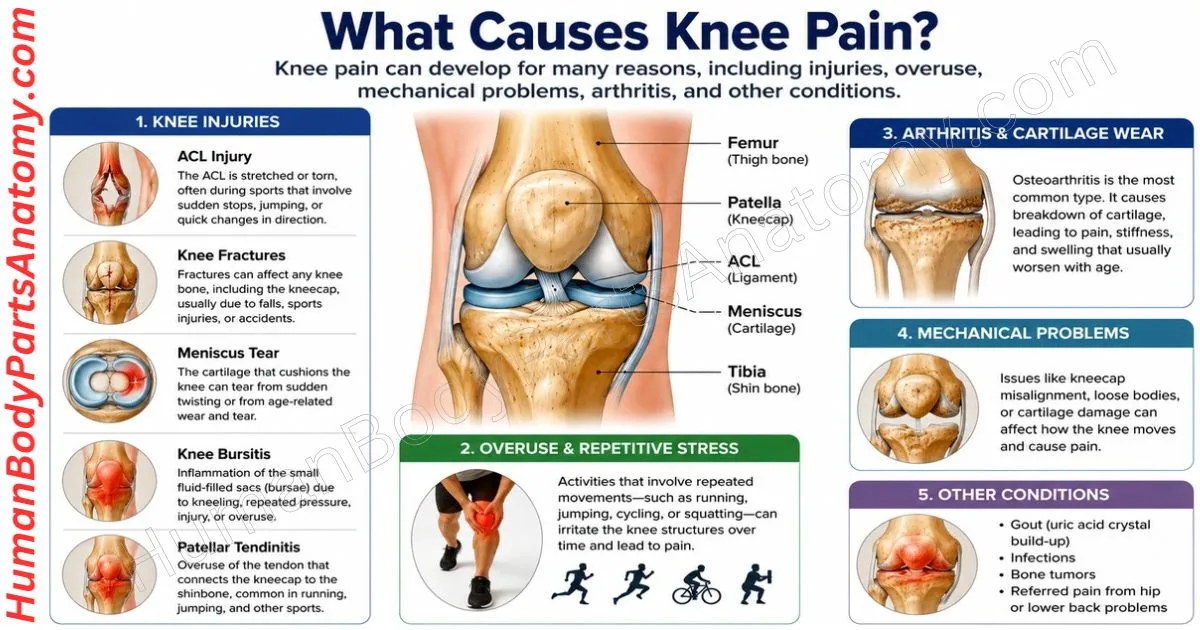
The knee is the largest joint in the body. It connects the femur (thigh bone) to the tibia (shin bone), while the patella (kneecap) sits at the front of the joint, protecting the surface of the thigh bone and giving the thigh muscles leverage to straighten the leg. Because the knee supports much of your body weight and is used for walking, standing, running, squatting, and climbing stairs, it is exposed to considerable stress.[2]
Knee pain can be acute (short-term) or chronic (long-term):
- Acute knee pain: This develops suddenly and usually lasts for a short period. It may occur after a fall, sports injury, sudden twisting motion, or overuse.[3] Sprains, strains, and other recent injuries can cause acute pain.[1]
- Chronic knee pain: This continues for weeks or longer and tends to build gradually, typically through repetitive overload rather than a single event.[3] Arthritis, cartilage wear, previous knee injuries, and certain long-term joint conditions are common causes of ongoing knee discomfort.[4]
The symptoms of knee pain can vary depending on the underlying problem. Some people notice pain only when moving or putting pressure on the knee, while others may experience discomfort even when sitting or resting. Pain can also change throughout the day. Morning stiffness may occur with some knee conditions, while soreness can become more noticeable at night after a physically active day.[4][5]
Common Symptoms of Knee Pain
Knee pain may occur along with:[1]
- Swelling or puffiness around the knee
- Stiffness or difficulty fully bending or straightening the leg
- Tenderness when touching the joint
- Weakness or reduced stability
- Clicking, popping, or grinding sensations
- A feeling that the knee may buckle or give way
- Difficulty walking, squatting, kneeling, or climbing stairs
Mild knee pain caused by temporary overuse may improve with rest, limiting activities that worsen symptoms, applying ice, and using appropriate over-the-counter (OTC) pain relievers.[1] However, severe pain, substantial swelling, difficulty walking, inability to bear weight, or symptoms that persist or worsen should be evaluated by a healthcare professional.[1]
What Causes Knee Pain?
Knee pain can develop for many reasons, including injuries, overuse, mechanical problems, arthritis, and other conditions.[1] Injuries may affect the bones, cartilage, ligaments, tendons, or bursae—the small fluid-filled sacs that help reduce friction around the knee joint.[5]
1. Knee injuries –
ACL Injury – An anterior cruciate ligament (ACL) injury occurs when this important ligament is stretched or torn. The ACL connects the thighbone (femur) to the shinbone (tibia) and helps keep the knee stable. ACL tears are common in sports that involve sudden stops, jumping, or rapid changes in direction, such as soccer, basketball, football, and skiing.[6]
Knee Fractures – A fracture can affect any of the bones that make up the knee, including the kneecap (patella).[1] Falls, sports injuries, and car accidents can cause knee fractures.[3] People with weakened bones, such as those affected by osteoporosis, may also be at greater risk of fractures from relatively minor movements or falls.[7]
Meniscus Tear – The menisci are two pieces of tough cartilage that sit between the thighbone and shinbone. They act as cushions and help absorb shock during movement. A meniscus tear may occur when the knee twists suddenly while the foot remains planted. Tears can also develop with less force as people get older, because the meniscus becomes more brittle with age. Symptoms can include pain, swelling, stiffness, or a catching or locking feeling in the knee.[8]
Knee Bursitis – Knee bursitis develops when a bursa becomes irritated and swollen. Bursae are small sacs filled with fluid that help reduce friction between bones, tendons, muscles, and skin. Frequent kneeling, repeated pressure, direct blows, or overuse can trigger bursitis. The affected area may feel sore, swollen, or tender to touch.[5]
Patellar Tendinitis – Patellar tendinitis is an overuse injury involving the tendon that connects the kneecap to the shinbone. This tendon plays an important role in straightening the knee and helps with running, jumping, and kicking.[9] Repeated stress can cause small amounts of tendon damage, leading to pain just below the kneecap; despite the traditional name, current evidence describes this as a degenerative tendon condition rather than an inflammatory one. This condition is more common among runners, skiers, and athletes involved in jumping activities.[10]
The exact cause of knee pain can sometimes be difficult to identify because several conditions may produce similar symptoms. Persistent pain, repeated swelling, knee instability, or difficulty walking should be assessed by a qualified healthcare professional.[1]
2. Mechanical Problems That May Lead to Knee Pain
Problems that affect the structure or movement of the knee can sometimes trigger pain and difficulty with everyday activities. Some mechanical causes of knee pain include:
Loose pieces inside the joint – An injury or long-term wear can sometimes separate a small piece of cartilage or bone from the joint surface.[4] This fragment may remain unnoticed while moving freely inside the knee. If it becomes lodged between the joint surfaces, it can suddenly interfere with movement and cause pain, catching, clicking, or locking.[11]
Iliotibial band irritation – The iliotibial (IT) band is a strong strip of tissue that runs along the outside of the thigh from the hip toward the knee. Repeated bending and straightening of the knee can irritate this tissue, especially when it becomes tight. The result is often aching or sharp pain along the outer side of the knee. Runners, cyclists, and people involved in repetitive lower-body activities are more likely to develop this problem.[12]
Kneecap dislocation – The patella, or kneecap, normally moves within a groove at the front of the knee. A sudden twist, awkward landing, or direct impact can push it out of its normal position, most often toward the outside. This can cause severe pain, swelling, and difficulty bearing weight or moving the leg. A kneecap that remains displaced needs prompt medical assessment.[13] The knee should still be examined even if the kneecap slips back into place on its own, because the dislocation can damage bone, cartilage or ligaments.[14]
Pain originating from the hip or foot – The knee does not work in isolation. Discomfort or restricted movement in the hip or foot can cause you to alter the way you stand and walk. This compensation may change the forces passing through the knee and gradually place extra strain on the joint, leading to pain.[4]
Mechanical knee problems can produce symptoms such as stiffness, clicking, catching, limited movement, or a sense that the knee may give way.[1] Finding the underlying cause can help guide the right treatment and prevent the problem from getting worse.
3. Types of Arthritis
Arthritis is a broad term for conditions that cause inflammation, pain, stiffness, or changes in the joints. More than 100 types of arthritis have been identified, but only a few commonly affect the knee. Each type has different causes and may require a different approach to treatment.[15]
Osteoarthritis – Osteoarthritis is the most common form of arthritis in the knee.[16] It occurs when the cartilage that cushions the joint gradually breaks down. As the cartilage becomes thinner, movement can become painful and stiff.[4] Age, previous knee injuries, obesity, and long-term stress on the joint can increase the likelihood of developing osteoarthritis.[17]
Rheumatoid Arthritis – Rheumatoid arthritis is an autoimmune condition that causes the immune system to attack healthy tissue around the joints. It can affect one or both knees and may also involve other joints. knee symptoms can include swelling, tenderness, warmth, and prolonged stiffness, particularly after periods of inactivity. Symptoms often vary over time, with flare-ups followed by periods of improvement.[18]
Gout – Gout develops when excess uric acid forms crystal deposits inside a joint.[19] Although the big toe is the most commonly affected area, gout can also occur in the knee.[20] A flare-up can cause intense pain that develops suddenly, along with swelling, redness, and significant tenderness.[19]
Pseudogout – Pseudogout occurs when calcium pyrophosphate crystals accumulate inside a joint. It can closely resemble gout, but the underlying crystal type is different. The knee is a common location for pseudogout, which may cause sudden swelling, pain, warmth, and difficulty moving the joint.[21]
Septic Arthritis – Septic arthritis is a joint infection caused by bacteria or other microorganisms. It can lead to rapid swelling, severe pain, warmth, redness, and restricted knee movement. Fever or chills may also occur. Because the infection can quickly damage the joint, suspected septic arthritis requires immediate medical attention.[22]
Other Conditions That Can Cause Knee Pain
Patellofemoral Pain Syndrome – Patellofemoral pain syndrome refers to pain that develops around or behind the kneecap. It commonly affects runners, athletes, and active young adults, especially when the kneecap does not move smoothly along its normal track. In older adults, pain in this area can sometimes be associated with wear and tear of the joint behind the kneecap. Activities such as running, squatting, going up or down stairs, or sitting for extended periods may make symptoms worse.[9]
Knee pain does not always mean you have arthritis. Injuries, tendon problems, cartilage damage, infections, and other conditions can produce similar symptoms. A healthcare professional can identify the underlying cause and recommend the most appropriate treatment.[1]
Risk factors
Certain lifestyle, physical, and work-related factors can make knee pain or injury more likely. Knowing these risks can help you protect your knees and support better joint health.
Being overweight — Extra body weight places additional load on the knees every time you walk, climb stairs, or perform other daily activities.[1] Over time, this added pressure can increase joint wear and raise the risk of knee osteoarthritis.[17]
Weak or inflexible muscles — The muscles around your hips, thighs, and knees help keep the joint stable during movement. When these muscles are weak or tight, the knee may have less support and be more vulnerable to strain, pain, and injury.[9] Regular strengthening and stretching can improve stability and movement.[23]
High-impact sports and activities — Running, jumping, twisting, and sudden changes in direction can put significant stress on the knee. Activities such as basketball, skiing, soccer, and jogging may increase the chance of injuries, particularly when the body is not properly conditioned.[3][6]
Physically demanding jobs — Work that involves repeated kneeling, squatting, lifting, climbing, or prolonged standing can place ongoing stress on the knees.[15] People working in construction, farming, and other physically demanding occupations may have a higher risk of developing knee problems over time.[24]
Previous knee injury — An earlier knee injury can make the joint more susceptible to future problems.[17] Incomplete recovery, reduced muscle strength, or lingering instability may increase the risk of reinjury. Following a proper rehabilitation program can help restore strength and improve knee stability.[3]
Other contributing factors — Age, poor exercise technique, sudden increases in physical activity, and certain health conditions can also affect knee health.[17] Maintaining a healthy weight, staying physically active, and using proper form during exercise can help reduce unnecessary stress on the knees.[17]
Prevention of Knee Pain
Not all knee problems can be avoided, but you can take practical steps to lower your risk of knee injuries, pain, and long-term joint damage. Maintaining a healthy weight, building strong leg muscles, using proper exercise techniques, and choosing activities that suit your fitness level can all help protect your knees.[17]
Maintain a Healthy Weight — Keeping your weight within a healthy range can reduce the amount of pressure placed on your knees during walking, climbing stairs, and exercise.[1] Extra weight can increase stress on the knee joint and may contribute to wear and tear over time. Regular physical activity and a balanced diet can support healthy weight management.[17]
Condition Your Body Before Sports — Do not jump into intense sports or workouts without preparing your body. Begin with a gentle warm-up and gradually increase the intensity of your activity.[1] Sport-specific conditioning can help your muscles and joints handle movements such as running, jumping, pivoting, and sudden changes in direction.[3]
Focus on Proper Form — The way you move during exercise can affect the amount of stress placed on your knees. Use proper technique when lifting weights, running, jumping, or performing other physical activities.[13] A qualified trainer, coach, or physical therapist can help you identify and correct poor movement patterns.
Build Strong Supporting Muscles — Strong muscles around the knee can improve joint support and stability. Exercises that strengthen the quadriceps, hamstrings, glutes, and core can help your knees handle everyday activities and exercise more efficiently.[9] Adding balance and stability exercises may further improve control and coordination.[23]
Keep Your Muscles Flexible — Limited flexibility can change normal movement and place extra strain on the knee.[9] Include gentle stretching exercises in your regular routine to maintain flexibility in your thighs, hips, calves, and other lower-body muscles. Stretching after a warm-up can help improve your range of motion.[1]
Choose Low-Impact Activities When Needed — People with persistent knee pain, osteoarthritis, or previous knee injuries may benefit from exercises that place less stress on the joints. Swimming, water exercise, cycling, and walking are often easier on the knees than activities involving repeated jumping or hard impact.[1][25] You may also need to reduce high-impact workouts when your symptoms flare up.
Increase Exercise Slowly — Avoid making sudden changes to your workout routine. Increasing exercise duration, intensity, or frequency too quickly can overload the muscles and joints.[3] Gradually increasing your activity gives your body time to adapt and may reduce the chance of overuse injuries.[12]
Listen to Knee Pain — Pain, swelling, stiffness, or a feeling of instability should not be ignored, especially when these symptoms continue or repeatedly return. Modifying an activity and seeking medical advice when necessary can help prevent a minor problem from becoming a more serious knee condition.[1]
A consistent exercise routine, healthy body weight, proper technique, and appropriate recovery can help keep your knees stronger and more functional over time.
When Should You See a Doctor for Knee Pain?
Many cases of knee pain improve with rest, activity modification, and basic home care. However, certain symptoms may indicate a more serious injury or medical condition and should be evaluated by a doctor. Seek medical attention if you experience any of the following:[1]
Difficulty Walking or Bearing Weight — See a doctor if knee pain makes it difficult to walk, put weight on your leg, or stand normally. A feeling that the knee may give way or suddenly buckle can also indicate an underlying problem.[1]
Significant or Persistent Swelling — Sudden swelling, swelling that keeps coming back, or swelling that does not improve may be linked to an injury, inflammation, or damage inside the knee joint.[1]
Limited Knee Movement — If you cannot fully bend or straighten your knee, especially after an injury, you may have a problem involving the ligaments, cartilage, meniscus, or other joint structures.[1][8]
Changes in Knee Shape or Alignment — A knee that appears deformed, out of alignment, or visibly different after an injury requires prompt medical evaluation. This may be a sign of a fracture, dislocation, or another serious injury.[1]
Fever Along With Knee Pain — Knee pain combined with fever, redness, warmth, or swelling can be a warning sign of a joint infection. Because infections can damage the joint quickly, seek medical care promptly.[22]
Symptoms in the Calf Below the Knee — Pain, swelling, numbness, tingling, or bluish discoloration in the calf below a sore knee should be assessed promptly, as these symptoms can point to a problem separate from the knee itself, such as a blood clot.[1]
Severe Pain After an Injury — Get evaluated after a significant fall, collision, twist, or sports injury, particularly if you hear a popping sound, develop rapid swelling, or cannot use the leg normally.[8]
Pain That Does Not Improve — Even without a major injury, persistent or worsening knee pain that interferes with walking, sleep, work, or everyday activities should be checked by a healthcare professional. Contact a provider if pain is still present after about three days of home treatment. [1]
Early evaluation can help identify the cause of knee pain and determine the right treatment before the problem becomes more difficult to manage.
FAQ’s –
If knee pain is new and not severe, self-care is reasonable at first — but contact your provider if it is still there after three days of home treatment. Do not wait that long if you cannot bear weight, the knee is deformed, it buckles or locks, you cannot straighten it, or there is a lot of swelling.[1]
Rest the knee and avoid the activities that hurt, apply ice, keep the knee raised to bring down swelling, and consider an elastic bandage or sleeve for support. Ibuprofen or naproxen help with pain and swelling; acetaminophen helps pain but not swelling. Check with your provider first if you have other medical problems or have been taking them more than a day or two. Sleeping with a pillow under or between the knees can also ease things.[1]
Knee pain often develops with no specific injury behind it. Common non-traumatic causes include osteoarthritis, rheumatoid arthritis, gout, a Baker cyst, bursitis from repeated kneeling or pressure, tendinitis following a change in activity, patellofemoral (anterior) knee pain, and less commonly an infection in the knee joint or surrounding bone. Being overweight and overusing the knee both raise the risk.[1]
References –
- U.S. National Library of Medicine, NIH. Knee pain. MedlinePlus Medical Encyclopedia. Last reviewed 7 November 2024. https://medlineplus.gov/ency/article/003187.htm
- Gupton M, Imonugo O, Black AC, Launico MV, Terreberry RR. Anatomy, Bony Pelvis and Lower Limb, Knee. StatPearls [Internet]. NCBI Bookshelf, NLM, NIH. Updated 5 November 2023. NBK500017. PMID: 29763193.
- NIAMS, NIH. Sports Injuries: Types, Symptoms & Risk Factors. Last reviewed June 2025. https://www.niams.nih.gov/health-topics/sports-injuries
- NIAMS, NIH. Osteoarthritis: Symptoms, Causes & Risk Factors. Last reviewed June 2025. https://www.niams.nih.gov/health-topics/osteoarthritis
- U.S. National Library of Medicine, NIH. Bursitis. MedlinePlus Medical Encyclopedia. Last reviewed 27 August 2024. https://medlineplus.gov/ency/article/000419.htm
- U.S. National Library of Medicine, NIH. Anterior cruciate ligament (ACL) injury. MedlinePlus Medical Encyclopedia. Accessed 24 August 2026. https://medlineplus.gov/ency/article/001074.htm
- NIAMS, NIH. Osteoporosis: Causes, Risk Factors & Symptoms. Last reviewed June 2025. https://www.niams.nih.gov/health-topics/osteoporosis
- U.S. National Library of Medicine, NIH. Meniscus tears — aftercare. MedlinePlus Medical Encyclopedia. Last reviewed 4 June 2025. https://medlineplus.gov/ency/patientinstructions/000684.htm
- U.S. National Library of Medicine, NIH. Anterior knee pain. MedlinePlus Medical Encyclopedia. Last reviewed 16 November 2025. https://medlineplus.gov/ency/article/000452.htm
- Mabrouk A, Lee CM, Sherman AL. Patellar Tendinopathy (Jumper’s Knee). StatPearls [Internet]. NCBI Bookshelf, NLM, NIH. Updated 26 February 2026. NBK532969. PMID: 30422564.
- Osteochondritis Dissecans of the Knee. StatPearls [Internet]. NCBI Bookshelf, NLM, NIH. Updated 25 January 2024. NBK538194. https://www.ncbi.nlm.nih.gov/books/NBK538194/
- U.S. National Library of Medicine, NIH. Iliotibial band syndrome — aftercare. MedlinePlus Medical Encyclopedia. Accessed 24 August 2026. https://medlineplus.gov/ency/patientinstructions/000683.htm
- U.S. National Library of Medicine, NIH. Kneecap dislocation. MedlinePlus Medical Encyclopedia. Last reviewed 7 November 2024. https://medlineplus.gov/ency/article/001070.htm
- Overview: Dislocated kneecap. InformedHealth.org [Internet]. Institute for Quality and Efficiency in Health Care (IQWiG). NCBI Bookshelf, NLM, NIH. NBK561511. https://www.ncbi.nlm.nih.gov/books/NBK561511/
- Centers for Disease Control and Prevention. Arthritis Basics. Last reviewed 2025. https://www.cdc.gov/arthritis/basics/index.html
- U.S. National Library of Medicine, NIH. Knee Injuries and Disorders. MedlinePlus Health Topic. Accessed 24 August 2026. https://medlineplus.gov/kneeinjuriesanddisorders.html
- Centers for Disease Control and Prevention. Osteoarthritis (OA). Last reviewed 2026. https://www.cdc.gov/arthritis/osteoarthritis/index.html
- NIAMS, NIH. Rheumatoid Arthritis: Symptoms, Causes & Risk Factors. Last reviewed June 2025. https://www.niams.nih.gov/health-topics/rheumatoid-arthritis
- NIAMS, NIH. Gout: Symptoms, Causes & Risk Factors. Last reviewed June 2025. https://www.niams.nih.gov/health-topics/gout
- U.S. National Library of Medicine, NIH. Gout. MedlinePlus Health Topic. Accessed 24 August 2026. https://medlineplus.gov/gout.html
- U.S. National Library of Medicine, NIH. Calcium pyrophosphate arthritis (pseudogout). MedlinePlus Medical Encyclopedia. Last reviewed 31 March 2024. https://medlineplus.gov/ency/article/000421.htm
- U.S. National Library of Medicine, NIH. Septic arthritis. MedlinePlus Medical Encyclopedia. Accessed 24 August 2026. https://medlineplus.gov/ency/article/000430.htm
- U.S. National Library of Medicine, NIH. Joint Disorders. MedlinePlus Health Topic. Accessed 24 August 2026. https://medlineplus.gov/jointdisorders.html
- Wang X, Perry TA, Arden N, Chen L, Parsons CM, Cooper C, Gates L, Hunter DJ. Occupational Risk in Knee Osteoarthritis: A Systematic Review and Meta-Analysis of Observational Studies. Arthritis Care Res (Hoboken). 2020 Sep;72(9):1213–1223. PMID: 32638548. DOI: 10.1002/acr.24333.
- Guglielmo D, Murphy LB, Theis KA, et al. Walking and Other Common Physical Activities Among Adults with Arthritis — United States, 2019. MMWR Morb Mortal Wkly Rep. 2021 Oct 8;70(40):1408–1414. PMID: 34618794. DOI: 10.15585/mmwr.mm7040a3.
Read More-
Pain Management –
- Lower Back Pain: An Overview of Types, Risk Factors, and When to Seek Medical Care
- Lower Back Pain in Women: Why It Affects Women Differently — Causes, Symptoms, Treatment & Prevention
- Lower Back Pain Treatments: Effective Relief Options, Tests & Expert Tips
- Lower Back Pain Causes & Symptoms: Common Reasons & Risk Factors
- RICE Method For Injuries – Rest, Ice, Compression & Elevation
- 13 Best Exercises for Knee Pain: Step-by-Step Guide with Images
- 15 Effective Home Remedies for Knee Pain with Pictures That Actually Work
- Knee Pain Relief: 9 Proven Ways to Reduce Pain and Support Recovery
Diagnostic Testing –
- PET Scan vs CT Scan: What’s the Difference and Which One Do You Need?
- CT Scan vs. MRI Scan: Key Differences, Uses, and Which One You Need
- What is Magnetic Resonance Angiography (MRA): Uses, Types & Risks
- MRA vs MRI: Key Differences, Uses, and Which Scan You Need
Medical Disclaimer
All content on HumanBodyPartsAnatomy.com is educational and based on verified, peer-reviewed medical sources. Articles are authored or reviewed by qualified medical or biomedical professionals to ensure accuracy.
This website does not provide medical advice, diagnosis, or treatment. Always consult a licensed healthcare professional for personal medical guidance.
No commercial or promotional interests influence the medical content published on this site.