
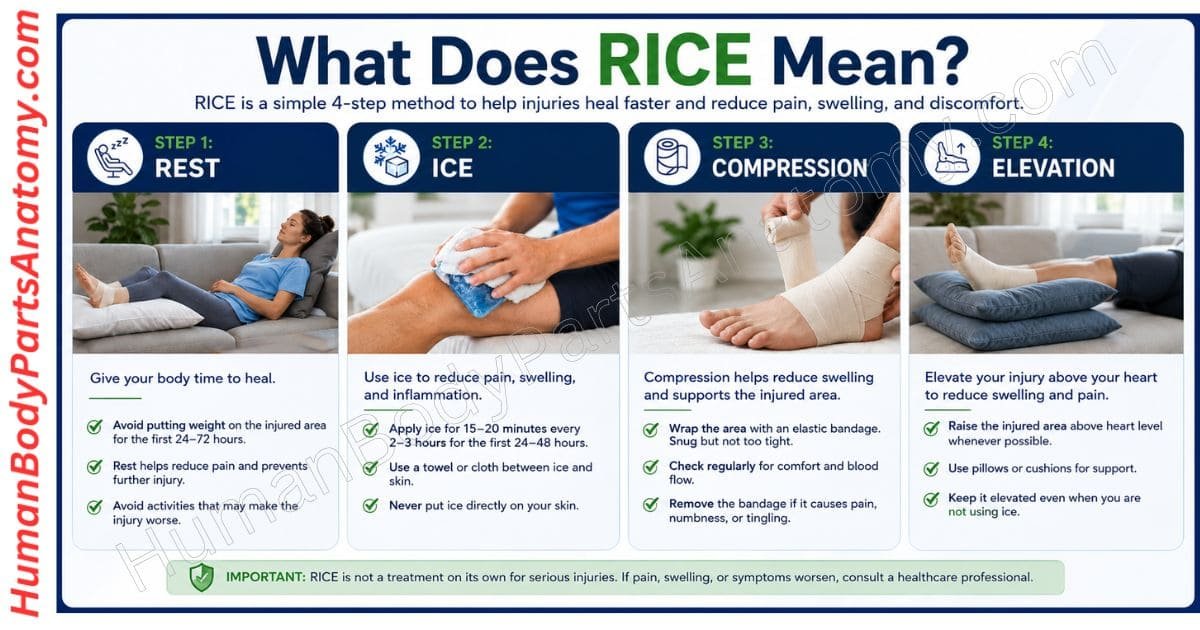
📅 Published on August 14, 2026 | 🕒 Last Reviewed & Updated on October 1, 2026
The RICE method is a first-aid approach for many muscle, ligament, tendon, and joint injuries, including sprains and strains.[1] RICE stands for Rest, Ice, Compression, and Elevation. The four steps aim to reduce pain and swelling and protect the injured area while healing begins.[1][2]
RICE is used mainly in the first 24 to 48 hours.[3] After that, the focus shifts to restoring movement and strength, because early functional rehabilitation produces better outcomes than prolonged rest.[8] Seek medical attention promptly if you have severe pain, a visibly deformed limb or joint, numbness or tingling, or you cannot move or bear weight on the injured area.[1][7]
What is R.I.C.E Method?
RICE is self-care for recent, minor soft tissue injuries — sprains, strains, and bruises. A sprain is an injury to the ligaments around a joint; a strain is a muscle stretched too far so that part of it tears.[1][2]
It is intended for new injuries, not for problems that build up over time. Conditions caused by repeated motion, such as tendinitis and bursitis, may get short-term relief from ice and rest, but they need the underlying activity addressed — reducing or stopping the motions causing symptoms, along with rest breaks and often physical therapy.[6]
RICE is not a substitute for assessment when an injury may be serious. Fractures, dislocations, complete ligament tears, and severe pain need prompt medical evaluation.[7]
What the evidence actually shows?
RICE has never been validated as a package by high-quality trials. A systematic review of 11 randomised and quasi-randomised trials involving 868 patients found insufficient randomised evidence to determine the relative effectiveness of RICE therapy for acute ankle sprains in adults, and concluded that treatment must be individualised.[11]
The four components are not equally well supported, and expert sources genuinely disagree about ice — that disagreement is set out in the Ice section below rather than smoothed over. The acronym has also been revised over time. Current clinical guidance for ankle sprains frames acute care as POLICE — protection, optimal loading, ice, compression, and elevation — replacing undifferentiated “rest” with graded loading.[8]
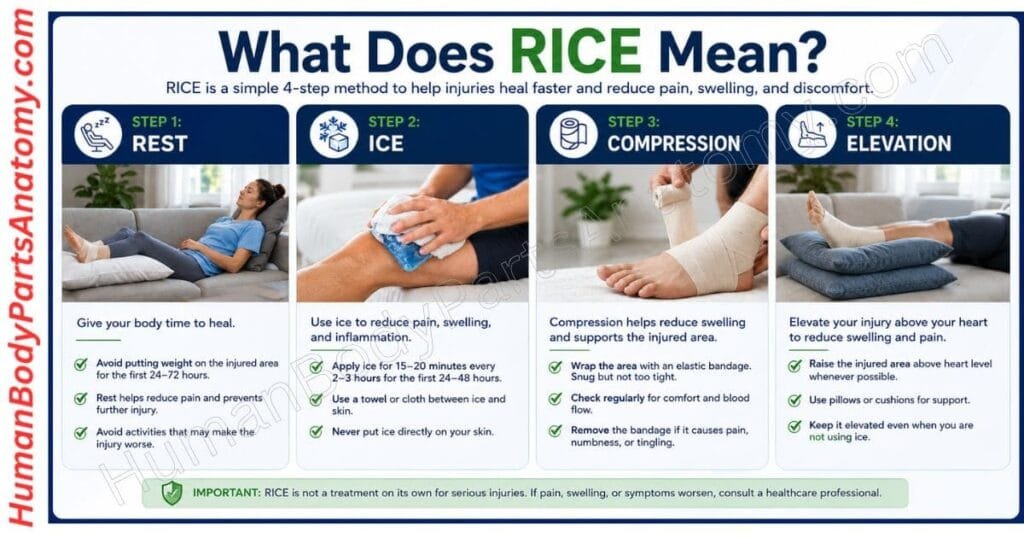
What does RICE (Rest, Ice, Compression, Elevation) mean?
Step 1: Rest
Stop the activity that caused the injury and avoid movements that reproduce your pain.[1] During the acute phase, the first one to three days, protect the joint and refrain from painful activity.[8]
“Rest” no longer means immobilisation. Substantial evidence supports functional rehabilitation over extended immobilisation. A short period of immobilisation may help a severe sprain — a grade III ankle sprain may benefit from up to 10 days in a cast or walking boot — but immobilisation beyond that is discouraged, because prolonged immobilisation causes weakness and stiffness without improving long-term outcomes.[8] Lighter protection, such as a semi-rigid brace, plus early motion, is preferred as soon as it is safe.[8]
Early range-of-motion exercises should begin once pain and swelling start to subside, typically within the first three to seven days depending on severity. Patients who start functional rehabilitation early return to work or sport sooner than those immobilised for longer.[8]
For a sprained ankle specifically, pain and swelling most often improve within about 48 hours, after which you can begin putting weight back on the foot — as much as is comfortable, stopping to rest if it hurts.[3]
Step 2: Ice
What ice reliably does: relieve pain. Beyond that, authoritative sources differ, and it is worth knowing why.
Clinical guidance for acute ankle sprain holds that cold therapy combined with compression should be started immediately, that these measures help limit swelling and reduce pain, and that cryotherapy in the acute stage is supported by strong evidence for improving short-term outcomes.[8] A detailed review of the cryotherapy literature reaches a narrower conclusion: in humans the primary demonstrated benefit is reduced pain, while reductions in metabolism, inflammation, and tissue damage have been shown in animal models of muscle injury without comparable human evidence — partly because standard ice-pack applications are too brief to cool deep tissue for long.[12]
Both can be true at once: ice is well supported for short-term symptoms, and less well supported as something that speeds biological healing. Neither source recommends against icing a fresh injury.
Using ice safely. Wrap an ice pack, or a bag of frozen vegetables, in a thin towel before it touches skin.[1] Never apply ice directly to bare skin, and never fall asleep with an ice pack in place — left on too long it can cause frostbite.[4][5]
How often and how long. Published schedules vary by injury:
| Injury | Icing schedule |
|---|---|
| Muscle strain | 10–15 minutes every hour on day 1, then every 3–4 hours; ice for the first 3 days [2] |
| Ankle sprain | 20 minutes every hour while awake for the first 24 hours, then 20 minutes 3–4 times daily, with at least 30 minutes between applications [3] |
| Knee injury | Up to 15 minutes every hour on day 1, then at least 4 times daily [4] |
| Foot sprain | 20 minutes, 2–3 times daily [9] |
Ice first, heat later. Use ice for the first three days. After three days, either heat or ice may help if you still have pain.[2]
If pain or swelling worsens, or symptoms do not improve after a few days, seek medical advice.[4]
Step 3: Compression
Compression with an elastic bandage or sleeve, applied together with cold therapy immediately after injury, helps limit swelling and reduce pain.[8] Wrap firmly, but not tightly — a wrap that causes pain or restricts circulation is too tight.[1]
Leave the fingers or toes below the wrap uncovered and check them regularly. Loosen the bandage immediately if they become numb or tingly, feel cold, become increasingly discoloured, or change in sensation.[3] Seek medical attention right away if this does not resolve after loosening, or if you develop severe pain: pale or blue skin, numbness or tingling, and loss of pulse indicate inadequate circulation.[7]
Step 4: Elevation
Raise the injured part above the level of your heart. Elevating an injured ankle above heart level, particularly in the first 48 hours, helps reduce swelling.[8] For a sprained ankle, lie down or sit with the foot on pillows at or above heart level.[3] For an injured arm or wrist, rest it on pillows. Keep a swollen joint raised whenever you can, including while sleeping.[1]
What Types of Injuries Can You Treat with the RICE Method?
The RICE method (Rest, Ice, Compression, and Elevation) is one of the most effective first-aid treatments for minor soft tissue injuries. It helps reduce pain, swelling, and inflammation while giving the injured area time to heal. RICE works best when started within the first 24 to 72 hours after an injury.
You can use the RICE method for the following injuries:
Sprains
Ligaments are strong, flexible fibres that hold bones together. When one is stretched too far or tears, the area around the joint becomes painful and swells.[1] Sprains commonly affect the ankle, wrist, thumb, and knee.
Ankle sprains are graded by severity:[8]
| Grade | Ligament damage | Typical presentation | Recovery |
|---|---|---|---|
| I (mild) | Slight stretching, microscopic tearing | Mild tenderness, minimal swelling, no instability; weight-bearing possible | 1–2 weeks |
| II (moderate) | Incomplete tear | Moderate pain, swelling, bruising; some difficulty weight-bearing | 3–6 weeks |
| III (severe) | Complete rupture of one or more ligaments | Significant pain and swelling, cannot usually bear weight, evident instability | 6–12 weeks or longer |
Grade II and III sprains often involve tearing of small blood vessels, letting blood leak into tissue and causing black-and-blue discolouration. The bruising may not appear for several days and is usually reabsorbed within about two weeks.[3]
Note that most ankle sprains — including virtually all grade I and II and most grade III — are managed without surgery.[8]
Jammed Finger
A jammed finger occurs when the fingertip is struck or forced backward. Mild cases settle with rest, an ice pack wrapped in a clean cloth, and over-the-counter pain relief.[5]
Seek medical attention right away if the finger is bent and you cannot straighten it, you cannot move or feel the fingertip, the skin is cut open and bone is exposed, the injury involves a joint or the palm, or the fingernail is no longer sitting properly on the nail bed.[5] Do not splint a smashed finger without consulting a provider, and do not drain blood from under the nail unless instructed.[5]
Repetitive Strain Injuries (RSI)
Repetitive motion disorders result from too many uninterrupted repetitions of an activity, unnatural or awkward motions such as twisting the arm or wrist, overexertion, incorrect posture, or muscle fatigue. They occur most often in the hands, wrists, elbows, and shoulders, but can also affect the neck, back, hips, knees, feet, legs, and ankles.[6]
Treatment starts with reducing or stopping the motions causing symptoms and taking breaks to rest the area. Ice and pain or anti-inflammatory medication can reduce pain and swelling, splints may relieve pressure on muscles and nerves, and physical therapy may ease soreness.[6]
Minor Knee Injuries
Minor knee sprains, strains, bruises, and overuse conditions such as bursitis and tendinitis often respond to home care: rest and avoid activities that cause pain, apply ice with a towel between the ice and your skin, keep the knee raised, and wear an elastic bandage or sleeve for support.[4]
When Should You Not Use the RICE Method?
RICE is not adequate on its own for injuries needing immediate care:
- A suspected broken bone — a visibly out-of-place or misshapen limb or joint, intense pain, numbness and tingling, broken skin with bone protruding, or inability to move a limb or bear weight.[7]
- A suspected dislocated joint — hard to distinguish from a fracture; both are emergencies, and the basic first-aid steps are the same.[7]
- A complete ligament tear — a grade III sprain involves complete rupture, evident instability, and usually inability to bear weight.[8]
- A deep cut or severe soft tissue injury, particularly with heavy bleeding.[7]
- A suspected internal injury after a blow or fall to the trunk. The spleen is the most frequently injured internal organ in blunt abdominal trauma, because of its fragile structure and rich blood supply, and splenic rupture is life-threatening.[10]
- Severe swelling, visible deformity, or bleeding you cannot control.[7]
When to See a Doctor After an Injury
Many minor injuries can be treated at home using the RICE method (Rest, Ice, Compression, and Elevation). However, some injuries require medical attention to prevent complications or long-term damage. If your pain is severe, your symptoms worsen, or you are unsure about the seriousness of your injury, it is safest to seek medical care.
Foot Injury
Seek emergency care for severe pain with rapid swelling, inability to put weight on the foot, visible deformity, heavy bleeding, or bone through the skin.[7] Numbness, tingling, coldness, or colour change in the foot also needs urgent assessment.[3]
Contact your provider for a sudden increase in pain or swelling, sudden numbness or tingling, or an injury not healing as expected.[9]
Knee Injury
Seek emergency care if you may have a broken bone, the knee appears out of position, you heard or felt a pop and immediately could not use the joint, or pain is severe.[1]
Contact your provider if you cannot bear weight, have severe pain even at rest, the knee is deformed, it buckles, clicks, or locks, you cannot flex or fully straighten it, you have fever, redness, or warmth or a lot of swelling, you have pain, swelling, numbness, tingling, or bluish discolouration in the calf below the knee, or pain persists after three days of home treatment.[4]
Muscle Strain
Call your local emergency number if you cannot move the injured muscle, or the injury is bleeding.[2]
Contact your provider if pain persists after several weeks, swelling has not begun to improve within two days, or you develop signs of infection such as red, warm, painful skin or a fever above 100°F (38°C).[1][2]
Key Takeaways
The RICE method—Rest, Ice, Compression, and Elevation—has been a common first-aid treatment for minor injuries such as sprained ankles, mild muscle strains, and soft-tissue injuries. It can help reduce pain, swelling, and discomfort during the first 24 to 48 hours after an injury.
However, recent research suggests that complete rest and prolonged icing may not always be the best approach. Some healthcare experts recommend gentle movement and early rehabilitation rather than extended rest, as light activity can improve blood flow, reduce stiffness, and support faster recovery. There is also ongoing debate about using ice, as inflammation is a natural part of the body’s healing process and may help repair damaged tissues.
The best treatment depends on the type and severity of the injury. If your symptoms are mild, you can start with the RICE method while gradually returning to normal activities as your pain improves. Avoid activities that cause sharp pain or make the injury worse.
If swelling, pain, or difficulty moving the injured area does not improve within a few days, or if your symptoms become more severe, seek medical advice. A healthcare provider can check for a more serious injury, such as a fracture, torn ligament, or tendon damage, and recommend the most appropriate treatment plan.
FAQ’s-
Mainly the first 24 to 48 hours.[3] After that the priority becomes restoring motion and strength, which should begin within roughly three to seven days.[8]
Protect it, but do not immobilise it for long. Immobilisation beyond about 10 days is discouraged even for severe sprains, because it causes weakness and stiffness without improving outcomes.[8] Weight-bearing usually resumes as tolerated once pain and swelling settle, often around 48 hours.[3]
No source reviewed here advises against icing a new injury. Cold therapy in the acute stage is supported for short-term outcomes,[8] though the human evidence is strongest for pain relief specifically rather than faster tissue healing.[12] Wrap the ice, and do not fall asleep with it on.[4][5]
Use ice for the first three days. After that, either heat or ice may help if pain persists.[2]
Go to hospital if you may have a broken bone, the joint looks out of position, pain is severe, or you heard a pop and immediately could not use the joint. Contact your provider if swelling has not begun to settle within two days or pain persists for several weeks.[1]
References-
- U.S. National Library of Medicine. Sprains. MedlinePlus Medical Encyclopedia. Review date 1 April 2025. Reviewed by Linda J. Vorvick, MD, University of Washington School of Medicine, and David C. Dugdale, MD. https://medlineplus.gov/ency/article/000041.htm
- U.S. National Library of Medicine. Strains. MedlinePlus Medical Encyclopedia. Review date 1 April 2025. https://medlineplus.gov/ency/article/000042.htm
- U.S. National Library of Medicine. Ankle sprain — aftercare. MedlinePlus Medical Encyclopedia. Review date 7 October 2024. Reviewed by Jesse Borke, MD, CPE, FAAEM, FACEP. https://medlineplus.gov/ency/patientinstructions/000574.htm
- U.S. National Library of Medicine. Knee pain. MedlinePlus Medical Encyclopedia. Review date 7 November 2024. Reviewed by C. Benjamin Ma, MD, Chief, Sports Medicine and Shoulder Service, UCSF Department of Orthopaedic Surgery. https://medlineplus.gov/ency/article/003187.htm
- U.S. National Library of Medicine. Smashed fingers. MedlinePlus Medical Encyclopedia. Review date 4 June 2025. https://medlineplus.gov/ency/article/000018.htm
- National Institute of Neurological Disorders and Stroke, NIH. Repetitive Motion Disorders. Accessed 11 August 2026. https://www.ninds.nih.gov/health-information/disorders/repetitive-motion-disorders
- U.S. National Library of Medicine. Broken bone. MedlinePlus Medical Encyclopedia. Review date 8 February 2024. https://medlineplus.gov/ency/article/000001.htm
- Bergman R, Li D, Shuman VL. Acute Ankle Sprain. In: StatPearls [Internet]. Treasure Island (FL): StatPearls Publishing; 2026 Jan–. Last update 2 August 2025. NCBI Bookshelf ID NBK459212; PMID 29083595. https://www.ncbi.nlm.nih.gov/books/NBK459212/
- U.S. National Library of Medicine. Foot sprain — aftercare. MedlinePlus Medical Encyclopedia. Review date 7 November 2024. https://medlineplus.gov/ency/patientinstructions/000652.htm
- Wang CF, Launico MV. Splenic Rupture. In: StatPearls [Internet]. Treasure Island (FL): StatPearls Publishing; 2026 Jan–. Last update 9 August 2025. NCBI Bookshelf ID NBK525951; PMID 30247826. https://www.ncbi.nlm.nih.gov/books/NBK525951/
- van den Bekerom MPJ, Struijs PAA, Blankevoort L, Welling L, van Dijk CN, Kerkhoffs GMMJ. What is the evidence for rest, ice, compression, and elevation therapy in the treatment of ankle sprains in adults? J Athl Train. 2012;47(4):435–443. PMID: 22889660. DOI: 10.4085/1062-6050-47.4.14 — Systematic review, 11 trials, 868 patients. No Tier 1 source quantifies the trial evidence base for RICE as a package.
- Kwiecien SY, McHugh MP. The cold truth: the role of cryotherapy in the treatment of injury and recovery from exercise. Eur J Appl Physiol. 2021;121(8):2125–2142. PMID: 33877402. DOI: 10.1007/s00421-021-04683-8 — Invited review, Nicholas Institute of Sports Medicine and Athletic Trauma, Lenox Hill Hospital. No Tier 1 source separates human from animal evidence on cryotherapy mechanisms.
Read More-
Pain Management –
- Lower Back Pain: An Overview of Types, Risk Factors, and When to Seek Medical Care
- Lower Back Pain in Women: Why It Affects Women Differently — Causes, Symptoms, Treatment & Prevention
- Lower Back Pain Treatments: Effective Relief Options, Tests & Expert Tips
- Lower Back Pain Causes & Symptoms: Common Reasons & Risk Factors
Diagnostic Testing –
- PET Scan vs CT Scan: What’s the Difference and Which One Do You Need?
- CT Scan vs. MRI Scan: Key Differences, Uses, and Which One You Need
Medical Disclaimer
All content on HumanBodyPartsAnatomy.com is educational and based on verified, peer-reviewed medical sources. Articles are authored or reviewed by qualified medical or biomedical professionals to ensure accuracy.
This website does not provide medical advice, diagnosis, or treatment. Always consult a licensed healthcare professional for personal medical guidance.
No commercial or promotional interests influence the medical content published on this site.