Complete Guide on Human Anatomy with Parts, Names & Diagram

📅 Published on April 10, 2026 | 🕒 Last updated on April 16, 2026

Overview of Human Anatomy and Physiology

The human body comprises 206 bones, ~650 muscles, ≈78–80 organs, and an extensive network of blood arteries. Within this organized framework, a complex collaboration of individual cells is present, diligently fulfilling their unique roles to sustain life. In our body’s unique design, there are two fundamental disciplines: physiology, which tells about the inner workings of the human body, and anatomy, which explores its complex structure. Human anatomy analyzes the body’s architecture, from the tiniest cellular components to the formation of tissues, organs, and interconnected systems. By studying human body anatomy, we gain valuable insights into the construction of our bodies and the cooperative relations among its diverse components, all of which are essential for preserving life.

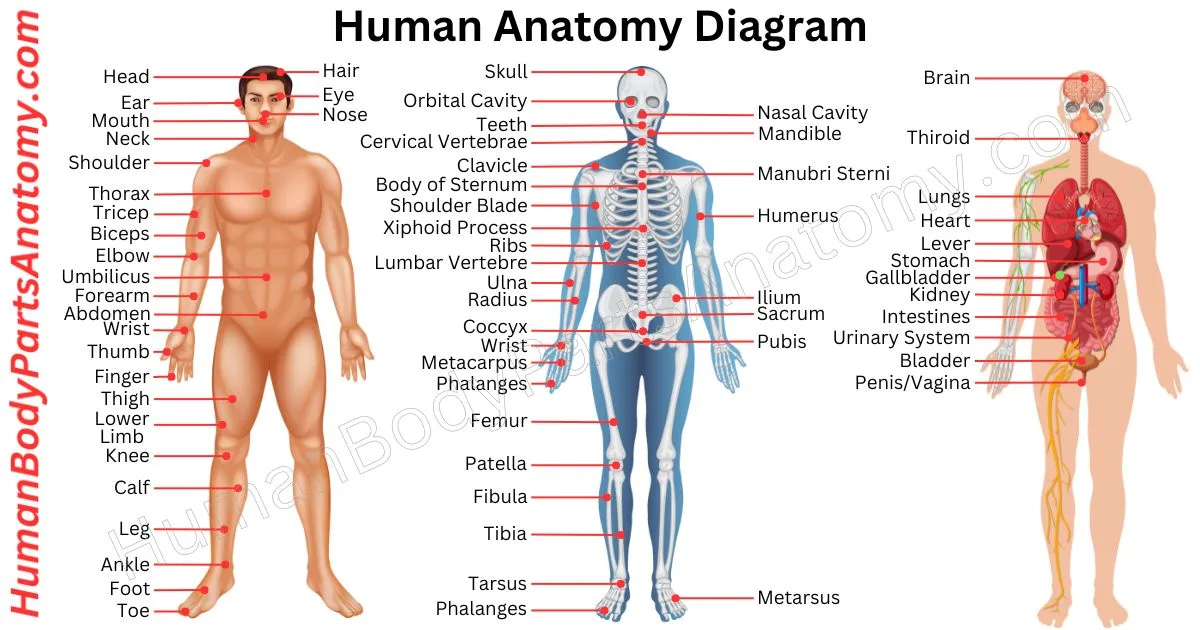
Human Anatomy Diagram

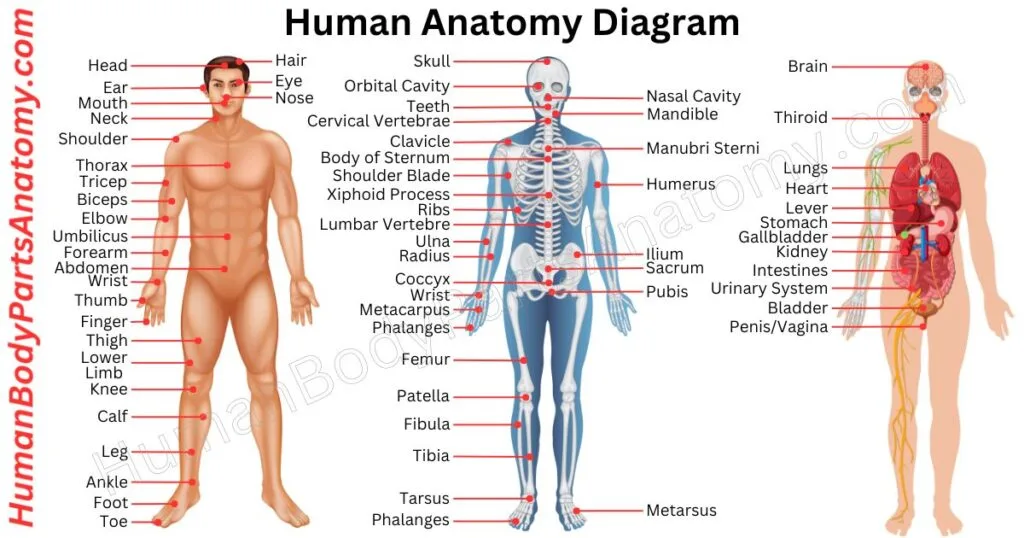
Detailed human anatomy diagram showing major human body parts with names and functions, including skeletal, muscular, and organ systems.

Human Body Parts Name

Skeletal System

  • Axial Skeleton
    • Skull
      • Cranial Bones
        • Frontal bone
        • Parietal bones (2)
        • Temporal bones (2)
        • Occipital bone
        • Sphenoid bone
        • Ethmoid bone
      • Facial Bones
        • Nasal bones (2)
        • Maxilla bones (2)
        • Zygomatic bones (2)
        • Lacrimal bones (2)
        • Palatine bones (2)
        • Inferior nasal conchae (2)
        • Vomer bone
        • Mandible
    • Hyoid Bone
    • Auditory Ossicles
      • Malleus (hammer)
      • Incus (anvil)
      • Stapes (stirrup)
    • Vertebral Column (Spine)
      • Cervical Vertebrae (7)
      • Thoracic Vertebrae (12)
      • Lumbar Vertebrae (5)
      • Sacrum (5 fused vertebrae)
      • Coccyx (3-5 fused vertebrae)
    • Ribs
      • True Ribs (1-7)
      • False Ribs (8-12)
        • Vertebrochondral Ribs (8-10)
        • Floating Ribs (11-12)
  • Sternum (Breastbone)
    • Manubrium
    • Body (gladiolus)
    • Xiphoid process
  • Thoracic cage
    • Thoracic cavity
    • Superior thoracic aperture (thoracic inlet)
    • Inferior thoracic aperture
    • Intercostal space
    • Infrasternal angle
  • Appendicular Skeleton
    • Pectoral Girdle (Shoulder Girdle)
      • Clavicle (Collarbone)
      • Scapula (Shoulder Blade)
    • Upper Limb (Arm)
      • Humerus
      • Radius
      • Ulna
      • Carpal Bones
      • Metacarpal Bones
      • Phalanges (Fingers Bones)
    • Pelvic Girdle (Hip Girdle)
      • Ilium
      • Ischium
      • Pubis
      • Acetabulum
    • Lower Limb (Leg)
      • Femur
      • Patella (Kneecap)
      • Tibia
      • Fibula
      • Tarsal Bones
      • Metatarsal Bones
      • Phalanges (Toe Bones)
  • Joints
    • Head and Neck Joints
      • Temporomandibular Joint (TMJ)
      • Atlanto-occipital Joint
    • Spinal Joints
      • Intervertebral Joints
      • Facet Joints (Zygapophyseal Joints)
      • Atlantoaxial Joint
    • Shoulder Joints
      • Glenohumeral Joint
      • Acromioclavicular Joint
      • Sternoclavicular Joint
    • Elbow Joint
      • Humeroulnar Joint
      • Humeroradial Joint
      • Proximal Radioulnar Joint
    • Wrist and Hand Joints:
      • Radiocarpal Joint
      • Intercarpal Joints
      • Carpometacarpal Joints
      • Metacarpophalangeal Joints (MCP Joints)
      • Interphalangeal Joints (IP Joints)
    • Hip Joint (Coxal Joint)
      • Acetabulofemoral Joint
    • Knee Joint
      • Tibiofemoral Joint
      • Patellofemoral Joint
    • Ankle and Foot Joints
      • Talocrural Joint (Ankle Joint)
      • Subtalar Joint
      • Midtarsal Joint (Chopart’s Joint)
      • Tarsometatarsal Joints
      • Metatarsophalangeal Joints (MTP Joints)
      • Interphalangeal Joints (IP Joints)
  • Cartilage
  • Ligaments
  • Tendons
  • Bone Marrow
  • Periosteum
  • Sesamoid Bones

Female Reproductive System

  • Ovary
    • Ligament of ovary
    • Suspensory ligament of ovary
  • Fallopian tube
  • Uterus
    • Cervix of uterus
    • Round ligament of uterus
    • Pubocervical ligament
    • Cardinal ligament
    • Uterosacral ligament
  • Va*ina
    • Hymen
    • Epoophoron
    • Paroophoron
  • Vulva
    • Mons pubis
    • Labia
  • Vestibule of the vagina
  • Bulb of the vestibule
  • Cliteris
    • Glans
    • Clitoral hood
  • Urinary meatus
    • Female urethra
  • Bartholin’s gland
  • Skene’s gland

Male Reproductive System

  • Testicle
    • Tunica vaginalis
    • Tunica albuginea
    • Seminiferous tubules
    • Straight tubules
    • Rete testis
  • Epididymis
  • Paradidymis
  • Spermatic cord
    • Cremaster
  • Vas deferens
  • Seminal vesicle
  • Seminal gland
    • Ejaculatory duct
  • Prostate
  • Bulbourethral gland
  • Penis
    • Glans
  • Foreskin
  • Body of the penis
    • Corpus cavernosum penis
    • Corpus spongiosum penis
  • Helicine arteries
  • Fascia of the penis
    • Suspensory ligament of the penis
  • Urinary meatus
    • Male urethra
  • Scrotum
    • Dartos fascia
  • Perineum
    • Perineal body
    • Subcutaneous perineal pouch
    • Superficial perineal pouch
    • Deep perineal pouch
    • Ischio-anal fossa

Sense Organs

Integumentary System

  • Skin
  • Hair
  • Nail
  • Breast
  • Subcutaneous tissue

Human Muscle Anatomy

  • Upper Body Muscles
    • Thorax Muscles
      • Pectoralis major
      • Pectoralis minor
      • Subclavius
      • Serratus anterior
      • Levatores costarum
      • External intercostal muscle
      • Internal intercostal muscle
      • Innermost intercostal muscle
      • Subcostales
      • Transversus thoracic
      • Pectoral fascia
      • Clavipectoral fascia
      • Thoracic fascia
      • Endothoracic fascia
      • Thoracic diaphragm
    • Shoulder Muscles (Deltoid Muscles)
      • Anterior Deltoid
      • Medial Deltoid
      • Posterior Deltoid
    • Upper Arm Muscles (Arm Muscles)
    • Back Muscles
      • Trapezius
      • Latissimus dorsi
      • Rhomboid major
      • Rhomboid minor
      • Levator scapulae
      • Serratus posterior inferior
      • Serratus posterior superior
      • Anterior cervical intertransversarii
      • Lateral posterior cervical intertransversarii
      • Intertransversarii laterales lumborum
      • Erector spinae
        • Erector spinae aponeurosis
        • Iliocostalis
        • Longissimus
        • Spinalis
      • Spinotransversales
        • Splenius
      • Transversospinales
        • Multifidus
        • Semispinalis
        • Rotatores
      • Interspinales
      • Intertransversarii
      • Thoracolumbar fascia
    • Neck Muscles:
      • Platysma
      • Longus colli
      • Longus capitis
      • Scalenus anterior
      • Scalenus medius
      • Scalenus posterior
      • Sternocleidomastoid
      • Suboccipital muscles
      • Suprahyoid muscles
      • Infrahyoid muscles
    • Rotator Cuff Muscles:
      • Supraspinatus
      • Infraspinatus
      • Teres Minor
      • Subscapularis
    • Abdominal Muscles (Upper Abdomen)
      • Rectus abdominis
      • Pyramidalis
      • External oblique
        • Inguinal ligament
      • Superficial inguinal ring
      • Internal oblique
        • Cremaster
      • Transversus abdominis
        • Inguinal falx
        • Deep inguinal ring
      • Linea alba
      • Linea semilunaris
      • Inguinal canal
      • Quadratus lumborum
      • Abdominal fascia
      • Pelvic fascia
      • Pelvic diaphragm
        • Levator ani
        • Ischiococcygeus
        • External anal sphincter
    • Triceps Brachii
    • Serratus Anterior
  • Lower Body Muscles
    • Hip Muscles:
      • Gluteus Maximus
      • Gluteus Medius
      • Gluteus Minimus
    • Thigh Muscles (Quadriceps)
      • Rectus Femoris
      • Vastus Lateralis
      • Vastus Medialis
      • Vastus Intermedius
    • Thigh Muscles (Hamstrings)
      • Biceps Femoris
      • Semimembranosus
      • Semitendinosus
    • Adductors (Inner Thigh Muscles):
      • Adductor Magnus
      • Adductor Longus
      • Adductor Brevis
      • Gracilis
    • Hip Flexors:
      • Iliopsoas
      • Tensor Fasciae Latae (TFL)
    • Calf Muscles:
      • Gastrocnemius
      • Soleus
      • Tibialis Posterior
    • Shin Muscles (Anterior leg)
      • Tibialis Anterior
    • Hip Rotators (Deep Muscles):
      • Piriformis
      • Gemellus Superior and Inferior
      • Obturator Internus and Externus

Alimentary System

  • Mouth
    • Oral Cavity
    • Teeth
    • Tongue
    • Lips
    • Salivary Glands Major & Minor
  • Uvula
  • Fauces
  • Pharynx
  • Stomach
  • Small intestine
  • Large intestine
  • Liver
  • Gall Bladder Pancreas

Respiratory System

  • Nose
  • Larynx
  • Trachea
  • Bronchi
  • Lungs

Urinary System

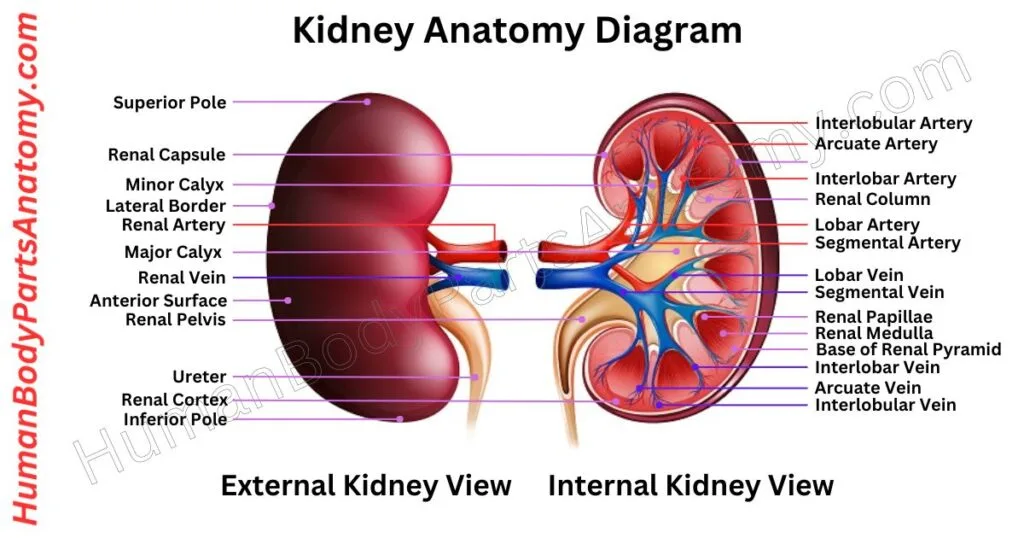
  • Kidney
    • Nephrons
    • Renal arteries
    • Renal veins
    • Renal pelvis
  • Ureter
  • Urinary bladder
  • Female urethra
  • Male urethra

Human Nervous System

  • Central nervous system
  • Peripheral nervous system
    • Cranial nerves
    • Spinal nerves
    • Autonomic division (Autonomic nervous system)

Cardiovascular System

  • Heart
    • Chordae tendinae
    • Right atrium
    • Right ventricle
    • Left atrium
    • Left ventricle
    • Endocardium
    • Myocardium
    • Pericardial cavity
    • Pericardium
  • Arteries
    • Pulmonary trunk
    • Aorta
  • Veins
    • Veins of the heart
    • Pulmonary veins
    • Superior vena cava
    • Inferior vena cava
    • Hepatic portal vein
  • Lymphatic trunks and ducts
    • Thoracic duct
    • Cisterna chyli

Human Bone Anatomy

In human anatomy, the skeleton is the internal framework of the body. It is responsible for both structure and function. At birth, it is composed of approximately 270 bones. However, by adulthood, this number reduces to roughly 206 due to bone fusions. This skeletal system accounts for around 14% of the average person’s body weight, which ranges from 10 to 11 kg. Bone mass reaches its peak between the ages of 25 and 30.

Skull

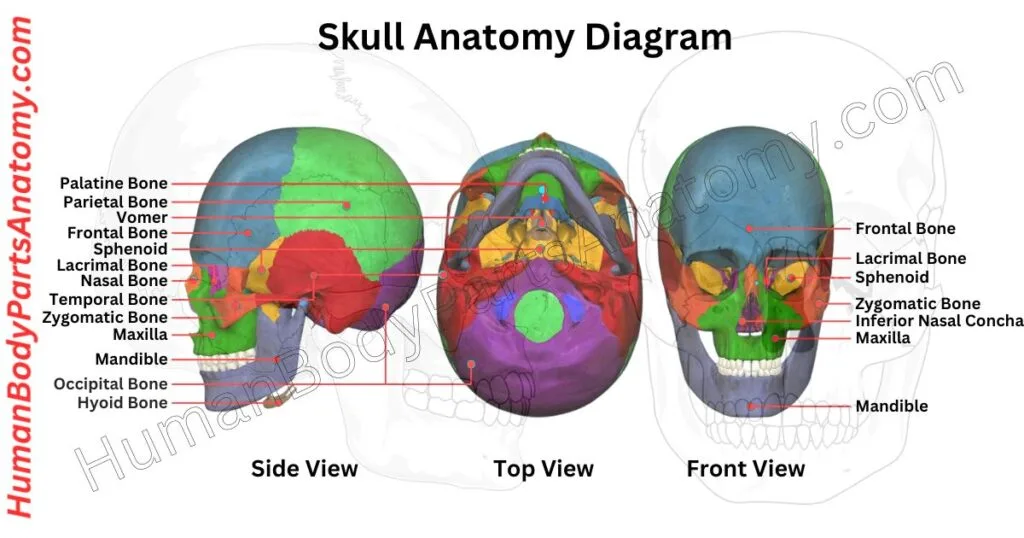
The skull is a bony structure that covers and protects the brain. It comprises three main types of bones: cranial bones, facial bones, and ear ossicles.

In humans, the skull is divided into the neurocranium (the braincase) and the viscerocranium (the facial skeleton), which includes the mandible. This structure is an example of cephalization, where the brain and sensory organs are concentrated at the head.

The skull is located at the front of the skeleton, a result of cephalization. It houses the brain along with key sensory organs such as the eyes, ears, nose, and mouth.

The human skull is made up of 22 bones, or 29 if you include the inner ear bones and the hyoid bone. These bones are mainly connected by ossified joints known as sutures.

The skull has several crucial functions: it protects the brain, maintains the proper distance between the eyes for stereoscopic vision, and positions the ears to help with sound localization.
In certain animals, like horned ungulates (hoofed mammals), the skull also serves a defensive role by supporting the horns on the frontal bone.

Detailed diagram of human skull anatomy showing all major bones, parts, and structures with labels, including frontal, parietal, temporal, occipital, and mandible bones.

Read More – Skull Anatomy: Complete Guide with Parts, Names, Functions & Diagram

/10

Skull Anatomy

Facial Bones

Start the Quiz on the Facial Bones.

1 / 10

1. Which of the 14 facial bones is most commonly involved in a 'tripod fracture'?

2 / 10

2. Which of the following facial bones forms the cheekbone prominence AND contributes to both the orbit and the zygomatic arch?

3 / 10

3. Which facial bone contributes to the floor of the orbit (eye socket)?

4 / 10

4. What are the two unpaired facial bones?

5 / 10

5. How many facial bones are paired (bilateral)?

6 / 10

6. What is the name of the bony midline ridge found on the internal surface of the mandible that gives attachment to the mylohyoid muscle?

7 / 10

7. A patient complains of cheek numbness after a facial injury. Damage to which nerve — transmitted through which facial bone — is most likely responsible?

8 / 10

8. The infraorbital foramen, which transmits the infraorbital nerve (CN V2), is located in which facial bone?

9 / 10

9. What is the function of the inferior nasal conchae?

10 / 10

10. The mandibular symphysis is the midline fusion point of the two halves of the mandible. When does this fusion typically complete?

Your score is

The average score is 60%

0%

/10

Skull Anatomy

Cranial Bones

Start the Quiz on the Cranial Bones.

1 / 10

1. Which of the following cranial bones is unpaired (occurs as a single bone rather than bilateral pairs)?

2 / 10

2. The squamous suture joins which two cranial bones?

3 / 10

3. Which cranial bone contains the sphenoid sinus?

4 / 10

4. Which of the following best describes the function of cranial sutures during fetal development and infancy?

5 / 10

5. Which cranial bone forms the forehead?

6 / 10

6. Which landmark marks the junction of the lambdoid suture and the sagittal suture?

7 / 10

7. Which cranial bone has ethmoid air cells (ethmoid sinuses) within it?

8 / 10

8. Which cranial bone is often called the 'keystone' of the cranial floor because it articulates with all other cranial bones?

9 / 10

9. Which suture connects the frontal bone to the two parietal bones?

10 / 10

10. How many parietal bones are present in the adult human skull?

Your score is

The average score is 60%

0%

Vertebral Column or Spine

The vertebral column, or the spine, is an essential human body part of the axial skeleton. It safeguards the spinal cord and nerves while maintaining an upright posture.

This complex skeletal framework bears most of the body’s weight to maintain a vertical pose. Its different feature lies in a flexible rod found in all chordates, into a segmented array of bones referred to as vertebrae.

These vertebrae are interposed with intervertebral discs, which enhance the spine’s durability and flexibility.
Each vertebra is named according to its position within the spinal column.

The spinal canal is enclosed within the vertebral column, a protective cavity that envelops and shields the spinal cord.

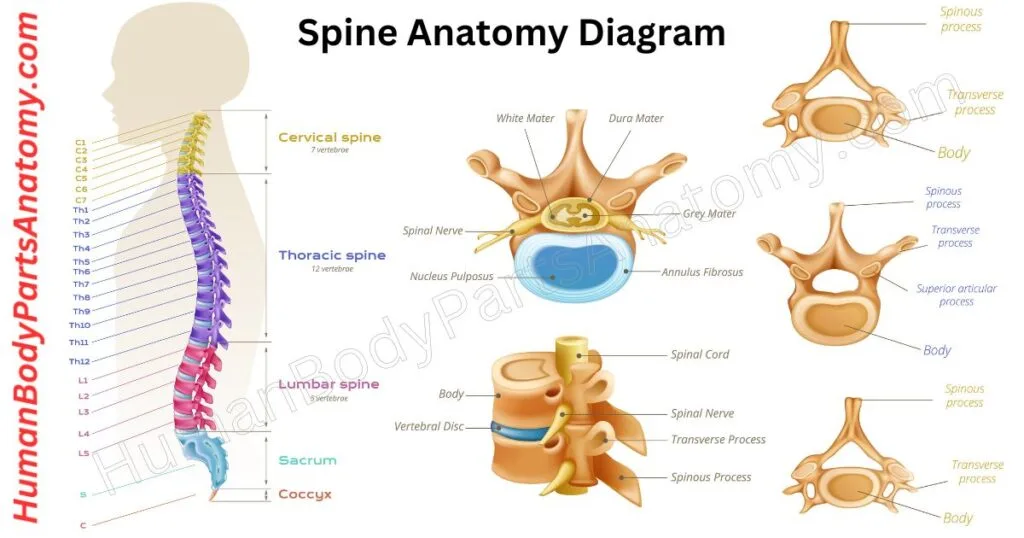
Human spine anatomy diagram showing cervical, thoracic, lumbar, sacrum, and coccyx regions with labeled vertebrae, structure, and functions.

Read More – Spine Anatomy: Complete Guide with Parts, Names, Functions & Diagram

0%

Spine Anatomy

Regions of the Spine Anatomy

Start the Quiz on the Regions of the Spine Anatomy.

1 / 10

1.

Which spinal region helps maintain an upright posture?

2 / 10

2.

Which spinal region is directly below the thoracic region?

3 / 10

3.

Which region has the largest vertebrae?

4 / 10

4.

The lumbar spine is located between which two regions?

5 / 10

5.

Which region of the spine is most commonly associated with lower back pain?

6 / 10

6.

The “neck” region of the spine corresponds to which set of vertebrae?

7 / 10

7.

How many vertebrae make up the human spine in total (typically)?

8 / 10

8.

The atlas and axis vertebrae belong to which spinal region?

9 / 10

9.

Which region is most rigid due to rib attachments?

10 / 10

10.

What region of the spine connects directly to the skull?

Your score is

The average score is 68%

0%

0%

Spine Anatomy

Curvatures of the Spine

Start the Quiz on the Curvatures of the Spine.

1 / 10

1.

What is the normal inward curve of the lower back called?

2 / 10

2.

Which spinal curve develops when a baby begins to lift their head?

3 / 10

3.

What condition involves a forward rounding of the upper back greater than 50 degrees?

4 / 10

4.

An excessive sideways curve in the spine is known as:

5 / 10

5.

What is the purpose of the spine’s S-shaped curves?

6 / 10

6.

Which type of scoliosis is most commonly diagnosed in teenagers?

7 / 10

7.

Which curvature disorder is often seen in pregnancy or obesity due to increased belly weight?

8 / 10

8.

Which spinal region has a normal outward curve (kyphotic curve)?

9 / 10

9.

Which condition is commonly nicknamed “hunchback”?

10 / 10

10.

A loss of the normal lumbar curve is often called:

Your score is

The average score is 25%

0%

Hip Bone

The hip is also known as the coxa in medical terms. It is a key area in vertebrate anatomy found on the outer side of the pelvis. It is located to the side and front of the buttocks, below the bony ridge of the iliac crest, and beside the obturator foramen.

This area includes muscles, tendons, and soft tissues that cover the prominent greater trochanter of the femur.

In adults, the hip bone forms from the fusion of three pelvic bones (the ilium, ischium, and pubis). It creates the sturdy inner and upper walls of the hip region.
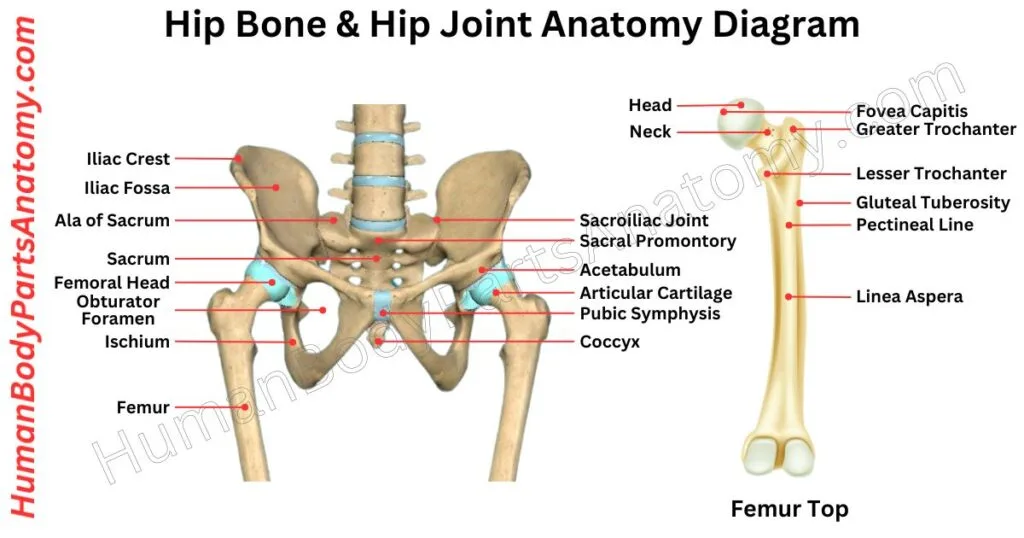
Detailed diagram of the human hip bone anatomy showing all parts, including ilium, ischium, pubis, acetabulum, and sacroiliac joint with labeled names and functions.

Read More – Hip Bone Anatomy: Complete Guide with Parts, Names, Functions & Diagram

/10

Hip Bones Anatomy

Hip Bones Anatomy

Start the Quiz on the Hip Bones Anatomy.

1 / 10

1. The iliac crest is best described as:

2 / 10

2. A fracture of the hip most commonly involves which bone?

3 / 10

3. Which bone is NOT part of the hip bone?

4 / 10

4. The main function of the hip bones is to:

5 / 10

5. Which part of the hip bone do you sit on?

6 / 10

6. The hip bone helps protect which organs?

7 / 10

7. Which structure marks the point where the three hip bones meet?

8 / 10

8. Which bone contributes the most to the acetabulum?

9 / 10

9. Which landmark is commonly used for bone marrow biopsy?

10 / 10

10. The hip bone reaches full fusion at approximately what age?

Your score is

The average score is 58%

0%

Femur

The femur, scientifically called the thigh bone, is essential within the human skeletal system. It is in the lower limb and bone between the hip joint and knee joints. This bone shapes the hip joint as its proximal end and forms an articulation point with the pelvic socket.

Moreover, the femur‘s distal end engages with the tibia and patella to form a knee joint structure. Beyond this, the femur bears the human body’s weight during stationary and dynamic activities.

Additionally, the femur is an essential anchor point for muscles, tendons, and ligaments that help move the hip joint and knee joints.

Detailed diagram of the human femur bone anatomy showing parts, names, and structure including head, neck, shaft, condyles, and functions.

Read More – Femur Anatomy: Complete Guide with Parts, Names, Functions & Diagram

/10

Femur Anatomy

Greater & Lesser Trochanter

Start the Quiz on the Greater & Lesser Trochanter.

1 / 10

1. Which imaging technique best visualizes gluteus medius and minimus tendon tears at the greater trochanter?

2 / 10

2. The trochanteric fossa is a deep depression on which surface of the greater trochanter?

3 / 10

3. In a child, avulsion of the lesser trochanter most commonly results from sudden forceful contraction of which muscle?

4 / 10

4. The greater sciatic notch, through which major vessels and nerves pass to the gluteal region, is located:

5 / 10

5. During hip joint replacement, the femoral component stem is inserted into the:

6 / 10

6. The gluteus medius muscle inserts on which facet of the greater trochanter?

7 / 10

7. In coxa valga (increased neck-shaft angle >135°), the greater trochanter is positioned:

8 / 10

8. Which of the following muscles does NOT attach to the greater trochanter?

9 / 10

9. An isolated lesser trochanter avulsion fracture in an adult should raise clinical suspicion for:

10 / 10

10. During a posterior hip approach (Moore/Southern approach) for arthroplasty, which structures are at risk for external rotation muscle detachment from the greater trochanter?

Your score is

The average score is 0%

0%

Rib Cage

Detailed Rib Cage Anatomy

The rib cage, or thoracic cage, is an important component of the skeleton in most vertebrates. It comprises the ribs, the vertebral column, and the sternum.

This structure safeguards vital organs such as the heart, lungs, and major blood vessels. It also supports the shoulder girdle, contributing to the central framework of the axial skeleton.

In humans, the thoracic cage consists of 12 ribs connected to the sternum via costal cartilage. The sternum itself has three parts: the manubrium, the body, and the xiphoid process.

The cage also includes 12 thoracic vertebrae that interact with the ribs. This setup provides attachment points for muscles in the neck, upper limbs, abdomen, and back. Along with the skin and other tissues, it forms the chest wall.

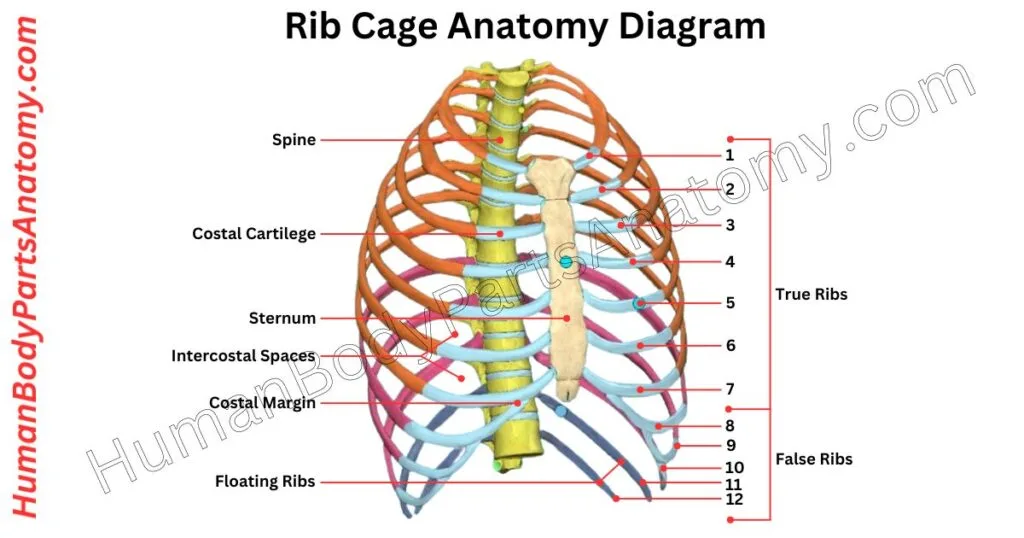
Detailed diagram of human rib cage anatomy showing all ribs, sternum, thoracic vertebrae, and intercostal spaces with labeled parts and functions.

Read More – Rib Cage Anatomy: Complete Guide with Parts, Names, Functions & Diagram

/10

Ribs & Sternum Anatomy

Ribs & Sternum Anatomy

Start the Quiz on the Ribs & Sternum Anatomy.

1 / 10

1. Can rib cartilage harden with age?

2 / 10

2. Which activity commonly causes rib stress injuries?

3 / 10

3. Can someone have extra ribs?

4 / 10

4. What is the main job of the sternum?

5 / 10

5. Which rib has the most movement?

6 / 10

6. Why is chest pain often mistaken for heart pain?

7 / 10

7. What bone runs down the center of the chest?

8 / 10

8. Where are cervical ribs located?

9 / 10

9. Is costochondritis dangerous?

10 / 10

10. Which ribs are most likely to be injured?

Your score is

The average score is 76%

0%

Sternum

The sternum, or breastbone, is a flat, vertical bone situated in the center of your chest. It forms a key part of the rib cage. It consists of three distinct sections:

  1. Manubrium: The uppermost section, shaped like a broad, quadrilateral. It has a notch at the top, known as the suprasternal notch, and two side notches for the collarbones (clavicles). It creates the sternoclavicular joints.
  2. Gladiolus (Body): This is the longest section of the sternum. It has ridges where the cartilages of ribs 3 through 7 attach. The body joins the manubrium at a prominent bump called the sternal angle. It also connects with the second pair of ribs.
  3. Xiphoid Process: The smallest and lowest section of the sternum, which has a triangular shape. Its size and shape can vary among individuals.

The sternal angle, or angle of Louis, is the noticeable bump where the manubrium and body connect. The primary function of the sternum is to shield vital organs such as the heart and lungs.

Detailed diagram of human sternum anatomy showing the manubrium, body, xiphoid process, and their connections to ribs and cartilage with labeled parts and functions.

Human Muscle Anatomy

In human anatomy, muscle tissues are made up of specialized cells that can contract and allow movement. This movement includes not just the motion of body parts and limbs but also the flow of blood, food, and other substances within the body.

Muscles are essential for moving the skeleton and making the heartbeat. They are found in the walls of organs like the intestines, uterus, and stomach.

Numerous muscles exist in our bodies, each serving various functions. Let’s examine the major muscles, understanding their different parts and how they contribute to movement and strength.

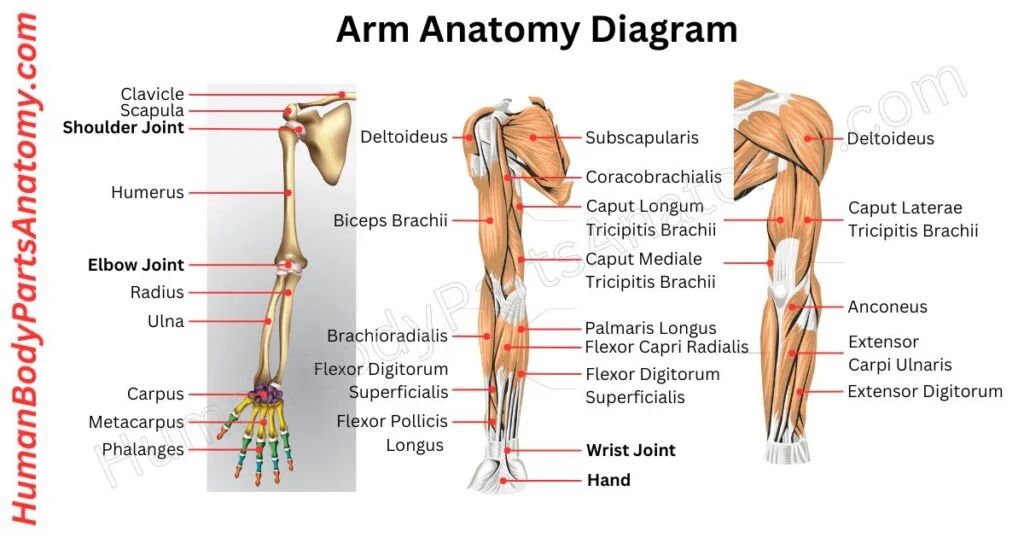
Biceps

The biceps brachii is a large muscle in the anterior upper arm that extends from the shoulder to the elbow. It has two unique heads, the long and short heads, which emerge from the scapula. These heads join together to produce a muscular system that joins to the upper section of the forearm.

Function—The biceps brachii is responsible for forearm flexion and supination. It helps with various activities and daily tasks. Curling the forearm at the elbow joint is referred to as forearm flexion.
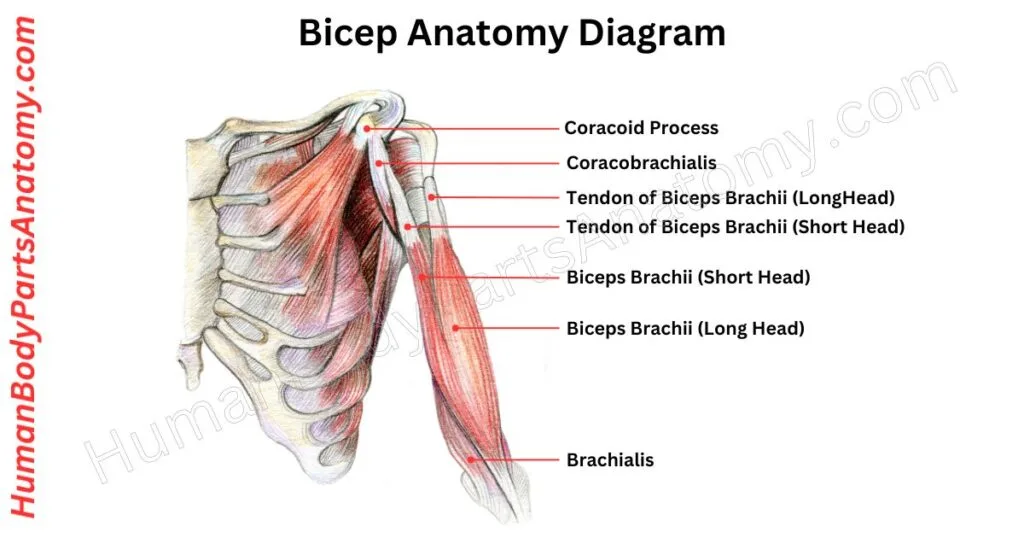
Detailed diagram of the bicep anatomy showing its parts, origin, insertion, functions, and relation to the upper arm.

Read More – Ultimate Guide to Bicep Anatomy: Parts, Names, Functions & Diagram

Triceps

The triceps brachii is an extensor muscle in various vertebrates at the back of the upper limb. These muscles originate from the humerus and scapula, which comprise three distinct parts: the medial, lateral, and long heads.

Function—The triceps brachii muscle extends the forearm at the elbow joint. Its long head helps extend and adduct the arm at the shoulder joint.

Forearm

The forearm is the part of your arm between the elbow and wrist. It is made up of two bones: the outer radius and the inner ulna.

It has 20 muscles grouped into front (flexor) and back (extensor) compartments, which control elbow, wrist, and hand movements.

There are two types of muscles: front flexors and back extensors. Fascia organizes and supports these muscles around the ulna and radius.

Two structures, the intermuscular septum and interosseous membrane, create compartments and offer extra support.

The septum starts from the front of the radius, connecting with the forearm fascia, while the membrane forms between the radius and ulna.

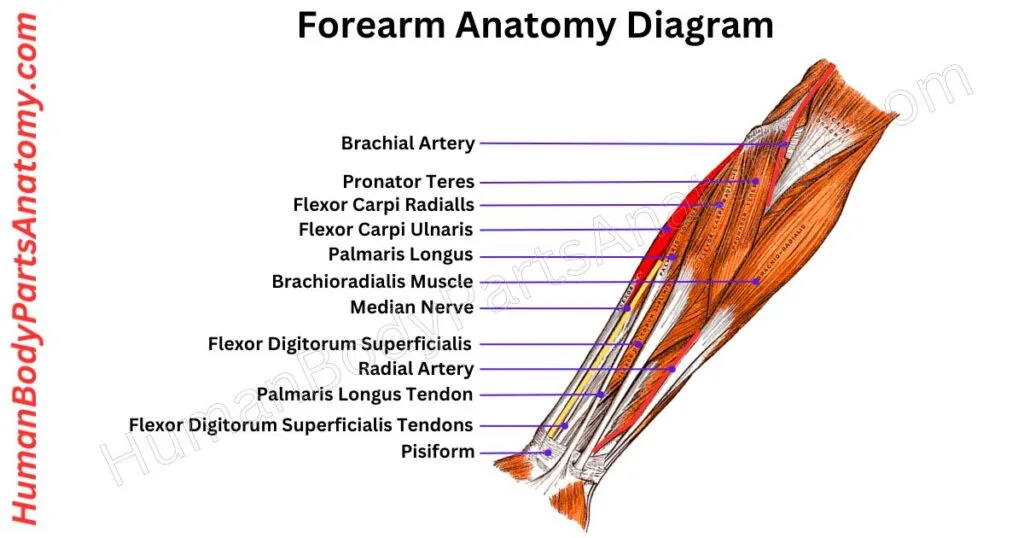
Detailed diagram of human forearm anatomy showing bones (radius and ulna), muscles, tendons, nerves, and blood vessels with labeled parts and functions.

Read More – Complete Guide to Forearm Anatomy: Parts, Names, Functions & Diagram

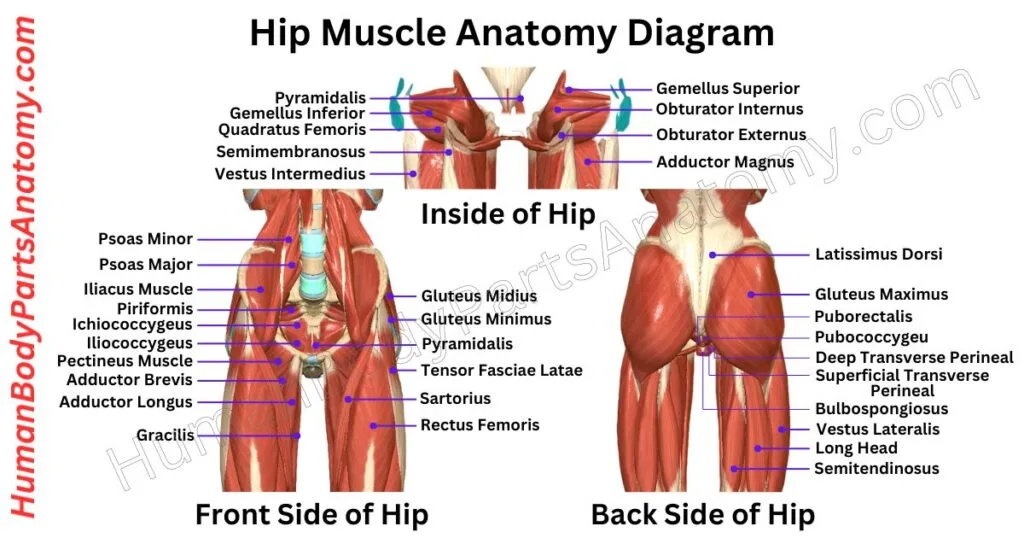
Hip Muscles

The muscles around the hip joint are crucial for its movement in human anatomy. Typically, anatomists identify 17 primary muscles involved in hip motion; also, more muscles are included.

These muscles are categorized into four groups based on their location around the hip joint: the gluteal group, the lateral rotator group, the adductor group, and the iliopsoas group.

Hip movements are achieved through the coordinated action of multiple muscles. Most muscles contribute to more than one type of movement. These movements are described using specific anatomical terms.

  • Flexion: Brings the thigh closer to the abdomen.
  • Lateral Rotation: Outward leg turns, like in the lotus yoga position.
  • Medial Rotation: Inward turning of the leg, opposite to lateral rotation.
  • Abduction: Moving the thigh away from the body’s midline, like spreading the thighs apart.
  • Adduction: Bringing the thigh back towards the midline, closing the thighs together.
Detailed diagram of hip muscle anatomy showing major muscles, their names, locations, and functions in human movement

Read More – Hip Muscle Anatomy: Complete Guide with Parts, Names, Functions & Diagram

/10

Hip Muscle Anatomy

Extensor Hip Muscles Anatomy

Start the Quiz on the Extensor Hip Muscles Anatomy.

1 / 10

1. Which muscle helps stabilize the pelvis when standing on one leg?

2 / 10

2. Which muscle helps decelerate hip flexion?

3 / 10

3. Which muscle attaches to the iliotibial band?

4 / 10

4. Which hip extensor also assists knee flexion?

5 / 10

5. Which muscle is MOST active during sprinting acceleration?

6 / 10

6. Which muscle gives the buttocks their shape and power?

7 / 10

7. Which muscle helps slow the body during downhill walking?

8 / 10

8. Weak hip extensors MOST commonly contribute to:

9 / 10

9. Which muscle originates from the posterior ilium and sacrum?

10 / 10

10. Weak hip extensors often cause:

Your score is

The average score is 0%

0%

/10

Hip Muscle Anatomy

Flexor Hip Muscles Anatomy

Start the Quiz on the Flexor Hip Muscles Anatomy.

1 / 10

1. Which muscle attaches to the lesser trochanter?

2 / 10

2. Which muscle is nicknamed the “tailor’s muscle”?

3 / 10

3. Pain in the front of the hip is MOST often linked to:

4 / 10

4. Where does the psoas major insert?

5 / 10

5. Weak hip flexors may affect:

6 / 10

6. Which daily activity uses hip flexors the MOST?

7 / 10

7. Hip flexor strain pain is usually felt:

8 / 10

8. Which hip flexor muscle is often strained in sprinting athletes?

9 / 10

9. Which muscle flexes the hip AND abducts it?

10 / 10

10. Which muscle helps lift the leg during a bicycle pedal stroke?

Your score is

The average score is 0%

0%

/10

Hip Muscle Anatomy

Abductor Hip Muscles Anatomy

Start the Quiz on the Abductor Hip Muscles Anatomy.

1 / 10

1. Which movement stretches hip abductors?

2 / 10

2. Which muscle originates from the outer surface of the ilium?

3 / 10

3. Which muscle helps maintain pelvic alignment?

4 / 10

4. Pain on the outer hip is commonly linked to dysfunction of:

5 / 10

5. Which muscle lies deep to the gluteus medius?

6 / 10

6. Which muscle assists with both abduction and pelvic stability?

7 / 10

7. Which muscle assists with internal rotation of the hip?

8 / 10

8. Which muscle assists with hip abduction and flexion?

9 / 10

9. Which muscle attaches to the iliotibial (IT) band?

10 / 10

10. Which muscle helps prevent excessive femur adduction?

Your score is

The average score is 0%

0%

Thigh

The thigh is a significant part of human anatomy in the lower limb. It is between the hip and houses the pelvis and the knee joint. The femur is the prominent bone within the thigh and has exceptional strength, density, and robustness.

Functionally, the femur is a ball and socket joint at the hip and a modified hinge joint at the knee. Remarkably, the thigh region houses various main muscles in the human body.

These muscles enable various body movements, including bending, flexing, and rotational.

Additionally, they bear most of the body’s total weight. Furthermore, these muscles help maintain the structural integrity of the hips and legs.

Detailed illustration of thigh muscle anatomy showing quadriceps (rectus femoris, vastus lateralis, vastus medialis, vastus intermedius), hamstrings (biceps femoris, semitendinosus, semimembranosus), adductors, and sartorius with labeled parts and functions.

Read More – Complete Guide to Thigh Muscle Anatomy: Learn Parts, Names & Diagram

/10

Thigh Muscles Anatomy

Anterior Thigh Muscles

Start the Quiz on the Anterior Thigh Muscles Anatomy.

1 / 10

1.

Which muscle’s activation helps stabilize the patella medially during knee extension?

2 / 10

2.

Which quadriceps muscle is positioned most laterally?

3 / 10

3.

Which muscle originates from the anterior inferior iliac spine (AIIS)?

4 / 10

4.

What is the insertion point of the quadriceps femoris group?

5 / 10

5.

Which muscle contributes most to the “teardrop” shape above the knee?

6 / 10

6.

Which muscle is most commonly involved in a “quad strain”?

7 / 10

7.

Which muscle forms the lateral border of the femoral triangle?

8 / 10

8.

Which anterior thigh muscle crosses both the hip and knee joints?

9 / 10

9.

Which of these muscles is most active when kicking a soccer ball?

10 / 10

10.

Which muscle’s weakness can cause the knee to buckle during walking?

Your score is

The average score is 40%

0%

/10

Thigh Muscles Anatomy

Posterior Thigh Muscles

Start the Quiz on the Posterior Thigh Muscles Anatomy.

1 / 10

1.

Which exercise best activates the hamstrings and glutes together?

2 / 10

2.

Which connective tissue separates the posterior thigh from the adductor compartment?

3 / 10

3.

Which sport shows the highest rate of hamstring strain injuries?

4 / 10

4.

What type of injury commonly affects the hamstrings in sprinters?

5 / 10

5.

Which exercise strengthens the hamstrings the most?

6 / 10

6.

Which test is commonly used to check hamstring tightness?

7 / 10

7.

Pain in the buttock radiating down the thigh is commonly due to irritation of which structure?

8 / 10

8.

Which muscle’s tightness limits hip flexion?

9 / 10

9.

Which hamstring lies deepest near the knee joint?

10 / 10

10.

Which hamstring muscle helps medially rotate the leg when the knee is flexed?

Your score is

The average score is 70%

0%

/10

Thigh Muscles Anatomy

Medial Thigh Muscles

Start the Quiz on the Medial Thigh Muscles Anatomy.

1 / 10

1.

Which muscle assists the hamstrings in hip extension during climbing?

2 / 10

2.

Which adductor muscle forms part of the floor of the femoral triangle?

3 / 10

3.

What is the main function of the obturator nerve?

4 / 10

4.

Which medial thigh muscle assists in stabilizing the pelvis during gait?

5 / 10

5.

A tear at the adductor longus tendon near its pubic attachment is known as:

6 / 10

6.

Which muscle is frequently tight in cyclists and can cause medial thigh discomfort?

7 / 10

7.

Which muscle is often tight in people with “knock-knees” (valgus knees)?

8 / 10

8.

Pain radiating to the inner thigh and knee might indicate irritation of which nerve?

9 / 10

9.

Which adductor muscle originates most posteriorly on the ischium?

10 / 10

10.

Which muscle assists the adductors during horseback riding or squeezing movements?

Your score is

The average score is 80%

0%

Human Body Parts – Joints

Wrist Joint

In human anatomy, the wrist is scientifically termed the carpus or carpal bones. It is a crucial part of the hand‘s structure, consisting of eight distinct bones that create the foundational framework for the upper part of the hand.

The wrist joint is scientifically known as the radiocarpal joint. It acts as the vital connection between the radius and the carpal bones. It includes both the carpus and the lower portions of the forearm bones.

The metacarpus is formed by the proximal sections of the five metacarpal bones. A network of interconnected joints exists among these anatomical components, making hand movement possible.

Detailed diagram of wrist anatomy showing bones, joints, ligaments, and tendons with labeled parts for understanding structure and function.

Read More – Wrist Anatomy: Ultimate Guide to Parts, Names, Functions & Diagram

Hip Joint

The hip joint connects your thigh bone (femur) to your hip bone (pelvis). It is a crucial body part, second in size only to your knee joint.

This ball-and-socket joint consists of the rounded head of the femur fitting snugly into a cup-like cavity in the pelvis, known as the acetabulum. This structure allows for extensive movement and helps your legs support your body weight.

It is located between your torso and lower legs. The hip joint serves several vital functions:

  • Balances and supports your upper body.
  • Facilitates the movement of your upper leg.
  • Bears and distributes your body weight.

The ball-and-socket configuration of the hip joint permits your upper leg to move in three primary ways:

  • Flexion (bending).
  • Extension (straightening).
  • Rotation (twisting).

This universal joint is essential for everyday activities, enabling a wide range of motions and providing stability and support.

Detailed diagram of the human hip bone anatomy showing all parts, including ilium, ischium, pubis, acetabulum, and sacroiliac joint with labeled names and functions.

Read More – Hip Bone Anatomy: Complete Guide with Parts, Names, Functions & Diagram

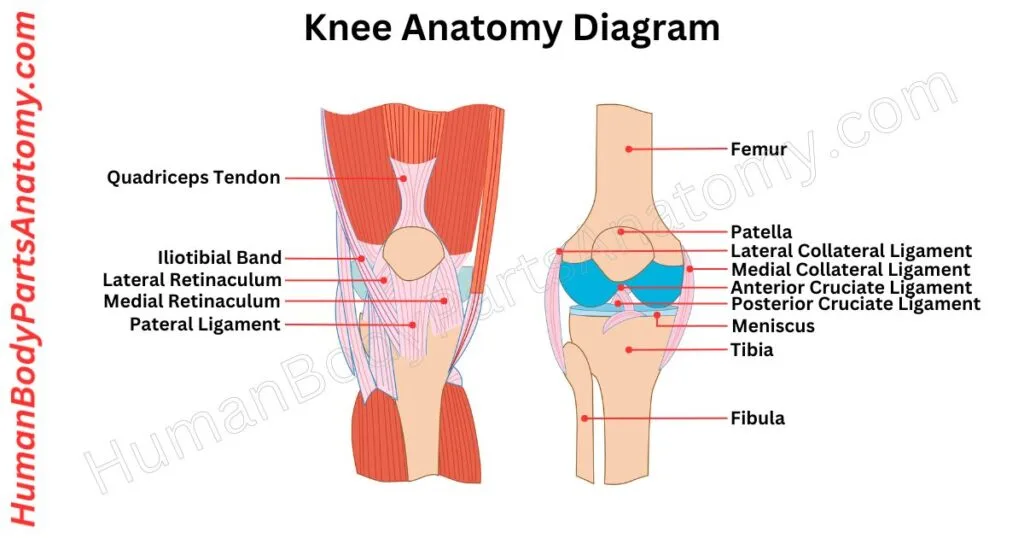
Knee Joint

The knee joint, or a synovial joint, is an essential link between the femur, tibia, and patella bones. It is the body’s largest joint, mainly allowing leg bending and straightening. It contains two primary components: the tibiofemoral and patellofemoral articulations.

The tibiofemoral joint forms a connection between the tibia and the femur, while the patellofemoral joint forms with the patella with the femur.

Your knees are vital in supporting your body weight and allowing leg movement. This joint helps in activities like walking, running, and jumping.

Detailed labeled diagram of knee anatomy showing bones, ligaments, cartilage, tendons, and muscles that support joint movement and stability.

Read More – Knee Anatomy: Complete Guide to Parts, Names, Functions & Diagram

/10

Knee Anatomy

Knee Bones Anatomy

Start the Quiz on the Knee Bones Anatomy.

1 / 10

1.

What is the function of the patella in knee movement?

2 / 10

2.

Which bone is most commonly injured in sports-related knee fractures?

3 / 10

3.

The line running down the front of the tibia that can easily be felt under the skin is called the:

4 / 10

4.

Which of the following bones is not directly part of the knee joint?

5 / 10

5.

The point where the femur meets the tibia and patella is collectively called the:

6 / 10

6.

What type of bone is the patella?

7 / 10

7.

The top surface of the tibia that interacts with the femur is called the:

8 / 10

8.

The lower end of the femur forms which key structures?

9 / 10

9.

What is the name of the bone often fractured in direct falls onto the knee?

10 / 10

10.

Which structure separates the two femoral condyles posteriorly?

Your score is

The average score is 68%

0%

/10

Knee Anatomy

Knee Muscles Anatomy

Start the Quiz on the Knee Muscles Anatomy.

1 / 10

1.

The semimembranosus muscle lies deep to which other hamstring muscle?

2 / 10

2.

Which quadriceps muscle is located deepest in the thigh?

3 / 10

3.

Which muscle acts as both a hip flexor and a knee flexor?

4 / 10

4.

Which muscle group is primarily responsible for straightening the knee?

5 / 10

5.

Which nerve controls most hamstring muscles?

6 / 10

6.

Which muscle is most active during jumping and running uphill?

7 / 10

7.

Which muscle forms part of the calf but crosses the knee joint?

8 / 10

8.

Which group of muscles is strengthened to reduce knee pain from patellar tracking issues?

9 / 10

9.

The quadriceps play a major role in which everyday activity?

10 / 10

10.

Which muscle assists in locking the knee during full extension?

Your score is

The average score is 40%

0%

/10

Knee Anatomy

Knee Joints Anatomy

Start the Quiz on the Knee Joints Anatomy.

1 / 10

1.

Which structure surrounds the knee joint and holds synovial fluid inside?

2 / 10

2.

What is the main movement that occurs at the knee joint?

3 / 10

3.

Which joint is the largest and most complex in the human body?

4 / 10

4.

The PCL prevents which type of movement?

5 / 10

5.

The small joint between the patella and femur is called the:

6 / 10

6.

What happens to the patella when the knee is fully extended?

7 / 10

7.

The menisci attach to which bone?

8 / 10

8.

The knee joint contains how many menisci?

9 / 10

9.

The joint that allows the patella to move during extension is the:

10 / 10

10.

What is the name of the joint space between the femur and tibia?

Your score is

The average score is 50%

0%

Ankle Joint

Your ankle is a hinge joint connecting your lower leg and foot. It is a hinge-like joint formed by the talus, tibia, and fibula bones.

The bony bump on the lower fibula (lateral malleolus) forms the outer boundary on one side, and the bony bump on the lower tibia (medial malleolus) creates the inner boundary. Together, they make up the ankle mortise.

The talus bone acts like a connector, linking with the calcaneus below and the navicular in front. The top part of the talus has a smooth surface, allowing comfortable up-and-down movement of your foot.

It snugly fits between the bony bumps, making the ankle most stable when you lift your toes towards your shin (dorsiflexion).

Strong ligaments act like rugged rubber bands on either side of the ankle to provide stability.

Shoulder Joint

The human shoulder anatomy has three bones: the collarbone, shoulder blade, and upper arm bone. These bones are connected by joints, with the main one being the shoulder joint or glenohumeral joint.

Other joints, like the acromioclavicular joint, are also part of the shoulder. The shoulder joint allows circular rotation and lifting of the arm away from the body. 

It is like a ball in a socket formed by the shoulder blade. A soft tissue envelope called the joint capsule surrounds the shoulder joint, lined with a smooth synovial membrane.

A group of four muscles maintains the shoulder’s stability, called the rotator cuff. These muscles attach to the shoulder blade and the upper arm bone. They are the supraspinatus, subscapularis, infraspinatus, and teres minor.

Detailed diagram of human shoulder anatomy showing bones (clavicle, scapula, humerus), muscles (deltoid, rotator cuff), joints, and ligaments with labeled parts and functions.

Read More –

Human Anatomy – Alimentary System

Mouth

The mouth is necessary for digestion. It is a complex structure with different parts that work together to make the digestion system more efficient.

The lips create two regions: the vestibule and the oral cavity. The tongue occupies the central cavity and is surrounded by teeth, cheeks, and the isthmus of the fauces at the back.

The hard palate forms the front roof, and the soft palate makes up the rear, with the uvula hanging down.
The inner lining is called the oral mucosa. It is made of stratified squamous epithelium.

Salivary glands provide fluid to keep the mouth moist. Nerves and blood vessels form a network essential for the mouth’s diverse functions in human life.
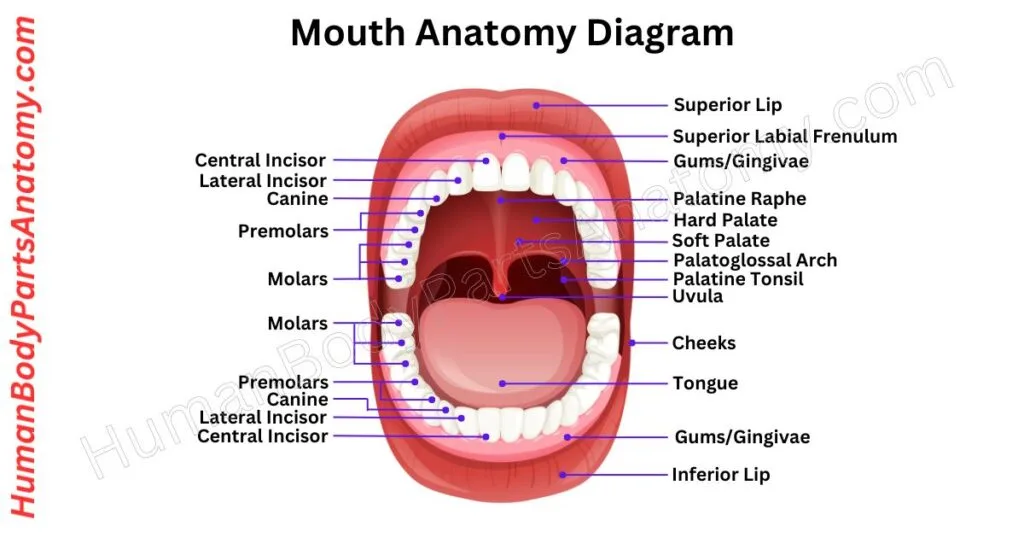
Detailed diagram of human mouth anatomy showing lips, teeth, tongue, gums, palate, uvula, and oral cavity with labeled parts and functions.

Read More – Mouth Anatomy: Complete Guide with Parts, Names, Functions & Diagram

/10

Mouth Anatomy

Mouth Anatomy

Start the Quiz on the Mouth Anatomy.

1 / 10

1. What is the roof of your mouth called?

2 / 10

2. What is the blood supply to the oral cavity?

3 / 10

3. What causes "bad breath" (halitosis)?

4 / 10

4. A patient has painful mouth ulcers that keep recurring. What might this be?

5 / 10

5. A patient has painful mouth ulcers that keep recurring. What might this be?

6 / 10

6. What is the lymphatic drainage pattern of the oral cavity, and why is it clinically significant

7 / 10

7. What is the pharynx's relationship to the oral cavity?

8 / 10

8. What is oral lichen planus?

9 / 10

9. Can you taste without saliva?

10 / 10

10. What is "dry mouth" called medically?

Your score is

The average score is 0%

0%

Teeth

Teeth are essential for chewing food and helping with digestion. Although they may look like bones, they’re ectodermal organs similar to hair and skin.

In adults, the 32 permanent teeth work together to cut, tear, mix, and grind food into smaller pieces. The tongue and oropharynx shape the food into a ball for easy swallowing.

Teeth have four main layers. The outer layer, called Enamel, is the hardest substance in the body and protects against cavity-causing bacteria.

Below the Enamel is dentin, a less intense layer. If Enamel wears away, it exposes dentin, increasing the risk of cavities.

The tooth root is covered by cementum, which, along with periodontal tissues, anchors the tooth in the jaw. The innermost layer, tooth pulp, houses nerves, blood vessels, and connective tissues, contributing to overall tooth health.

Detailed labeled diagram of human tooth anatomy showing crown, root, enamel, dentin, pulp cavity, cementum, periodontal ligament, and surrounding gum structure.

Read More – Complete Guide to Tooth Anatomy: Learn Parts, Names & Diagram

/10

Tooth Anatomy

Tooth Anatomy

Start the Quiz on the Tooth Anatomy.

1 / 10

1. What is the junction between the crown and root of a tooth called?

2 / 10

2. What causes tooth sensitivity to hot, cold, or sweet foods?

3 / 10

3. Which teeth are known as "eye teeth" or "fangs"?

4 / 10

4. Which nerve provides sensation to the lower teeth?

5 / 10

5. What is the visible part of the tooth above the gum line called?

6 / 10

6. What are premolars (bicuspids) designed to do?

7 / 10

7. Why do teeth sometimes appear yellow?

8 / 10

8. What is a root canal treatment?

9 / 10

9. What mineral primarily makes up tooth enamel?

10 / 10

10. How many roots does a typical upper first molar have?

Your score is

The average score is 90%

0%

Lips

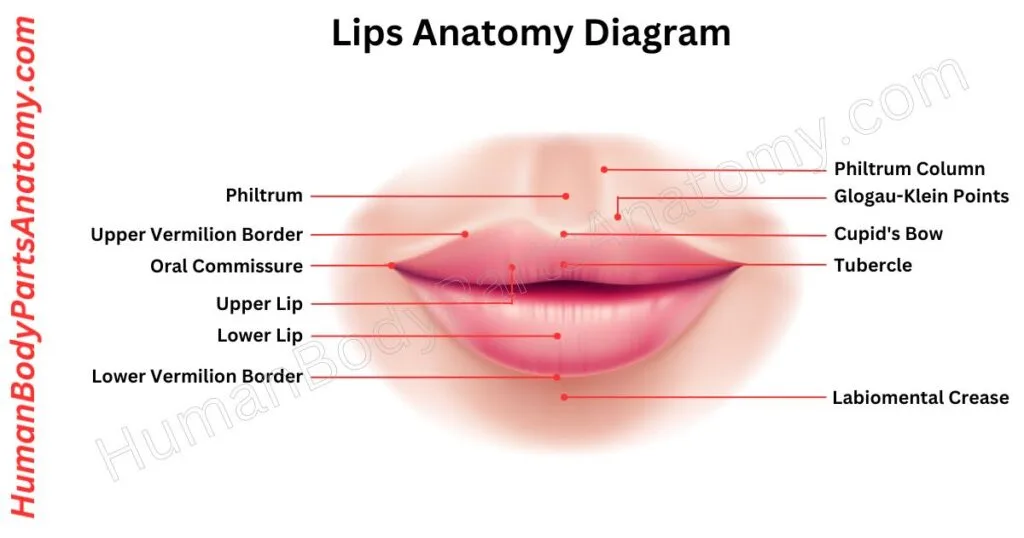
The lips are an essential part of the human face, pivotal in expressing emotions, talking, feeling, chewing, and romantic moments. Soft structures connected to the jaws are visible in many animals, including humans.

The upper and lower lips are scientifically called labium superius oris and labium inferius oris. Both lips have inner mucosal membranes, a colored vermilion layer, and outer skin.

In animals, including humans, lips are soft and flexible, helping with tasks like eating (such as sucking and swallowing) and forming sounds for speech.

Detailed human lips anatomy diagram showing upper lip (labium superius), lower lip (labium inferius), vermilion border, philtrum, orbicularis oris muscle, and surrounding structures.
/10

Lip Anatomy

Lip Anatomy

Start the Quiz on the Lip Anatomy.

1 / 10

1. What is lip licking dermatitis?

2 / 10

2. What is the difference between the upper and lower lip?

3 / 10

3. What connects the inside of the upper lip to the gums?

4 / 10

4. What is the primary function of lips?

5 / 10

5. What are Fordyce spots on lips?

6 / 10

6. Can lips regenerate if injured?

7 / 10

7. What are cold sores (fever blisters)?

8 / 10

8. What is the "vermillion border"?

9 / 10

9. What is the clinical significance of the nasolabial fold in relation to lip anatomy?

10 / 10

10. What is the difference between squamous cell carcinoma of the lip versus other lip lesions?

Your score is

The average score is 63%

0%

Stomach

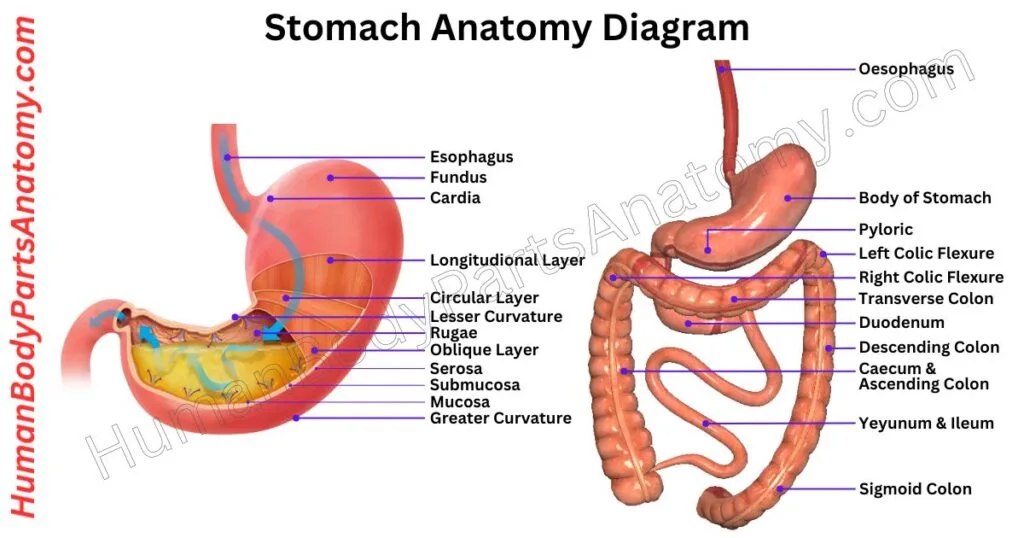
The stomach is a J-shaped crucial component of the digestive system. It makes enzymes and acids that chemically decompose food.

This process helps digestion before the food passes into the small intestine via the gastrointestinal (GI) tract. This tube extends from the mouth to the anus, through which food travels and waste exits.

The primary function of the stomach is to temporarily store food, mixing and breaking it down through muscular contractions and producing specialized cells and enzymes necessary for digestion.

Detailed diagram of human stomach anatomy showing all parts, including fundus, body, pylorus, and associated blood vessels, labeled for easy understanding of stomach structure and function.

Read More – Stomach Anatomy: Complete Guide with Parts, Names, Functions & Diagram

/10

Stomach Anatomy

External Stomach Anatomy

Start the Quiz on the External Stomach Anatomy.

1 / 10

1. What separates the stomach from the lungs?

2 / 10

2. Which structure limits food entry speed?

3 / 10

3. Which structure marks the stomach’s exit?

4 / 10

4. Which stomach part is palpable during exam?

5 / 10

5. Which sphincter helps prevent acid reflux?

6 / 10

6. Which structure connects the stomach to the liver?

7 / 10

7. Which region is closest to the diaphragm?

8 / 10

8. Which curvature is a common surgical landmark?

9 / 10

9. Why is the stomach not fixed in position?

10 / 10

10. Which curvature is shorter and medial?

Your score is

The average score is 60%

0%

/10

Stomach Anatomy

Internal Stomach Anatomy

Start the Quiz on the Internal Stomach Anatomy.

1 / 10

1. Which artery supplies the fundus of the stomach?

2 / 10

2. What is chyme?

3 / 10

3. What protects the stomach from self-digestion?

4 / 10

4. Which structure secretes gastrin?

5 / 10

5. Which layer is outermost?

6 / 10

6. Why is the stomach considered both endocrine and exocrine?

7 / 10

7. Which stomach layer is rich in lymphatic tissue?

8 / 10

8. Which stomach disorder commonly causes epigastric pain after meals?

9 / 10

9. Which layer anchors the stomach in the abdominal cavity?

10 / 10

10. Why doesn’t the stomach digest itself?

Your score is

The average score is 0%

0%

Intestine

The intestine is also known as the bowel. It is a long, coil-shaped muscular tube that runs from the stomach to the anus. Its primary function is digestion, but it also helps produce hormones that regulate physiological activities and help in immunological protection.

The small intestine is directly connected to the stomach. It is 10 to 16 feet long and has three sections: the duodenum, jejunum, and ileum. Its inner lining is folded like an accordion, considerably increasing its surface area.

Enzymes present in the small intestine convert food into sugars, amino acids, and fatty acids. The nutrients are later taken into the circulation and distributed throughout the body.

The large intestine is present in the lower right abdomen and spans about 3 to 5 feet. It includes the cecum, appendix, colon, and rectum, terminating at the anus.

The main function of the large intestine is to absorb water and salts from digested food and convert them into solid waste (stool). Muscular contractions along the intestine propel waste toward the anus for elimination.

Detailed diagram of human intestine anatomy showing parts, names, and functions of small and large intestines, including duodenum, jejunum, ileum, cecum, colon, rectum, and anus.

Liver

The liver is a critical organ found only in vertebrate animals that helps maintain the body healthy. It performs multiple critical functions, like removing toxins from the blood and producing proteins and other compounds required for digestion and development.

In humans, the liver is positioned in the upper right abdomen, just below the diaphragm, and protected by the lower ribs.

One of the liver‘s primary functions is to assist in controlling the body’s carbohydrate utilization, which includes storing and releasing energy like glucose and glycogen. It also promotes the breakdown of old red blood cells and the production of hormones.

In addition, the liver produces bile, which aids in the digestion of fats. Bile is stored in the gallbladder, a tiny pouch behind the liver, and discharged into the small intestine when needed to help digestion.

Detailed diagram of liver anatomy showing lobes, hepatic vessels, bile ducts, and key functional regions with labeled parts and structures.

Read More – Liver Anatomy: Complete Guide with Parts, Names, Functions & Diagram

/10

Liver Anatomy

Lobes of the Liver

Start the Quiz on the Lobes of the Liver Anatomy.

1 / 10

1. In a healthy liver, what color should the organ appear?

2 / 10

2. During a living donor liver transplantation, which lobes are typically donated to pediatric recipients?

3 / 10

3. What embryological structure does the ligamentum venosum represent, and which lobe does it border?

4 / 10

4. A surgeon planning a liver resection would use which imaging modality to best visualize the segmental anatomy?

5 / 10

5. On a CT scan, a radiologist describes a lesion "in the anatomical left lobe of the liver." Which segments could this include?

6 / 10

6. What clinical sign might suggest massive right lobe enlargement?

7 / 10

7. Which surface of the liver is smooth and convex, conforming to the dome of the diaphragm?

8 / 10

8. A patient with hepatocellular carcinoma has a tumor in the "bare area" of the liver. Which lobe is most likely affected?

9 / 10

9. What is the primary functional difference between anatomical and surgical liver divisions?

10 / 10

10. Riedel's lobe is an anatomical variation of which lobe?

Your score is

The average score is 0%

0%

Pancreas

The pancreas is a big gland found deep within the belly. It works in both your digestive and endocrine systems. This dual-role organ functions as a factory with two independent manufacturing lines:

  1. Enzymes for Digestion: It creates enzymes that help break down the food you ingest.
  2. Hormones for Blood Sugar Regulation: It secretes hormones that control blood sugar levels in your body.

Beyond these primary functions, the pancreas supports other vital organs, including the heart, liver, and kidneys. Each day, it secretes about 1 to 4 liters of enzyme-rich juice, with the exact amount depending on your food intake.

Detailed diagram of the human pancreas anatomy including the head, body, tail, pancreatic ducts, and surrounding blood vessels, with labeled parts and functions.

Human Anatomy – Respiratory System

Nose

The nose is an essential part of our face. Its primary function is to let air inside our body. The nose filters, warms, and adds moisture to the air during breathing. It has bones and cartilage, which give it a unique shape.

Inside the nose, there are shell-like bones called nasal conchae. The tiny hairs in our nostrils act as filters that stop large particles from entering our lungs.

If something irritates the inside of our nose, like dust or allergens, our body makes us sneeze to get rid of them.

The nose is also essential for our sense of smell. It gives each person a unique look, which adds beauty to our face. Common issues like a stuffy nose or nosebleeds can affect how well our nose works and how we feel.

Detailed diagram of human nose anatomy showing external and internal parts including nostrils, nasal cavity, septum, sinuses, and their functions.

Read More –Nose Anatomy: Complete Guide with Parts, Names, Functions & Diagram

Human Anatomy – Sense Organs

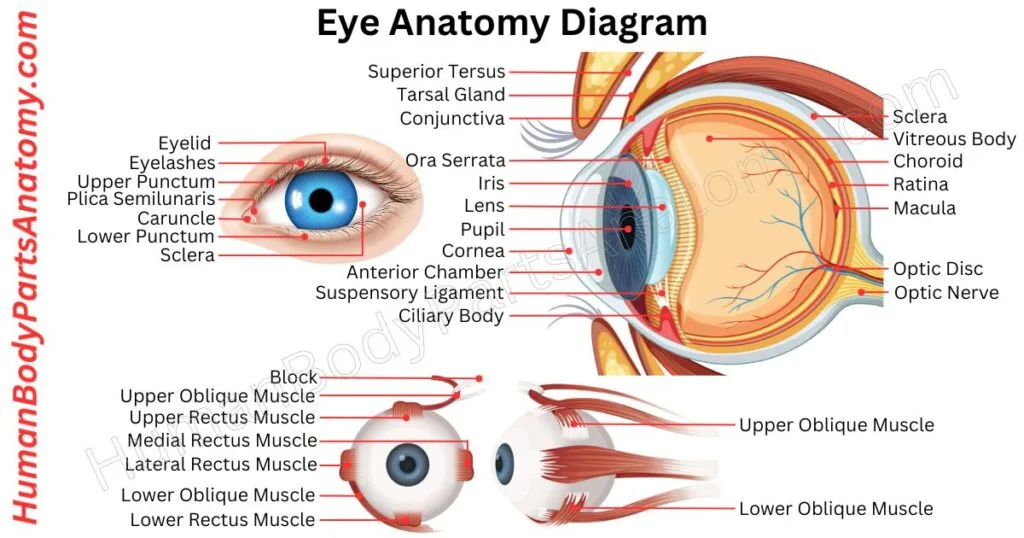
Eye

Our eyes are incredible organs that respond to light and allow us to see and understand the world around us. The human brain can’t sense the environment directly.

Our eyes collect crucial information about what’s happening and help us to see things and keep our body balanced.

Most people have two eyes that work together to give us a broad view—about 200 degrees side-to-side and 135 degrees up and down. When our eyes cooperate well, we can perceive depth and see things in 3D and colors.

It’s important to note the difference between sight and vision. Sight is what our eyes do, capturing images and light. Vision is the whole process—from the eyes sending signals to the brain interpreting those signals into meaningful images.

Detailed labeled diagram of human eye anatomy showing cornea, iris, pupil, lens, retina, optic nerve, and other major parts with their functions.

Read More – Ultimate Guide to Eye Anatomy: Parts, Structure, Functions & Diagram

Ear

Your ears help us hear and stay balanced. When sound enters your ear, it makes your eardrum vibrate. This vibration passes through tiny bones in your middle ear, making the sound louder. Then, in your inner ear, small hair cells turn the vibrations into electrical signals and send them to your brain.

Your inner ear also has fluid-filled canals that help you stay balanced. These canals have hair-like sensors. When you move, the fluid shifts and sends signals to your brain.

Your brain uses these signals to help your muscles keep you steady. So, your ears do much more than hear—they help you stay on your feet!

Detailed diagram of human ear anatomy showing outer ear, middle ear, and inner ear with labeled parts including pinna, ear canal, eardrum, ossicles, cochlea, and auditory nerve.

Read More – Ultimate Guide to Ear Anatomy: Parts, Structure, Functions & Diagram

/10

Ear Anatomy

External Ear Anatomy

Start the Quiz on the External Ear Anatomy.

1 / 10

1. Which muscle is primarily responsible for moving the auricle in people who can 'wiggle their ears'?

2 / 10

2. The point of maximal concavity in the tympanic membrane is called the:

3 / 10

3. Which of the following correctly describes the lymphatic drainage of the auricle?

4 / 10

4. What is the primary function of the helix of the ear?

5 / 10

5. Malignant (necrotizing) otitis externa is a severe infection primarily seen in:

6 / 10

6. The resonant frequency of the adult external ear canal is approximately:

7 / 10

7. Which bone houses the external auditory meatus?

8 / 10

8. In children under age 3, the external auditory canal is pulled in which direction for otoscopy?

9 / 10

9. Aural atresia refers to:

10 / 10

10. The intertragic notch separates which two structures?

Your score is

The average score is 0%

0%

/10

Ear Anatomy

Middle Ear Anatomy

Start the Quiz on the Middle Ear Anatomy.

1 / 10

1. Which ossicle connects directly to the oval window of the inner ear?

2 / 10

2. In acute otitis media in the US, which organism is the most common bacterial cause?

3 / 10

3. The mastoid process communicates with the middle ear through which opening?

4 / 10

4. The chorda tympani nerve, which carries taste from the anterior two-thirds of the tongue, passes through which space?

5 / 10

5. 'Glue ear' in children most commonly causes which type and degree of hearing loss?

6 / 10

6. The stapedius is the smallest skeletal muscle in the human body. It is innervated by:

7 / 10

7. What are the three ossicles of the middle ear in order from lateral to medial?

8 / 10

8. The tensor veli palatini muscle is involved in Eustachian tube function. It is innervated by:

9 / 10

9. What is the promontory of the middle ear?

10 / 10

10. What is a cholesteatoma?

Your score is

The average score is 0%

0%

/10

Ear Anatomy

Inner Ear Anatomy

Start the Quiz on the Inner Ear Anatomy.

1 / 10

1. Otoacoustic emissions (OAEs) are used in newborn hearing screening. They are generated by:

2 / 10

2. What is the role of the efferent olivocochlear system in hearing?

3 / 10

3. Presbycusis (age-related hearing loss) typically involves:

4 / 10

4. How do outer hair cells differ functionally from inner hair cells?

5 / 10

5. Sudden sensorineural hearing loss (SSNHL) is defined as:

6 / 10

6. The helicotrema is located at the:

7 / 10

7. What is the vestibulo-ocular reflex (VOR)?

8 / 10

8. The nystagmus seen in BPPV is typically:

9 / 10

9. Which imaging modality is the gold standard for evaluating cochlear and vestibular aqueduct anatomy, bony inner ear malformations, and otosclerosis?

10 / 10

10. Hair cell stereocilia deflection toward the tallest stereocilia (kinocilium direction) causes:

Your score is

The average score is 0%

0%

Tongue

The tongue is a muscle in your mouth that helps you eat, talk, and taste food. It is covered in tiny bumps called taste buds, which let you taste sweet, sour, salty, and bitter. The tongue is always wet because of saliva, which also helps you taste and chew.

When you eat, the tongue helps move food around so you can chew it properly. It also enables you to swallow by pushing food down your throat. 

In humans, the tongue plays a big role in talking, helping to form words and sounds. In other animals, it helps make different noises or vocalizations.

The tongue has two main parts: the front part, which is in the mouth, and the back part, which is closer to the throat. A line down the middle of the tongue separates it into left and right halves.

Detailed diagram of tongue anatomy showing parts such as tip, dorsum, root, papillae, muscles, taste buds, and their functions in speech, swallowing, and taste.

Read More – Tongue Anatomy: Complete Guide with Parts, Names, Functions & Diagram

/10

Tongue Anatomy

Tongue Anatomy

Start the Quiz on the Tongue Anatomy.

1 / 10

1. Why does your tongue feel "fuzzy" or tingly when you eat fresh pineapple?

2 / 10

2. What is the medical term for tongue inflammation?

3 / 10

3. Can you live without your tongue?

4 / 10

4. A burning sensation on the tongue with no visible cause is called:

5 / 10

5. What are the small bumps visible on your tongue's surface called?

6 / 10

6. What causes the condition known as "geographic tongue"?

7 / 10

7. Which cranial nerve is primarily responsible for taste sensation in the front two-thirds of the tongue?

8 / 10

8. Where is the foramen cecum located on the tongue?

9 / 10

9. What color should a healthy tongue normally be?

10 / 10

10. Which of the following conditions causes a "strawberry tongue" appearance?

Your score is

The average score is 0%

0%

Human Body Parts – Integument

Nails

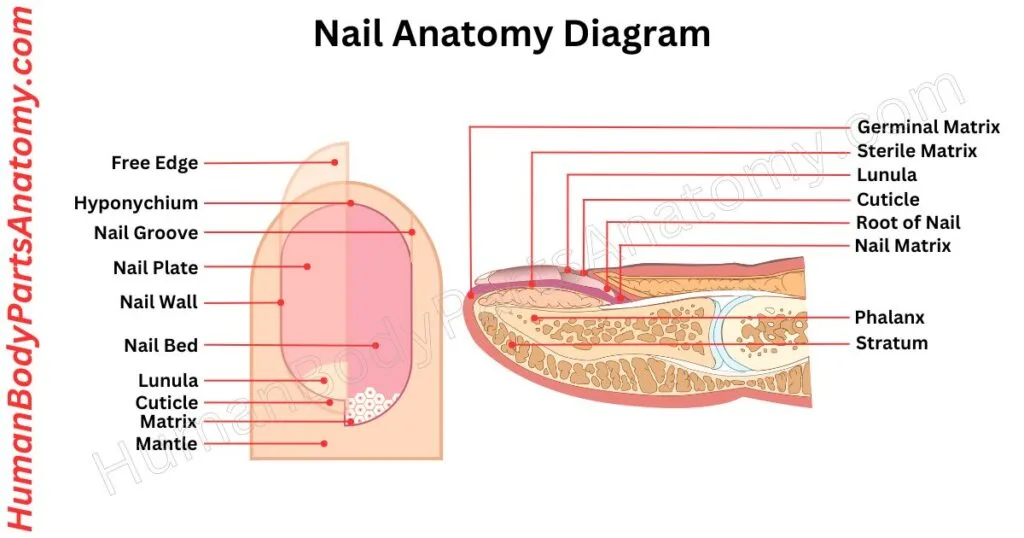
Nails, found on our fingers and toes, are rigid plates made of a protein called alpha-keratin. This protein is also in other animals’ claws, hooves, and horns.

Nails are attached to the nail bed and can be used for scratching. The visible part is the “nail plate,” made of hard keratin and about half a millimeter thick.

Nails have lateral folds on each side and a proximal nail fold at the base. The cuticle, a thin layer of skin, protects and enhances sensory experiences.

Nail Anatomy, Parts, Names & Diagram

Read More – Complete Guide to Nail Anatomy with all Parts, Names & Diagrams

Hair

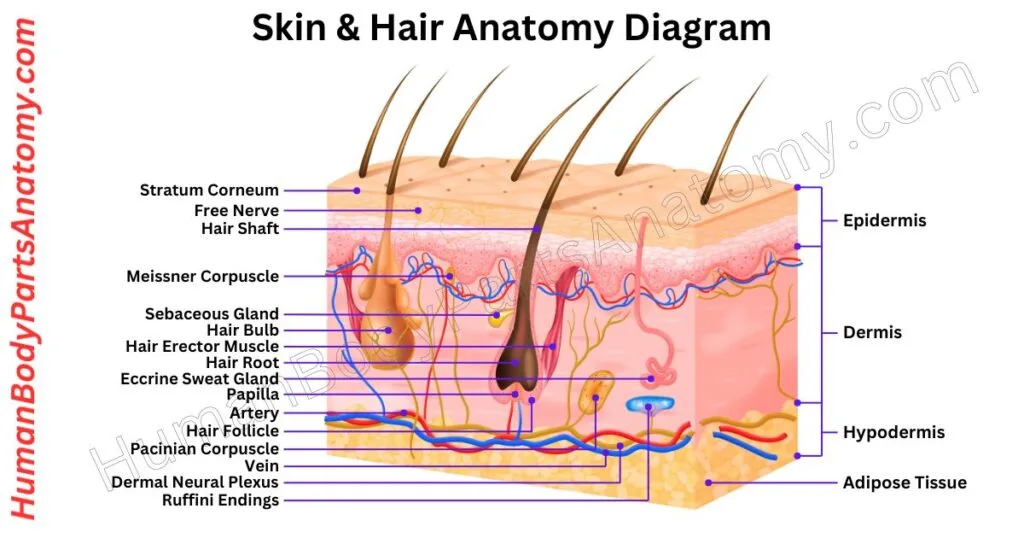
Hair is a protein-based filament that emerges from follicles embedded in the dermis layer of the skin. It is a distinctive feature of mammals.

Except for areas of smooth, hairless skin, the human body is largely covered with follicles that produce two types of hair: thick terminal hair and fine vellus hair.

While much attention is given to hair growth, types, and care, hair also serves as a significant biomaterial, primarily composed of alpha-keratin protein.

Many mammals have hair that serves various purposes. Hair helps animals stay warm and can help them blend into their surroundings. For some, it also sends signals to other animals, like warnings or attracting a mate.

In some cases, hair can even help defend the animal or, though rarely, be used for attack. Hair can also act like a sensor, enhancing the sense of touch.

Detailed diagram of human skin and hair anatomy showing layers of the skin, hair follicle structure, sebaceous glands, sweat glands, and associated parts with labeled names and functions.

Skin

Skin is the soft outer layer that covers and protects the bodies of humans and many animals. It has three main jobs: protecting, controlling, and sensing.

First, the skin acts as a shield, keeping out harmful things like germs and preventing the body from losing too much water. It also helps keep us warm or cool by controlling our body temperature.

Additionally, the skin lets us feel sensations like touch. When exposed to sunlight, skin helps make vitamin D, which is important for our health.

If the skin gets hurt, it can heal itself by forming scar tissue, which might look different from the surrounding skin.

The thickness of the skin changes depending on where it is on the body. For example, the skin around the eyes is very thin, only about 0.5 mm thick, making it more prone to wrinkles.

On the other hand, the skin on the palms of our hands and the soles of our feet is much thicker, up to 4 mm. Hormones like estrogen can help skin wounds heal faster.

Human Anatomy – Nervous System

Brain

The brain is a vital organ that acts as the control center of the nervous system in all vertebrates and most invertebrates. It sits inside the skull, where it is cushioned and protected by cerebrospinal fluid.

As one of the most complex and essential organs, the brain works closely with the spinal cord to form the central nervous system.

This system manages nearly all body functions by processing information from the senses and sending out appropriate responses.

At birth, a baby’s brain weighs around 350 to 400 grams—only about 25% of the adult brain’s weight, which averages around 1.4 to 1.45 kilograms.

Despite making up just 2% of total body weight, the brain plays a huge role in overall function and development.

The most rapid brain growth happens during the first three years of life, and by age five, it reaches about 90% of its adult size.

On average, the adult brain measures roughly 167 mm in length, 140 mm in width, and 93 mm in height.

While the brain keeps changing throughout life, the most dramatic structural changes occur in early childhood. After the age of four, brain growth continues but at a slower and more gradual pace.

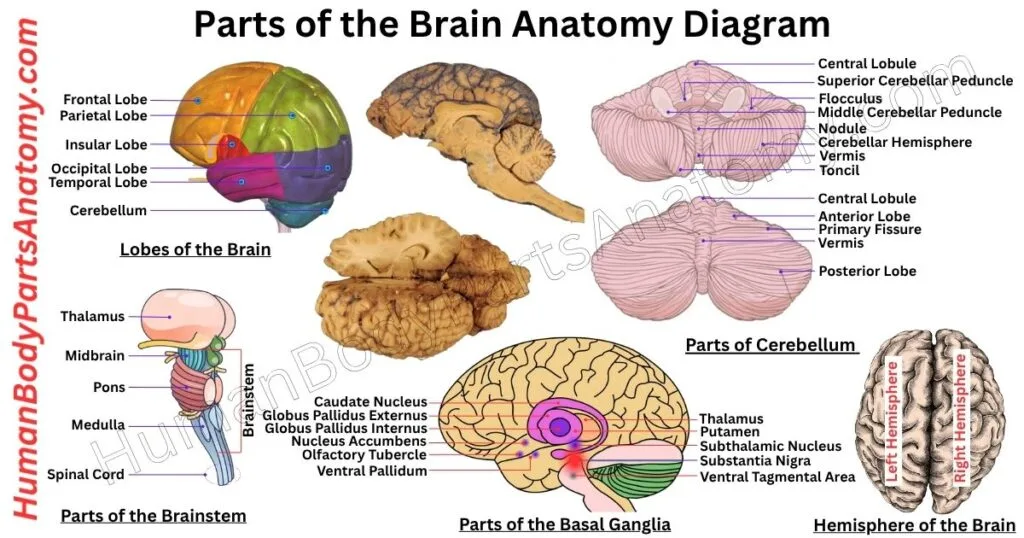
Detailed diagram of parts of the brain anatomy showing all major parts including cerebrum, cerebellum, brainstem, lobes, and functional regions labeled with names and their functions.
A complete diagram of the human brain highlighting key anatomical parts and their respective functions for easy learning and reference.

Read More – Parts of the Brain Anatomy: Complete Guide with Names, Functions & Diagram

/10

Brain Anatomy

Midbrain Anatomy

Start the Quiz on the Midbrain Anatomy.

1 / 10

1. The nigrothalamic pathway projects from which midbrain structure to which thalamic nucleus?

2 / 10

2. The rubrospinal tract decussates at which level of the brainstem and descends to control which muscles?

3 / 10

3. The red nucleus is a large, well-vascularized structure in the midbrain tegmentum. It receives input from which major sources?

4 / 10

4. The substantia nigra pars compacta (SNc) contains neurons with dark brownish-black pigment due to what substance?

5 / 10

5. The 'pretectal nucleus' involved in the pupillary light reflex is located just anterior to which midbrain landmark?

6 / 10

6. The superior colliculi are located on the dorsal midbrain and are primarily involved in which function?

7 / 10

7. Which of the following correctly describes the organization of the cerebral peduncles (crus cerebri)?

8 / 10

8. The decussation of the superior cerebellar peduncle (SCP) occurs at which midbrain level?

9 / 10

9. The decussation of the trochlear nerves (CN IV) occurs in the dorsal midbrain. What structure do they decussate within?

10 / 10

10. The oculomotor nerve (CN III) travels through the subarachnoid space and passes between which two arteries, making it susceptible to compression by aneurysms in that region?

Your score is

The average score is 0%

0%

/10

Brain Anatomy

Brainstem Anatomy

Start the Quiz on the Brainstem Anatomy.

1 / 10

1. The pyramid of the medulla contains which major descending tract?

2 / 10

2. Which cranial nerve exits at the pontomedullary junction on the ventral surface, near the pyramid of the medulla?

3 / 10

3. A unilateral hypoglossal nerve (CN XII) palsy causes the tongue to deviate toward which side when protruded?

4 / 10

4. The corticospinal tract decussates (crosses) at which level of the brainstem?

5 / 10

5. Parinaud's syndrome (dorsal midbrain syndrome) is caused by pressure on which structure, typically from what pathology?

6 / 10

6. Locked-in syndrome results from bilateral lesion of which brainstem structure?

7 / 10

7. Which long tract, when damaged in the brainstem, produces the distinctive finding of loss of pain and temperature on the CONTRALATERAL body?

8 / 10

8. Which brainstem pathway, when activated, produces analgesia by inhibiting pain transmission at the spinal cord level?

9 / 10

9. The raphe nuclei, the major serotonergic cell groups in the brain, are distributed along the midline of which brainstem structures?

10 / 10

10. Which cranial nerve emerges from the dorsal surface of the brainstem and wraps around the cerebral peduncle?

Your score is

The average score is 0%

0%

/10

Brain Anatomy

Cerebellum Anatomy

Start the Quiz on the Cerebellum Anatomy.

1 / 10

1. Which condition, caused by chronic alcohol abuse, primarily damages the anterior lobe of the cerebellum and presents with gait ataxia out of proportion to limb ataxia?

2 / 10

2. In cerebellar circuitry, what is the net effect of Purkinje cell activation on the deep cerebellar nuclei?

3 / 10

3. Which fiber type provides the major excitatory drive to Purkinje cells via the molecular layer?

4 / 10

4. In the circuit: cortex → pontine nuclei → cerebellum → dentate nucleus → SCP → ???, what is the final destination before commands reach the motor cortex?

5 / 10

5. The blood supply to the anterior inferior cerebellum, inner ear (labyrinthine artery), and lateral pons comes primarily from which artery?

6 / 10

6. The spinocerebellar tract (anterior and posterior) carries which type of sensory information to the cerebellum?

7 / 10

7. A student performs the heel-shin test on a patient and notices the patient slides their heel erratically off the shin. This finding indicates dysfunction of which system?

8 / 10

8. Which hereditary ataxia is autosomal dominant and caused by CAG repeat expansions, often manifesting as SCA1, SCA2, SCA3 (Machado-Joseph disease), etc.?

9 / 10

9. Friedreich's ataxia (FA) is a genetic spinocerebellar disease. What is the mode of inheritance and which protein is deficient?

10 / 10

10. Arnold-Chiari malformation Type I is characterized by which anatomical finding?

Your score is

The average score is 0%

0%

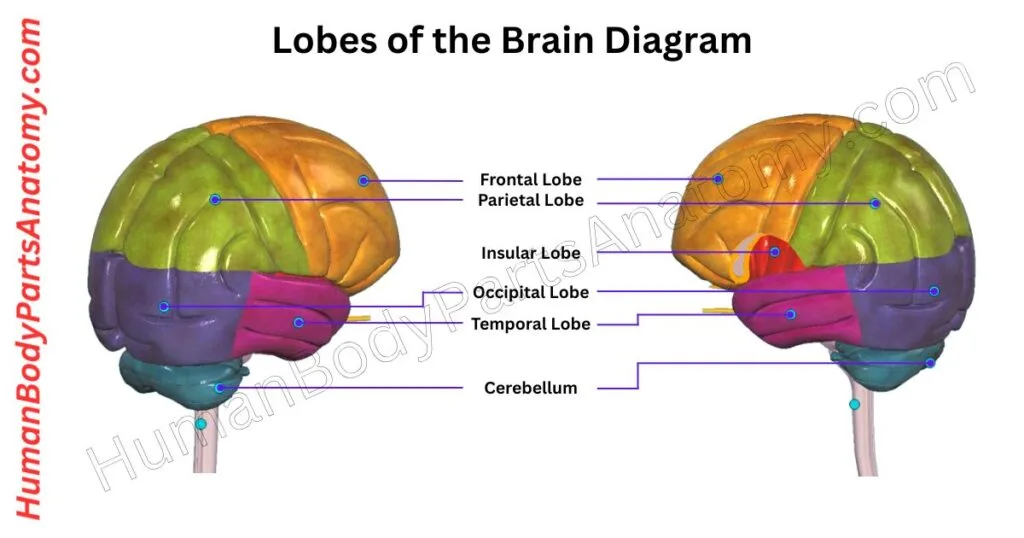
Lobes of the Brain

The cerebrum is the largest portion of the brain and sits at the top of the skull. Its outer layer is folded into grooves called sulci and raised ridges called gyri.

These folds let the brain fit more surface area inside the skull without getting bigger. Just beneath the folds, there is a thin layer—about 2 to 4 millimeters thick—of gray matter.

This gray matter contains neuron cell bodies and is where information is processed. Below it lies the white matter, made up of long fiber tracts that carry signals in and out of the gray layer.

The cerebrum is split into two halves, known as the left and right hemispheres. A bundle of fibers called the corpus callosum connects these halves and lets them send messages back and forth.

Each hemisphere mainly controls the opposite side of the body: the left side of the brain handles movement and sensation on the right side of the body, and vice versa.

Finally, each hemisphere is divided into four regions, or lobes, which specialize in tasks like processing touch, planning movements, handling vision, and managing speech. These lobes are Frontal Lobe, Parietal Lobe, Temporal Lobe, and Occipital Lobe.

/0

Brain Anatomy

Lobes of the Brain

Start the Quiz on the Lobes of the Brain Anatomy.

Add at least one question to start

Your score is

The average score is 0%

0%

Human Anatomy – Cardiovascular System

Heart

Detailed Human Heart Anatomy

The heart is a vital organ of muscles that pumps blood throughout the body and delivers oxygen and nutrients to every human body part. While doing this, it removes waste like carbon dioxide from the body.

In humans, the heart is located in the chest’s central space between the lungs and leaning left. It is around the size of a closed fist and weighs around 10 ounces in adults. However, it varies with factors like body size and gender.

Humans, birds, and mammals have four heart chambers – right atria, upper left, lower left, and right ventricles. The right side is the right heart, and the left is the left heart.

The heart is separated by the muscular wall called the septum. Blood is pumped from the right side of the heart through the pulmonary arteries for oxygen, and this blood goes to the lungs.

Special valves on the right side of the heart prevent blood from backflowing into the heart. After the lungs receive oxygen, the left side gets the blood through the pulmonary veins.

Detailed diagram of human heart anatomy showing chambers, valves, arteries, and veins with labeled parts and their functions.

Read More – Heart Anatomy: Complete Guide with Parts, Names, Functions & Diagram

/10

Heart Anatomy

Valves of the Heart Anatomy

Start the Quiz on the Valves of the Heart Anatomy.

1 / 10

1. Which of the following correctly describes the anatomy of the tricuspid valve annulus?

2 / 10

2. The opening snap (OS) in mitral stenosis is produced by:

3 / 10

3. The Gallavardin phenomenon describes which specific clinical feature of aortic stenosis?

4 / 10

4. Which physical examination finding is characteristic of aortic regurgitation?

5 / 10

5. The mitral valve is anatomically different from the tricuspid valve in that it:

6 / 10

6. A patient with rheumatic heart disease has involvement of multiple valves. What is the MOST common pattern of valve involvement in rheumatic heart disease?

7 / 10

7. The 'sail-like' tricuspid valve leaflet seen in Ebstein's anomaly refers to which leaflet?

8 / 10

8. The semilunar valves (aortic and pulmonary) differ from the AV valves in which key anatomical way?

9 / 10

9. Transcatheter aortic valve replacement (TAVR) targets which anatomical location?

10 / 10

10. Bicuspid aortic valve (BAV) is associated with which vascular complication?

Your score is

The average score is 0%

0%

/10

Heart Anatomy

Heart Chambers Anatomy

Start the Quiz on the Heart Chambers Anatomy.

1 / 10

1. A cardiac MRI shows that the right ventricle is dilated with fatty infiltration and fibrosis of the free wall. This is MOST consistent with:

2 / 10

2. The moderator band (septomarginal trabecula) is a muscular band found in which cardiac chamber?

3 / 10

3. The interventricular septum (IVS) is made up of which two portions?

4 / 10

4. What is the approximate end-diastolic volume (EDV) of the normal adult left ventricle?

5 / 10

5. Which of the following is NOT a correct anatomical boundary of the right atrium?

6 / 10

6. During auscultation, the S3 heart sound is produced by which event involving the cardiac chambers?

7 / 10

7. The left ventricular outflow tract (LVOT) is bounded by which structures?

8 / 10

8. A 35-year-old woman is found to have an 'ostium secundum' atrial septal defect (ASD). This defect is located:

9 / 10

9. A 60-year-old man has calcific aortic stenosis. Which chamber undergoes the most significant structural change as a result?

10 / 10

10. The smooth-walled portion of the left atrium (posterior wall) is derived embryologically from:

Your score is

The average score is 0%

0%

/10

Heart Anatomy

External Structure of Heart Anatomy

Start the Quiz on the External Structure of Heart Anatomy.

1 / 10

1. The middle cardiac vein runs in which groove?

2 / 10

2. The left border of the heart (on anterior view) is formed primarily by which chamber?

3 / 10

3. The oblique sinus of the pericardium is clinically significant because:

4 / 10

4. Which chamber of the heart forms most of the anterior surface of the heart?

5 / 10

5. The sinuses of Valsalva are located at the root of which vessel?

6 / 10

6. The great cardiac vein runs alongside which artery on the anterior surface of the heart?

7 / 10

7. Which of the following correctly describes the relationship between the aorta and pulmonary trunk at their origins?

8 / 10

8. The 'bare area' of the heart refers to:

9 / 10

9. Which of the following accurately describes the position of the heart in the mediastinum?

10 / 10

10. Which external groove separates the two ventricles posteriorly?

Your score is

The average score is 0%

0%

Arteries

Arteries carry oxygen-rich blood from the heart to all our organs. They work closely with veins and the heart, like tubes that transport blood from the heart to all parts of the body.

This blood, with oxygen and nutrients, is essential for adequately functioning the different organs. Arteries can change based on signals from the nervous system and outside factors like pressure and temperature.

Nerves in the arteries help them respond to these signals. Hormones like catecholamines can narrow or widen arteries, influencing blood pressure and flow. So, arteries are dynamic vessels that ensure our body gets the oxygen and nutrients it needs.

Human Anatomy – Urinary System

Ureter

The ureters are two muscular tubes that carry urine from the kidneys to the bladder for storage before it is excreted from the body.

After blood is filtered in the kidneys, the resulting liquid, called filtrate, goes through several stages of reabsorption in the kidneys tubules.

Eventually, the liquid becomes urine and passes into the collecting ducts. From there, urine moves into the calyces and then the renal pelvis, which is the starting point of the ureters.

The ureters get their blood supply directly and indirectly from the abdominal aorta. While there are no nerve ganglia on the ureters, they do receive signals from both the sympathetic and parasympathetic nervous systems.

In adults, the ureters are usually 20 to 30 centimeters long and 3 to 4 millimeters wide. They are lined with urothelial cells, a type of transitional epithelium, and have an extra layer of smooth muscle in the lower third to help move urine through peristalsis (wave-like muscle contractions).

Detailed diagram of ureter anatomy showing structure, parts, and function in the human urinary system, including kidney connection to bladder.

Kidney

The kidneys are two bean-shaped organs in your urinary system that filter your blood. Every day, they process about 200 quarts of fluid, which is enough to fill a large bathtub.

They remove waste products, excreted as urine, amounting to about two quarts per day. The remaining 198 quarts of fluid are reabsorbed and reused by your body.

In addition to waste removal, the kidneys maintain fluid balance and regulate electrolytes, including essential minerals like sodium and potassium.

They play a crucial role in filtering out toxins and waste from your blood, such as urea, creatinine, and acids, processing about half a cup of blood every minute.

Each kidney houses over a million filtering units called nephrons. Nephrons consist of :

  • Glomeruli: These are clusters of tiny blood vessels that initiate the blood filtration process, a step known as glomerular filtration. They filter substances, which are then passed to the renal tubules.
  • Renal Tubules: These small tubes reabsorb water, nutrients, and essential minerals, including sodium and potassium. They also remove waste and excess acids, sending these to the kidney’s collecting chambers. The waste is eventually excreted as urine.

This streamlined process ensures that your body efficiently removes waste and maintains a balanced internal environment.

Detailed kidney anatomy diagram showing major parts including renal cortex, medulla, pyramids, renal pelvis, ureter, arteries, and veins, with labels explaining structure and function.
/10

Kidney Anatomy

External Kidney Anatomy

Start the Quiz on the XYZ External Kidney Anatomy.

1 / 10

1. What type of organ is the kidney?

2 / 10

2. What external feature distinguishes kidneys from other organs?

3 / 10

3. What is the indentation on the kidney where vessels enter called?

4 / 10

4. What is the kidney’s overall shape often compared to?

5 / 10

5. Which layer directly touches the kidney surface?

6 / 10

6. Which organ lies directly above the right kidney?

7 / 10

7. Where are the kidneys located in the human body?

8 / 10

8. What role does the external kidney anatomy play?

9 / 10

9. Why are kidneys not considered abdominal organs?

10 / 10

10. Which imaging test commonly shows kidney location?

Your score is

The average score is 70%

0%

/10

Kidney Anatomy

Internal Kidney Anatomy

Start the Quiz on the XYZ Internal Kidney Anatomy.

1 / 10

1. What is the function of the nephron?

2 / 10

2. What part of nephron senses sodium levels?

3 / 10

3. Which part of the nephron regulates salt balance?

4 / 10

4. Which kidney structure plays a role in anemia prevention?

5 / 10

5. Why is nephron damage irreversible?

6 / 10

6. Where does urine leave the kidney?

7 / 10

7. Which internal structure directs urine flow

8 / 10

8. Which structure is sensitive to blood pressure changes?

9 / 10

9. Which structure fine-tunes urine composition?

10 / 10

10. Where does blood filtration begin?

Your score is

The average score is 60%

0%

Human Body Parts

Leg

The leg is part of your body between your knee and foot. It is made up of two bones: the tibia and the fibula. These bones give support and balance to your body, and they work with muscles to help you move around.

The tibia connects with the femur at your knee, and at the bottom, it joins with the fibula to form the ankle joint with the talus bone. This ankle joint is special because it helps your foot move smoothly while also keeping it stable.

When your ankle joint works properly, it lets your foot move. It makes the human body easier to walk and move around comfortably.

Detailed human leg anatomy diagram showing major parts including femur, tibia, fibula, patella, thigh muscles, calf muscles, knee joint, ankle, and foot with labeled names, diagram and functions.

Read More – Complete Guide on Leg Anatomy with Parts, Functions & Diagram

0%

Leg Anatomy

Leg Bone Anatomy

Start the Quiz on Leg Bones Anatomy.

1 / 10

1.

The head of the fibula articulates with the tibia but not the knee joint. True or False?

2 / 10

2.

The femur’s neck angle decreases with age; abnormalities in this angle can lead to hip or knee misalignment. True or False?

3 / 10

3.

The fibula contributes to the upper ankle’s stability by forming which feature?

4 / 10

4.

Which bone has a trochlear groove for the patella to glide over during knee motion?

5 / 10

5.

During a “hip fracture” in elderly persons, which bone is fractured?

6 / 10

6.

The tibia articulates with the femur and the fibula. True or False

7 / 10

7.

Which bone’s head forms part of the proximal tibio-fibular joint (just below the knee)?

8 / 10

8.

The distal end of the fibula creates the lateral malleolus. True or False?

9 / 10

9.

Which bone’s distal end articulates with the talus and also forms the fibular notch for the fibula?

10 / 10

10.

Which bone is most vulnerable to fractures in severe trauma because of its weight-bearing and load-transmitting role?

Your score is

The average score is 60%

0%

0%

Leg Anatomy

Leg Muscles Anatomy

Start the Quiz on Leg Muscles Anatomy.

1 / 10

1.

Which muscle is activated when you stand on tip-toes to reach something on a high shelf?

2 / 10

2.

Which muscle lies deep to the gastrocnemius and is crucial for maintaining standing posture by plantar-flexion when the knee is bent?

3 / 10

3.

Which muscle controls the position of the knee cap (patella) and can be relevant in patellofemoral pain syndrome?

4 / 10

4.

Which muscle is most important for controlling pronation and supporting the arch of the foot?

5 / 10

5.

Which posterior leg muscle is important for toe-off during running by plantar-flexing the foot while knee is bent?

6 / 10

6.

Which muscle crosses both the hip and knee joints and hence can flex the hip and extend the knee?

7 / 10

7.

Which muscle crosses the hip joint to flex the thigh and also originates from the lumbar spine?

8 / 10

8.

Which muscle is most active when you push off during a sprint, contributing to ankle plantar-flexion and knee flexion?

9 / 10

9.

Which muscle connects to the tibial tuberosity via the patellar ligament and helps with knee extension?

10 / 10

10.

Which muscle is the primary knee flexor and also contributes to lateral rotation of the leg when knee is bent?

Your score is

The average score is 13%

0%

0%

Leg Anatomy

Leg Joints Anatomy

Start the Quiz on Leg Joints Anatomy.

1 / 10

1.

The medial collateral ligament (MCL) of the knee resists what type of movement?

2 / 10

1.

A “meniscus tear” occurs in which joint?

3 / 10

2.

The proximal tibio-fibular joint helps with what?

4 / 10

3.

Which of the following joints is not a major weight-bearing joint of the leg?

5 / 10

4.

Which joint feature reduces friction between the moving bones in the hip, knee, and ankle joints?

6 / 10

5.

Which joint has a “mortise” socket structure that grips the talus like a fork?

7 / 10

6.

Which is the largest joint in the human body and connects the thigh to the lower leg?

8 / 10

7.

A “runner’s knee” often involves which joint pathology?

9 / 10

8.

When performing a lunge, which joint primarily undergoes flexion to lower the body?

10 / 10

9.

What movement is the ankle joint primarily designed for?

Your score is

The average score is 0%

0%

Foot

The foot is a complicated part of the human anatomy, consisting of many bones, joints, muscles, and tendons. It helps us walk and stand up straight. The foot includes everything below the ankle joint.

The ankle joint is where the shinbone (tibia), the thinner bone next to it (fibula), and a bone called the talus meet.

There are 26 bones in the foot, divided into three groups: the hindfoot, midfoot, and forefoot. These bones have cartilage covering their surfaces, where they meet each other to form joints.

The joints are surrounded by capsules and ligaments, which keep them stable. Twenty-nine muscles move the foot and ankle bones, which are connected to the bones by tendons.

Detailed labeled diagram of human foot anatomy showing bones, muscles, tendons, ligaments, and arches with their names and functions.

Arm

The upper extremity, or arm, is a crucial part of the human anatomy. It has three main sections: the upper arm, forearm, and hand. It starts from the shoulder to the fingers and includes 30 bones, nerves, blood vessels, and muscles.

Starting at the shoulder joint, often called a ball-and-saucer joint. It allows for a wide range of movement, though it’s less stable than the hip joint.

Next is the elbow joint, a hinge joint that facilitates arm bending and straightening. This joint also gives the forearm the unique abilities of pronation and supination.

The wrist joint is ellipsoidal or condyloid, providing a good range of motion. The carpal bones have intercarpal joints, which allow some movement. The interphalangeal joints in the fingers act as basic hinge joints.

Detailed arm anatomy diagram showing upper arm, forearm, shoulder, elbow, wrist, bones, muscles, and joints with labeled parts and functions.

Read More – Comprehensive Guide to Arm Anatomy: Parts, Names & Diagram

Hand

A hand is a helpful part at the end of our arm. Humans and some animals like monkeys and koalas have hands. Even raccoons are said to have hands but don’t have thumbs like we do.

A human hand usually has five parts called fingers. We count the thumb as one of them. There are 27 bones in a hand, not depending on a particular bone. There are 14 finger bones connecting to the wrist bones.

Each hand has five long metacarpal bones and eight small carpal bones. Thus, a hand comprises fingers, thumbs, and bones that help it move and work.
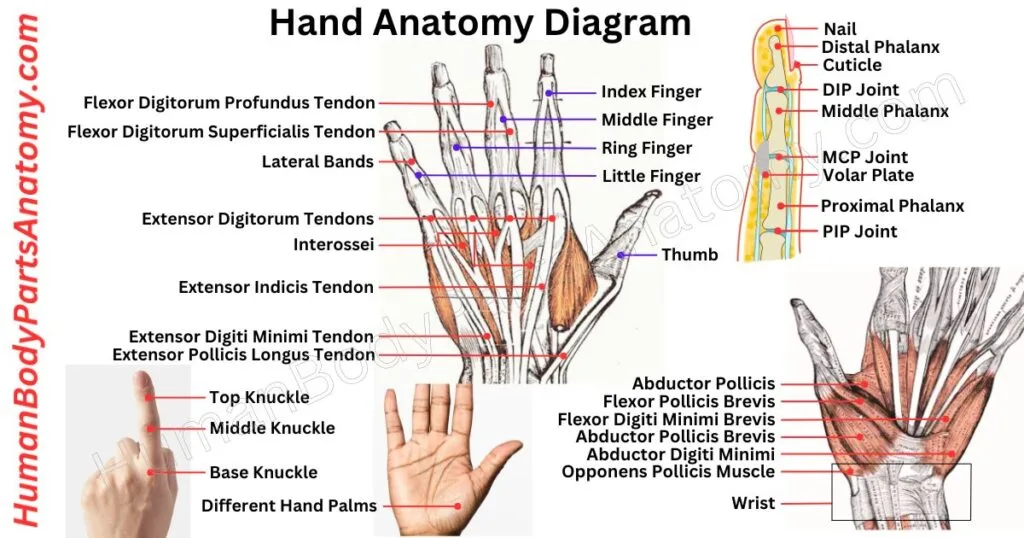
Also, it contains various muscles, tendons, and ligaments, which help to do multiple operations like gripping and holding something in hand.

Detailed diagram of human hand anatomy showing bones, muscles, tendons, joints, and nerves with labeled parts and functions.

Read More – Comprehensive Guide to Hand Anatomy: Parts, Functions & Diagram

/10

Hand Anatomy

Hand Bone Anatomy

Start the Quiz on the Hand Bone Anatomy.

1 / 10

1. Which bone is prone to dislocation from high-force wrist extension?

2 / 10

2. Which bone forms the center of wrist motion?

3 / 10

3. Which bone features a hook used for ligament and tendon attachment?

4 / 10

4. Which bone is central to carpal tunnel space?

5 / 10

5. The pisiform sits on top of which bone?

6 / 10

6. Which bone is most commonly fractured in the wrist?

7 / 10

7. Which bone allows circular thumb motion (opposition)?

8 / 10

8. Which bone sits between scaphoid and capitate?

9 / 10

9. Which carpal bone lies closest to the radius?

10 / 10

10. Which bone lies on the thumb side of the wrist?

Your score is

The average score is 62%

0%

/10

Hand Anatomy

Hand Joints Anatomy

Start the Quiz on the Hand Joints Anatomy.

1 / 10

1. Which joint supports precise stylus use on tablets?

2 / 10

2. Which joint allows fingertip precision like picking up a needle?

3 / 10

3. Which joint is central to strong pinch (thumb to index)?

4 / 10

4. Which joint is most commonly injured during sports ball impact (e.g., basketball jammed finger)?

5 / 10

5. Which joint enables finger spread when typing on wide keyboards?

6 / 10

6. Which joint between phalanges straightens when holding a tray flat?

7 / 10

7. Which joint stabilizes thumb when opening bottles?

8 / 10

8. Which joint at the thumb base allows wide motion like texting or opening jars?

9 / 10

9. Which joint forms your main knuckles when you make a fist?

10 / 10

10. Which joint gets stiff first in rheumatoid arthritis hand deformity?

Your score is

The average score is 0%

0%

/10

Hand Anatomy

Hand Muscles Anatomy

Start the Quiz on the Hand Muscles Anatomy.

1 / 10

1. Which muscle mainly flexes the thumb tip for gripping small objects like screws?

2 / 10

2. Finger extension to release rock climbing hold?

3 / 10

3. Pinky control in flute playing?

4 / 10

4. Opposes thumb for gaming joystick?

5 / 10

5. Which muscle extends fingers after gripping weights?

6 / 10

6. Muscle active when squeezing toothpaste tube?

7 / 10

7. Extends fingers to release basketball?

8 / 10

8. Finger spread for high-five?

9 / 10

9. Finger adduction while shuffling poker chips?

10 / 10

10. Which muscle prevents finger collapse while lifting grocery bags?

Your score is

The average score is 0%

0%

Finger

Fingers are essential parts of our hands and similar limbs in many animals. Most animals with limbs, like humans and primates, have five fingers, while shorter ones are called toes.

Fingers are flexible and opposable in humans. They help us feel things and make precise movements, and they are vital for skills like grabbing and moving objects.

The thumb is the first digit, followed by the index finger, the middle finger, the ring finger, and the little finger, also known as the pinkie.
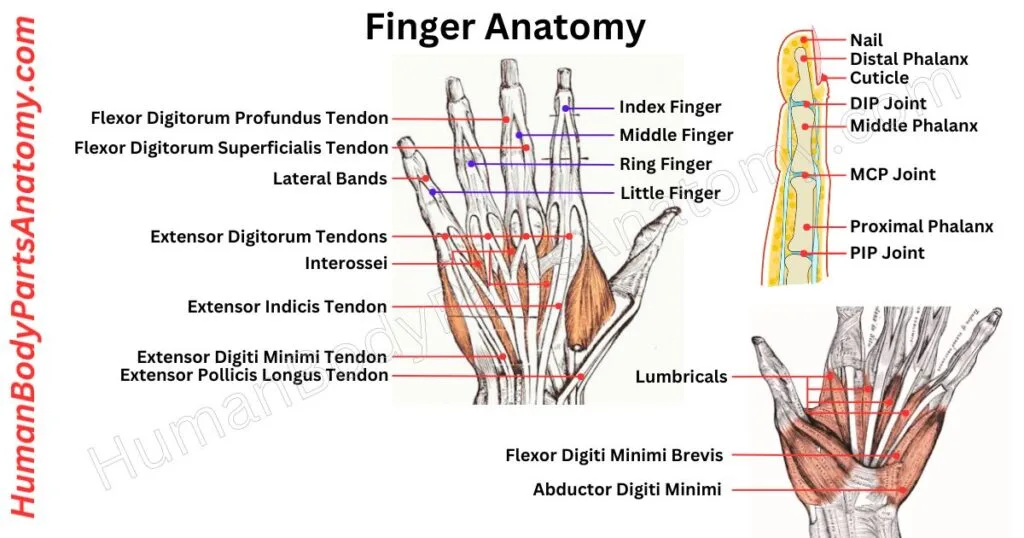
Finger anatomy diagram showing bones (phalanges), joints, tendons, muscles, nerves, and blood vessels with labeled parts and functions.

Read More – Complete Guide to Finger Anatomy with Parts, Names, Functions & Diagram

/10

Finger Anatomy

Finger Joints Anatomy

Start the Quiz on the Finger Joints Anatomy.

1 / 10

1. What structure prevents joint overextension?

2 / 10

2. Why are finger joints prone to arthritis?

3 / 10

3. What is the main job of finger joints?

4 / 10

4. Which joint is most commonly fractured?

5 / 10

5. What is joint dislocation?

6 / 10

6. Which finger joint has the thickest cartilage?

7 / 10

7. What fluid lubricates finger joints?

8 / 10

8. How many joints does each finger have?

9 / 10

9. Which finger joint helps with fine motor skills?

10 / 10

10. Why do finger joints hurt in cold weather?

Your score is

The average score is 66%

0%

/10

Finger Anatomy

Finger Ligaments Anatomy

Start the Quiz on the Finger Ligaments Anatomy.

1 / 10

1. What is ligament fibrosis?

2 / 10

2. Which ligament prevents finger joints from bending backward?

3 / 10

3. What sport commonly injures finger ligaments?

4 / 10

4. Why do finger ligaments get injured easily?

5 / 10

5. Which finger joint commonly suffers ligament sprains?

6 / 10

6. What is buddy taping used for?

7 / 10

7. What is the main function of ligaments?

8 / 10

8. What injury causes finger joint instability?

9 / 10

9. What is chronic ligament laxity?

10 / 10

10. What does ligament calcification cause?

Your score is

The average score is 60%

0%

Thumb

The thumb is a particular part of the hand with impressive flexibility. It can bend at the knuckle and touch the tips of other fingers. It enables various essential movements for holding and grasping objects.

The thumb consists of the metacarpal bone connected to the trapezium in the wrist. This bone is linked to the proximal phalanx, which then connects to the distal phalanx, forming the tip of the thumb.

Unlike the other fingers, the thumb lacks an intermediate phalanx bone. Oxygenated blood is mainly supplied to the thumb through the Princeps pollicis artery.

The thumb muscles, labeled ‘pollicis,’ include the extensor, flexor, opponents, and abductor muscles, with additional distinctions like longus and brevis.

One crucial muscle, the first dorsal interosseus, plays a significant role in thumb movement.

Detailed diagram of thumb anatomy showing bones (distal phalanx, proximal phalanx, metacarpal), joints, muscles, tendons, and ligaments with labeled parts.

FAQ’s

How many muscles are in the human body?

The human body has around 600 to 650 muscles. These muscles help with movement, posture, breathing, and essential internal functions like digestion and blood circulation.
Muscles are divided into three types: skeletal (movement), smooth (internal organs), and cardiac (heart). The exact number may vary slightly based on classification, but most anatomy sources agree on over 600 muscles in the human body.

How many nerves are in the human body?

The human body has about 86 billion neurons (nerve cells). These neurons form the central nervous system (brain and spinal cord) and the peripheral nervous system, which includes 12 pairs of cranial nerves and 31 pairs of spinal nerves. Together, they transmit signals that control movement, sensation, thinking, and vital body functions.

How many organs are in the human body?

The human body has about 78 organs, based on modern anatomy. These organs work together to carry out essential functions like breathing, digestion, circulation, and thinking.
The exact number may vary slightly depending on how an organ is defined, but 78 organs is the most widely accepted and commonly referenced figure.

How many body systems are there in the human body?

The human body has 11 major body systems, each performing essential functions to keep the body healthy and alive. These systems include the circulatory, respiratory, digestive, nervous, endocrine, muscular, skeletal, integumentary, urinary, reproductive, and lymphatic systems. Understanding these systems is crucial for studying human anatomy, healthcare, and biology.

What are the major organs and body parts in the human body?

The human body has over 78 organs, but the most vital ones include the brain, heart, lungs, liver, and kidneys. Together with bones, muscles, and joints, they maintain life functions such as movement, circulation, and digestion.

How many bones are in the human body?

An adult human has 206 bones, while a newborn has about 270 bones that gradually fuse as the body grows. Bones provide structure, protect organs, and store essential minerals like calcium.

Why do joints crack or pop?

Joint cracking often happens when gas bubbles in the synovial fluid burst or when tendons move slightly out of place. It’s usually harmless, but persistent pain or swelling may indicate arthritis or joint problems.

What causes muscle pain in the body?

Muscle pain, or myalgia, can result from overuse, strain, dehydration, poor posture, or medical conditions like fibromyalgia. Most mild cases improve with rest, hydration, and stretching, but chronic pain should be checked by a doctor.

Which body parts are most prone to injury?

Commonly injured parts include the knee, ankle, lower back, shoulder, and wrist. These areas are highly mobile and bear significant stress during daily activities and sports.

What is the difference between tendons, ligaments, and muscles?

Muscles generate movement by contracting.
Tendons connect muscles to bones, helping transfer force.
Ligaments connect bones to other bones, stabilizing joints.

What does the muscular system do?

It works by contracting and relaxing muscles to enable movement, support joints, aid breathing and digestion, pump blood through the heart, and produce heat to regulate body temperature.

A PAIN-FREE LIFE STARTS HERE

Explore natural, safe, and effective pain-relief strategies guided by anatomy science — without medication or surgery.

We don’t spam! Read our privacy policy for more info.

Leave a Comment